


































Connect with Zorays

Hi, what are you looking for?

World Affairs

Sergio Gor Called Kashmir an “Important Part of India.” He Did Not Rewrite International Law

Sergio Gor called Kashmir part of India. Here is why one envoy cannot erase UN resolutions, disputed status, or the Kashmiri people’s right to decide.

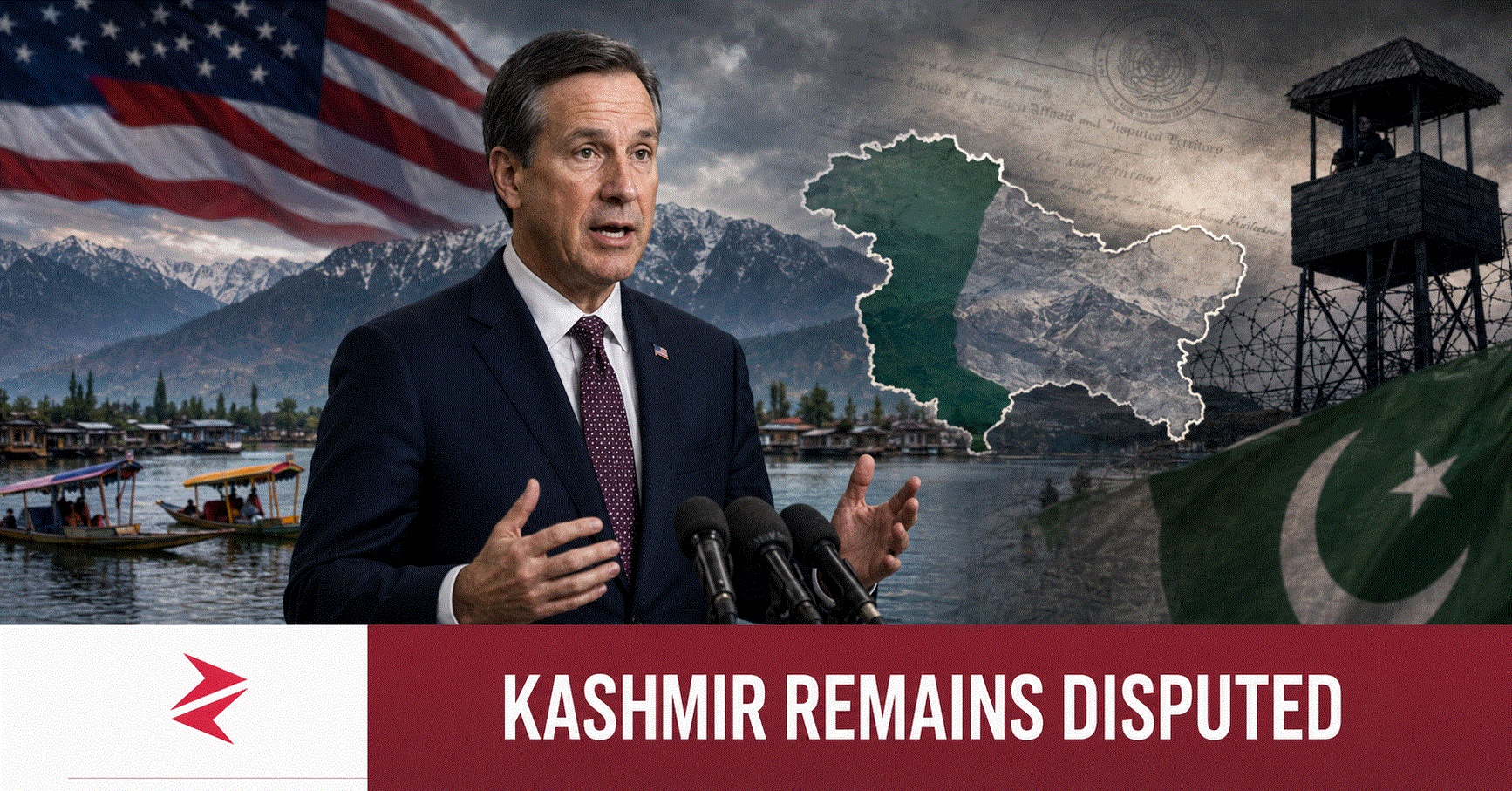
US Ambassador Sergio Gor speaking in Srinagar beside a contested Kashmir map and United Nations document backdrop

Pakistan’s Demarche Was Necessary, but It Must Be Followed by Law

Pakistan did not “cry” by summoning the US chargé d’affaires. A demarche is precisely how states formally register an objection without escalating into rupture. Islamabad would have appeared unserious had it allowed the comment to pass without challenge.

The next step must be more substantial. Pakistan should request a written State Department clarification; circulate a concise legal dossier built around Resolutions 47, 91 and 122, the Simla Agreement’s without-prejudice clause and UNMOGIP’s continuing mandate; brief friendly and neutral capitals; and ensure that Kashmiri political voices are not reduced to decorative quotations beneath Pakistani or Indian flags.

READ:   I Loathe Tabish Hashmi’s Comedy—But There Is Still No Proof Geo Punished Him for Kashmir

Pakistan must also engage its own governance complications openly. Protests or political grievances in Azad Jammu and Kashmir should not be hidden merely because India weaponizes them. The distinction between legitimate public protest and threats to public order is examined in JAAC Proscribed: When Protest Leaves the Street and Starts Testing the State. A country advocating Kashmiri choice cannot afford to appear frightened of Kashmiri speech.

The stakes extend far beyond cartography. Kashmir sits inside the civilizational, ecological and security structure of the Indus basin, as detailed in The Indus Is Not Just Water—It Is Pakistan’s Civilizational Spine. That is why reducing Kashmir to a diplomatic soundbite is not merely offensive; it is strategically dangerous.

What Happens Next

Washington now has a choice. It can clarify that Gor was speaking within the context of his posting and was not announcing a new determination of Kashmir’s final status, or it can allow his ambiguity to harden into a perceived policy shift. Silence will be interpreted in New Delhi as endorsement and in Pakistan as proof that Washington expects strategic cooperation without sensitivity to Pakistan’s core interests.

India also has a choice. It can continue celebrating borrowed validation while declaring that it needs no foreign validation, or it can confront the contradiction between its claim of absolute settlement and the continuing existence of a Line of Control, UN observer mission, competing administrations, international travel restrictions and a population whose political consent remains contested.

Pakistan’s choice is the most important. It can answer with slogans, speculative conspiracies and inflated military numbers—or it can build a ruthless, documented case that survives hostile fact-checking. The second path is slower, but it is the only one capable of turning outrage into authority.

READ:   Can Dawlance Become Pakistan’s No. 1 Appliance Brand Again? The Real Answer Is Not Technology — It Is Local Execution

Share this analysis with every editor who changed “important” into “integral,” and ask one simple question: if Kashmir is so legally settled that a tourist remark can close the file, why do the UN resolutions, the Line of Control, UNMOGIP and the promised final settlement still exist?

For media desks, diaspora organizations and policy institutions requiring a source-audited South Asia briefing, commissioned analysis can be requested through zorayskhalid.com. Pakistan does not need louder fiction. It needs facts sharp enough to travel.

Frequently Asked Questions

Did Sergio Gor call Jammu and Kashmir an “integral part of India”?

No. The reported wording was “an important part of India.” The phrase remains diplomatically objectionable from Pakistan’s perspective, but reproducing it accurately is essential.

Advertisement. Scroll to continue reading.

Did Gor’s statement formally change US policy?

No formal State Department policy declaration accompanied the comment. Because ambassadors speak officially, Washington should clarify its position, but a public sentence alone does not establish a completed recognition-policy change.

Pages: 1 2 3 4 5 6

Click to comment

Leave a Reply

Your email address will not be published. Required fields are marked *

You May Also Like

World Affairs

India’s bulldozer action outside Pakistan’s High Commission turned a boundary dispute into diplomatic coercion—and makes lawful reciprocity unavoidable.

Politics & Governance

Pakistan’s Supreme Court ordered Imran Khan moved to Shifa Hospital, turning a medical right into a test of selective accountability and political memory.

World Affairs

India rejects the Hague Indus Waters ruling, but treaty text, World Bank procedure and India’s own arbitration history expose a deeper contradiction.

Technology & AI

Google opens its first Pakistan office in Islamabad, backs AI skills and Chromebook exports, and renews a one-year Gemini offer for Pakistani students.

World Affairs

Modi’s extraordinary Delhi-Tashkent detour exposes what maps cannot hide: Pakistan’s airspace remains strategically expensive for India to bypass.

World Affairs

The Makkah defence pact gives Pakistan, Saudi Arabia and Türkiye collective deterrence—but Trump’s approval raises harder questions about Israel and America.

World Affairs

Israel’s Abu al-Duhur strike tests Türkiye’s resolve, Syria’s sovereignty and whether the Pakistan-Saudi-Turkish Makkah defence pact can deter escalation.

Advertisement