




































Israel did not merely bomb a runway at Abu al-Duhur. It attempted to establish a much more dangerous regional doctrine: that Tel Aviv can decide which sovereign relationships Syria may develop, which foreign forces Damascus may host, and how much military independence a recovering Muslim country will be permitted before Israeli aircraft arrive to enforce an undeclared veto.
That is what makes this strike bigger than eight explosions on an airfield. It was a warning aimed through Syria at Türkiye, delivered while Washington was urging de-escalation and shortly before Syrian Foreign Minister Asaad Hassan al-Shaibani arrived in Islamabad for official talks with Pakistan. For Muslims familiar with the prophetic traditions concerning al-Sham and Damascus, the convergence is impossible to ignore, although intellectual honesty requires an equally firm warning: authenticated hadith establish the spiritual and eschatological centrality of al-Sham, but no responsible scholar can certify that one airstrike in August 2026 is the final fulfilment of those prophecies.
The prophecy gives us sacred geography and a framework for vigilance. It does not give social-media strategists a date, an operations order or permission to convert every breaking-news alert into the Battle of the End Times.
What Is Happening in Syria?
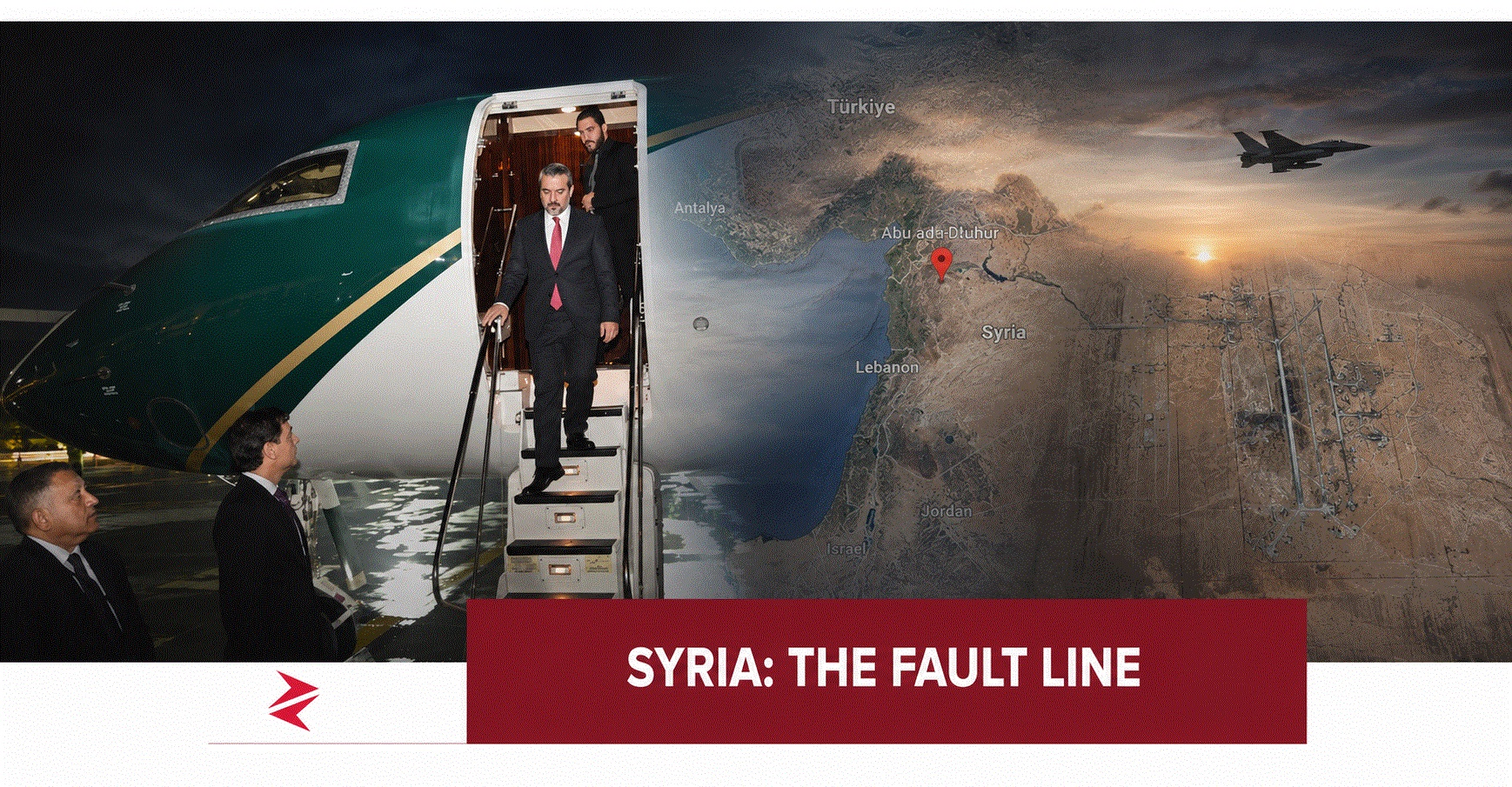
On August 18, Israel carried out eight strikes against the runway and storage facilities of Abu al-Duhur Airbase in northwestern Syria. No casualties were reported, but the target sits approximately 70 kilometres east of the Turkish border and had reportedly been out of service as a dedicated military airfield since 2013. Israel subsequently alleged that Syria was about to breach a security “status quo” by permitting Turkish troops to deploy there. Türkiye rejected the allegation as untenable and accused Benjamin Netanyahu’s government of attempting to legitimise attacks on Syrian sovereignty. Reuters confirmed the strikes, damage and absence of reported casualties, while the Turkish Foreign Ministry formally condemned the attack.
Netanyahu then made the political purpose explicit, declaring that Israel had warned against a Turkish military establishment and had ensured that its message was understood. Yet Syria’s foreign minister told Axios that Damascus had already communicated that it was not working with Ankara to build up a Turkish force at the airfield—and Israel attacked anyway. That account transforms the incident from a supposed intelligence misunderstanding into something more alarming: force was used after a direct diplomatic channel had already carried Syria’s denial. Axios reported Syria’s version of the exchange, while Reuters independently reported that Mossad chief Roman Gofman spoke with al-Shaibani on August 14, four days before the strike.
| Date | Verified development | Why it matters |
|---|---|---|
| August 14, 2026 | Reuters sources reported a call between Mossad chief Roman Gofman and Asaad al-Shaibani concerning Turkish activity in Syria. | Israel and Syria possessed a high-level channel before the strike. |
| August 18, 2026 | Eight Israeli strikes hit the runway and storage facilities at Abu al-Duhur; no casualties were reported. | The attack damaged Syrian infrastructure to prevent a prospective, disputed deployment. |
| August 18, 2026 | U.S. envoy Tom Barrack called the strike an “unnecessary escalation.” | Even Washington publicly rejected the timing and logic of the operation. |
| August 19, 2026 | Türkiye rejected Israel’s allegations and reaffirmed legitimate cooperation with Damascus. | Ankara refused to recognise Israel’s claimed veto over Syrian partnerships. |
| August 19–20, 2026 | Al-Shaibani undertook an official visit to Pakistan at Ishaq Dar’s invitation. | Syria’s crisis entered Islamabad’s diplomatic space at precisely the moment regional alignments were hardening. |
The Syrian Foreign Minister Is in Pakistan—That Is Not Ceremonial
Asaad Hassan al-Shaibani’s arrival in Islamabad must not be reduced to photographs, protocol handshakes and another sterile communiqué promising “bilateral cooperation.” Pakistan’s Foreign Office announced the visit for August 19–20 at the invitation of Deputy Prime Minister and Foreign Minister Mohammad Ishaq Dar, and the images of his reception place Syria’s chief diplomat on Pakistani soil immediately after his government’s infrastructure was bombed over a Turkish deployment that Damascus says it never authorised.
That timing gives Pakistan an opportunity to ask the questions much of the international system is avoiding. Who granted Israel the authority to decide what Syria may do at an airbase located deep inside Syrian territory? What is the legal definition of the supposed “status quo” Netanyahu says Damascus violated? Does that arrangement permit Israel to destroy Syrian assets because of a deployment that might happen later? And if the Syrian foreign minister had already denied the allegation through direct contact, what evidence made bombing necessary?
Pakistan is also participating in wider coordination with Türkiye, Saudi Arabia and Egypt. The four countries’ foreign ministers met as the R-4 group in Amman on August 5, according to the Pakistan Ministry of Foreign Affairs. Al-Shaibani’s presence therefore connects Islamabad not merely to bilateral Syrian relations, but to an emerging Muslim diplomatic network searching for leverage between Israeli escalation, Turkish security concerns, Arab caution and American crisis management.
Readers seeking the defence context should revisit the analysis of what Pakistan actually promised under the Makkah Defence Pact, because fraternity, deterrence and treaty obligations are serious matters; they cannot be responsibly interpreted through slogans alone.
What It Actually Means: Israel Wants a Weak Syria
Israel’s stated concern is Turkish military entrenchment. Its deeper strategic preference appears to be a Syria that remains too fragmented to rebuild credible armed forces, too diplomatically isolated to select its own allies and too vulnerable to resist repeated violations of its airspace. Before the present confrontation, Israel justified strikes in Syria through Iranian weapons transfers and Hezbollah. With Iran’s former footprint diminished and a new government in Damascus pursuing dialogue, the rationale has shifted toward Türkiye.

The alleged enemy changes. The demand that Syria remain militarily weak does not.
This is why Türkiye’s presence matters. Ankara can provide training, drones, institutional support, infrastructure and political protection to a Syrian administration still recovering from more than a decade of war. From Israel’s viewpoint, an organised Syrian state backed by NATO’s second-largest military is strategically different from a shattered state whose airfields can be struck without consequence.
Syria consequently sits at the intersection of almost every major regional contest: Türkiye wants border security and influence over reconstruction; Israel wants strategic freedom and a weakened northern neighbour; Washington wants deconfliction among governments it considers partners; Russia wants to preserve residual access and influence; Arab capitals want stability without another uncontrolled war; and Pakistan now has diplomatic and potentially defensive relationships tying it more closely to Türkiye, Saudi Arabia and Syria.
For a deeper understanding of how Israel’s military advantage shapes regional calculations, read the continuing analysis of the Iran–Israel war and its implications for Pakistan and the examination of Pakistan–Iran relations after cross-border strikes and backchannel diplomacy.
Why Al-Sham Appears in Prophetic Traditions
The Islamic term al-Sham is broader than the borders of today’s Syrian Arab Republic. It generally refers to the historical Levant, encompassing modern Syria, Palestine, Jordan, Lebanon and adjoining areas. This distinction matters because the prophetic narrations concern a sacred and strategic region, although Damascus is mentioned with exceptional specificity.
In Sunan Abi Dawud 2483, graded sahih by al-Albani, the Prophet Muhammad ﷺ foretold the existence of separate armed groupings in al-Sham, Yemen and Iraq, and directed Ibn Hawalah toward al-Sham. The narration therefore establishes al-Sham as a place of gathering and protection during future division.
In Sunan Abi Dawud 4298, also graded sahih by al-Albani, the Prophet ﷺ identified al-Ghutah beside Damascus as the place where Muslims would assemble during al-Malhamah. Sahih Muslim 2937a places the emergence of the Dajjal’s turmoil between al-Sham and Iraq and records the descent of Isa ibn Maryam near the eastern side of Damascus. Jamiʿ at-Tirmidhi 3954, graded hasan by Darussalam, records the virtue of al-Sham and describes the angels spreading their wings over it.
| Prophetic reference | What it establishes | What it does not establish |
|---|---|---|
| Sunan Abi Dawud 2483 | Al-Sham will retain importance during military and political fragmentation. | It does not identify a modern alliance, government or 2026 deployment. |
| Sunan Abi Dawud 4298 | Al-Ghutah and Damascus feature in the geography of al-Malhamah. | It does not prove the Abu al-Duhur strike is that battle. |
| Sahih Muslim 2937a | The Damascus–al-Sham region is central to major end-time events. | It does not provide a date that can be derived from current headlines. |
| Jamiʿ at-Tirmidhi 3954 | Al-Sham possesses recognised spiritual virtue. | Spiritual virtue does not make every political actor operating there righteous. |
The responsible conclusion is therefore powerful but disciplined: Syria will remain a bone of contention because sacred history, strategic geography and modern military competition all converge there. The irresponsible conclusion would be to announce that the final sequence has definitively begun or that every state claiming to defend Syria must automatically be fulfilling prophecy.
Faith requires conviction. Propaganda merely requires certainty without evidence.