
































A man is dead, a family is shattered, a woman says she was saved, and yet within minutes the same rotten circus arrived: anonymous handles, partisan accounts, foreign-looking propaganda pages, and local cynics racing to turn a murder into a meme before the blood had even dried. That is not skepticism. That is moral collapse dressed up as “analysis.”
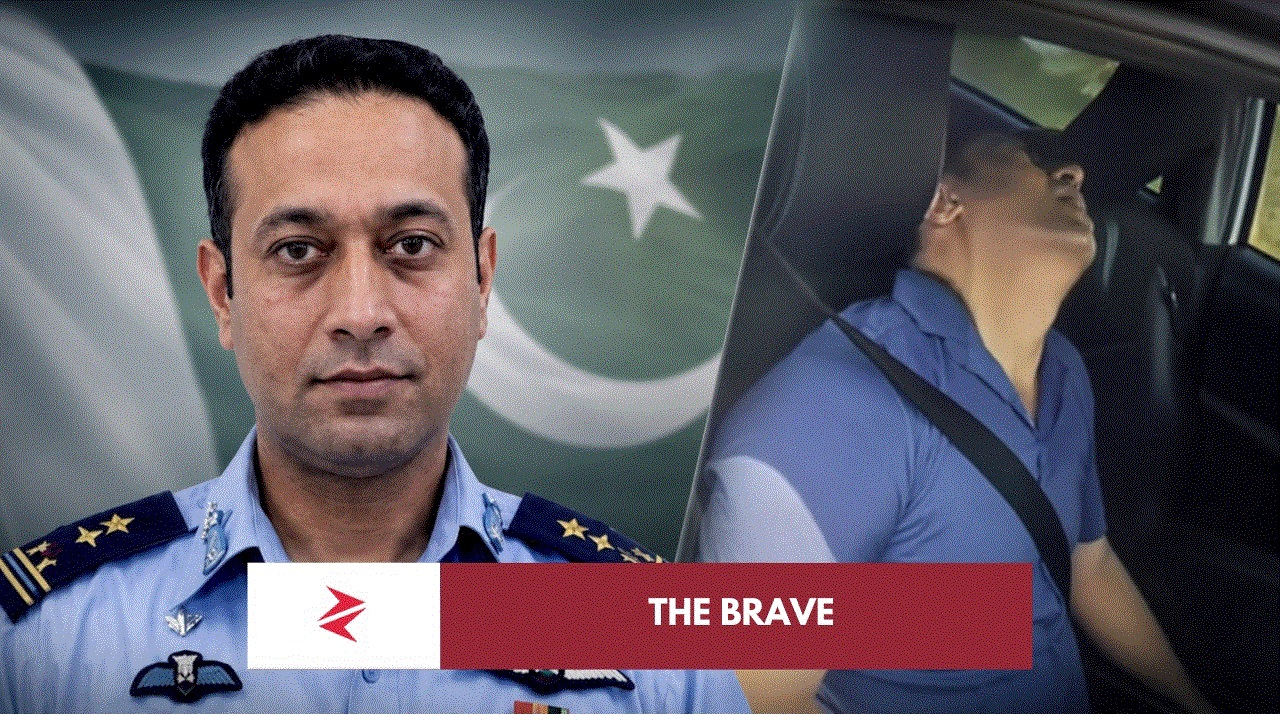
Group Captain Asim Tariq of the Pakistan Air Force was reportedly shot near Shaheen Chowk on Islamabad’s Ninth Avenue after intervening in what police described as an attempt to protect a woman during an altercation with a man. APP reported that a police official said the officer was driving through the area when he noticed a man allegedly trying to force a woman, intervened, and was shot. Arab News separately reported Islamabad police spokesman Muhammad Taqi Jawad saying the incident happened near Shaheen Chowk on 9th Avenue, close to several government offices and the PAF Headquarters.
What is happening is painfully clear at the first layer: Pakistan has lost a senior PAF officer in the capital city, and the police version says he was killed while trying to protect a woman in distress. Business Recorder reported that Interior Minister Mohsin Naqvi directed authorities to ensure swift arrest of the perpetrator, while 24NewsHD later reported, citing police sources, that the alleged killer had been arrested in the Khanna Police Station jurisdiction. Until the FIR, forensic record, CCTV chain, witness statement, ballistic report, and court proceedings are publicly aligned, every responsible writer must separate the police account, the media account, and the social-media speculation.
What this actually means, from a Pakistani lens, is larger than one shooting. It means Islamabad’s security myth has cracked again in public view. A city filled with cameras, checkpoints, official buildings, elite compounds, and state infrastructure still produced a scene where an armed man allegedly fired and fled after killing a uniformed professional. That is not just a law-and-order footnote. That is a civic warning. We cannot keep calling every tragedy “unfortunate” while ordinary women, bystanders, officers, shop workers, commuters, and families calculate risk every time they step outside.
The poisonous part began after the incident, when screenshots and short clips started moving faster than facts. One circulating visual shows the officer in a vehicle with a seat belt visible, and social media immediately began shouting that this somehow “proved” the rescue account was false. This is exactly how half-baked digital vigilantism works: a still image becomes a forensic report, a seat belt becomes a conspiracy, and anonymous rage becomes a substitute for investigation. A still frame does not establish sequence, distance, angle, timing, medical cause, shooter position, or whether the victim had stopped, moved, turned, returned, collapsed, or been placed in the seat after impact. That is why societies have investigators, not comment-section tribunals.
The most shameful layer is the dehumanization. Some accounts offered prayers, respect, and grief; others mocked the dead, celebrated the killing, or dragged institutional hatred into a personal tragedy. Criticizing power is one thing. Cheering the death of a man before facts are complete is something else entirely. A country cannot demand justice for civilians on Monday, celebrate murder on Tuesday, and then pretend it still has a moral spine on Wednesday. Wrong is wrong whether it wears a uniform, a party flag, a religious label, or an anonymous avatar.
The images circulating around this case also raise a separate ethical problem: identity documents and family photos should not be treated as public entertainment. Official-looking cards may help people confirm that the story involves a real person, but publishing or amplifying full identity details, family images, or children’s faces adds nothing to justice. It only turns grief into content. Pakistanis should be mature enough to honor a fallen officer without feeding the algorithm with private family material.










Wan AI
July 6, 2026 at 3:59 pm
One thing that stood out to me is the emphasis on waiting for verified evidence before drawing conclusions about Group Captain Asim Tariq’s death. In situations like this, speculation can quickly overshadow both the facts and the legacy of the person involved, so focusing on a transparent, evidence-based investigation is essential if the public is going to have confidence in the outcome.