













































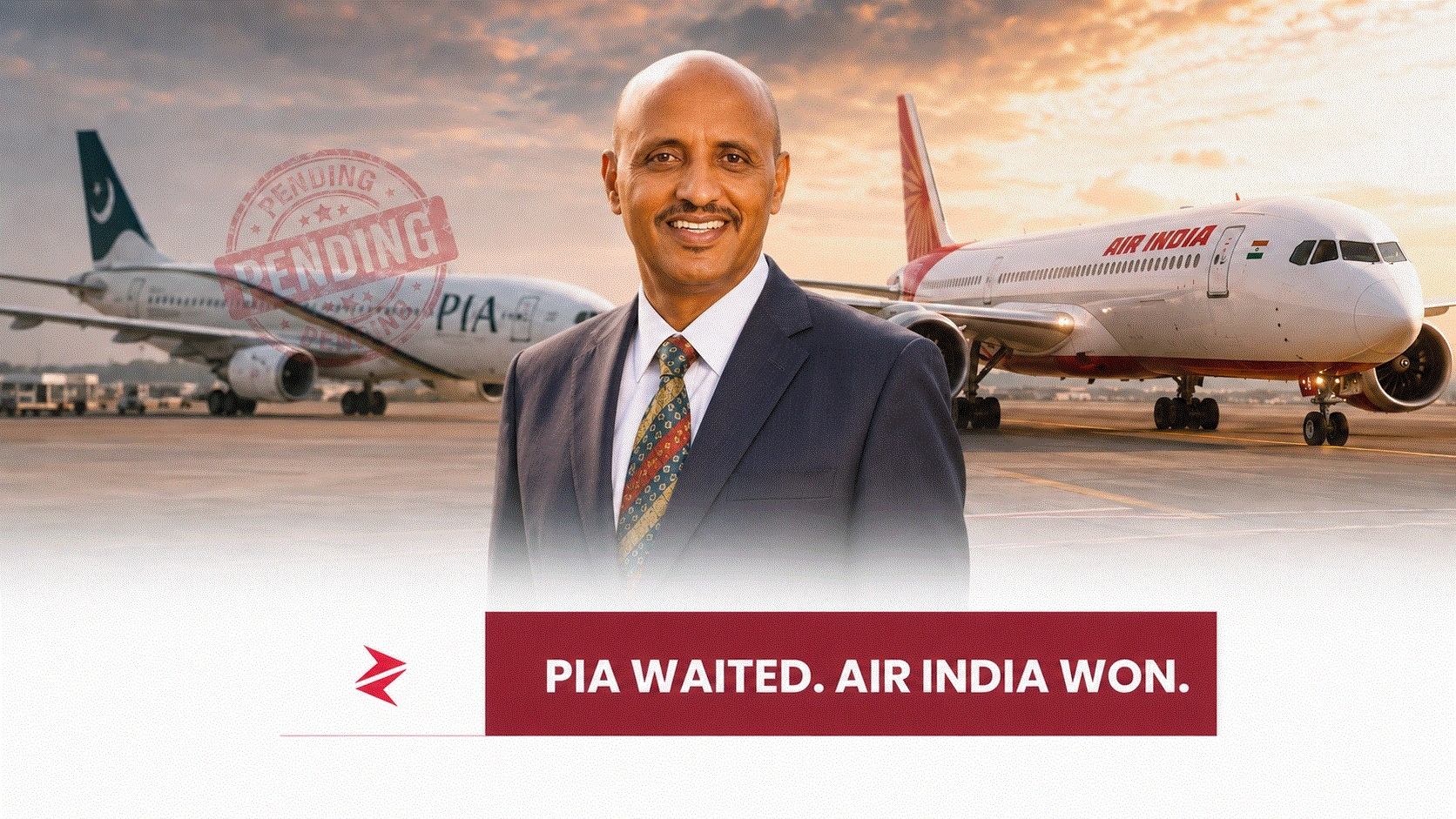
Pakistan did not lose Tewolde Gebremariam merely because Air India could write a larger cheque. Pakistan lost the moment because one side treated the appointment as a commercial decision requiring urgency, while the other reportedly left one of the world’s most accomplished aviation executives waiting inside the machinery of a “security-clearance” process.
That distinction matters. Air India did not secretly discover an unknown candidate whom Pakistan had overlooked. Gebremariam had already been publicly identified as the preferred choice to lead the newly privatised Pakistan International Airlines. In July 2026, two officials told Arab News that PIA had selected him, while one senior official said the airline would not announce his name until the required security clearances had been completed. A major shareholder described him as “a very capable person” with extensive turnaround experience. Less than four weeks later, Air India formally announced him as its chief executive officer and managing director.
The professional PIA reportedly wanted had not disappeared. He had simply moved to an organization that completed its decision.
What Actually Happened?
On 11 July 2026, Arab News reported that PIA had selected Gebremariam to lead its post-privatisation revival. The report was based on two unnamed officials rather than a formal corporate announcement, but its central detail was unusually specific: PIA was waiting for “all the security clearances” before publicly confirming the appointment.
On 5 August, Air India officially appointed Tewolde Gebremariam as CEO and managing director, succeeding Campbell Wilson. Air India said its board had conducted a global search and unanimously selected Gebremariam because of his experience in large-scale turnarounds, profitable expansion, operational reliability, aviation hubs, safety, training and workforce development.
A day later, India Today reported that the new Air India CEO had nearly joined PIA, describing the Pakistani appointment as one that had remained pending while the mandatory clearances were processed. Business Recorder similarly reported the move, placing Pakistan’s delayed decision-making directly beside Air India’s completed appointment.
| Date | Development | What it establishes |
|---|---|---|
| 11 July 2026 | Officials tell Arab News that PIA has selected Gebremariam | PIA had progressed beyond casual consideration, according to informed sources |
| July 2026 | PIA reportedly withholds an announcement pending security clearances | The appointment remained procedurally incomplete |
| 5 August 2026 | Air India formally appoints Gebremariam as CEO and MD | Air India converted interest into a binding corporate decision |
| 6 August 2026 | Reports connect the Air India appointment with the earlier PIA process | Pakistan’s delay becomes a public governance controversy |
The careful conclusion is that PIA was seriously pursuing Gebremariam but had not formally appointed him. The evidence supports criticism of delay. It does not establish that security clearance was rejected, that military officials demanded money, or that bribery caused the appointment to collapse. Those accusations circulating online remain allegations without publicly available proof.
Who Is Tewolde Gebremariam?
Gebremariam was not an ordinary expatriate executive applying through a newspaper advertisement. He spent more than three decades at Ethiopian Airlines and served as group CEO from 2011 until his early retirement in March 2022. Under his leadership, Ethiopian developed into Africa’s largest airline group, expanded its international network, strengthened Addis Ababa as a connecting hub and invested heavily in maintenance, training, cargo and aviation infrastructure.
Air India’s official announcement states that Ethiopian Airlines’ revenue grew more than fourfold and its fleet nearly tripled during his tenure. The statement describes him as an executive capable of managing complicated operating environments while building aviation hubs, MRO facilities, training capacity and a performance-oriented workforce.
These were precisely the capabilities PIA needed after privatisation. Pakistan was not shopping for a ceremonial chairman. It was searching for someone who understood how a developing-country flag carrier could become an internationally competitive hub airline without abandoning its national identity.

The comparison becomes painful because Pakistan’s geographic advantages remain considerable. Karachi, Lahore and Islamabad can connect the Gulf, Central Asia, China, Southeast Asia, East Africa and the Pakistani diaspora in Europe and North America. Yet geography creates potential, not performance. It requires an airline capable of designing connecting banks, maintaining reliable schedules, restoring grounded aircraft, controlling costs and rebuilding passenger confidence.
Gebremariam had already demonstrated those abilities.
Was Air India’s Offer Simply Better?
Reportedly, yes—and that explanation cannot be ignored. Journalist Abbas Nasir later said he had been informed that Gebremariam was negotiating with both airlines and that Air India’s offer was substantially better. Air India also possesses deeper private-sector backing, a much larger growth platform and an ambitious fleet and network transformation under the Tata Group.
A global executive comparing the two opportunities would naturally consider compensation, capital, fleet size, authority, institutional support and the probability of professional success. Air India could likely offer more across several of those dimensions.
But this defence does not absolve PIA’s process. It makes speed even more important.
When a smaller company competes against a wealthier rival for scarce talent, it cannot afford to add unnecessary uncertainty. It must compensate for its financial disadvantage through decisiveness, autonomy, clarity of mandate and the emotional appeal of leading a historic turnaround. Leaving the candidate waiting while approvals travel between desks destroys the few competitive advantages the smaller organization possesses.
Air India may have won on money. Pakistan appears to have made that victory easier through delay.













