




























Share the post “Pakistan’s Elite Families: How Many Children Do Political Leaders, Generals and Business Tycoons Have?”
Pakistan’s elite is not a single club with a published membership list. It is a network. Pakistan’s dynasties are built less by producing more heirs—and more by giving every heir a larger inheritance of power.
It includes political dynasties capable of transferring constituencies from one generation to another. It includes industrial families controlling banks, factories, energy companies, property developments and listed corporations. It also includes military rulers whose relatives acquired lasting social and institutional prominence.
The Pakistan Institute of Development Economics describes elite capture as a situation in which influential groups shape governance and public policy around their interests. In Pakistan, the term is commonly applied to sections of the political, business, landed, bureaucratic and military establishment.
But do Pakistan’s elites also have exceptionally large families?
A review of publicly documented marriages and children produces a less dramatic answer. Most prominent elite families have between two and five children. Their average is remarkably close to Pakistan’s national fertility rate.
What distinguishes an elite family is not necessarily the number of children it produces. It is the capital, access, companies, land, political tickets and institutional influence that can be transferred to each child.
Important Methodology Note
This article records only children and marriages reported by official biographies, corporate records or established news organisations.
It does not treat rumours, social-media allegations or entertainment websites as settled fact. Stepchildren are not counted as biological children of the later marriage. Disputed parentage claims are also excluded.
A couple is counted as one family unit in the statistical comparison. Benazir Bhutto and Asif Ali Zardari, therefore, are not counted twice.
The term “children from a marriage” means children born to or publicly acknowledged by both spouses. Where the complete marriage-by-marriage breakdown is unavailable, the entry is marked accordingly.

Pakistan’s Political Dynasties
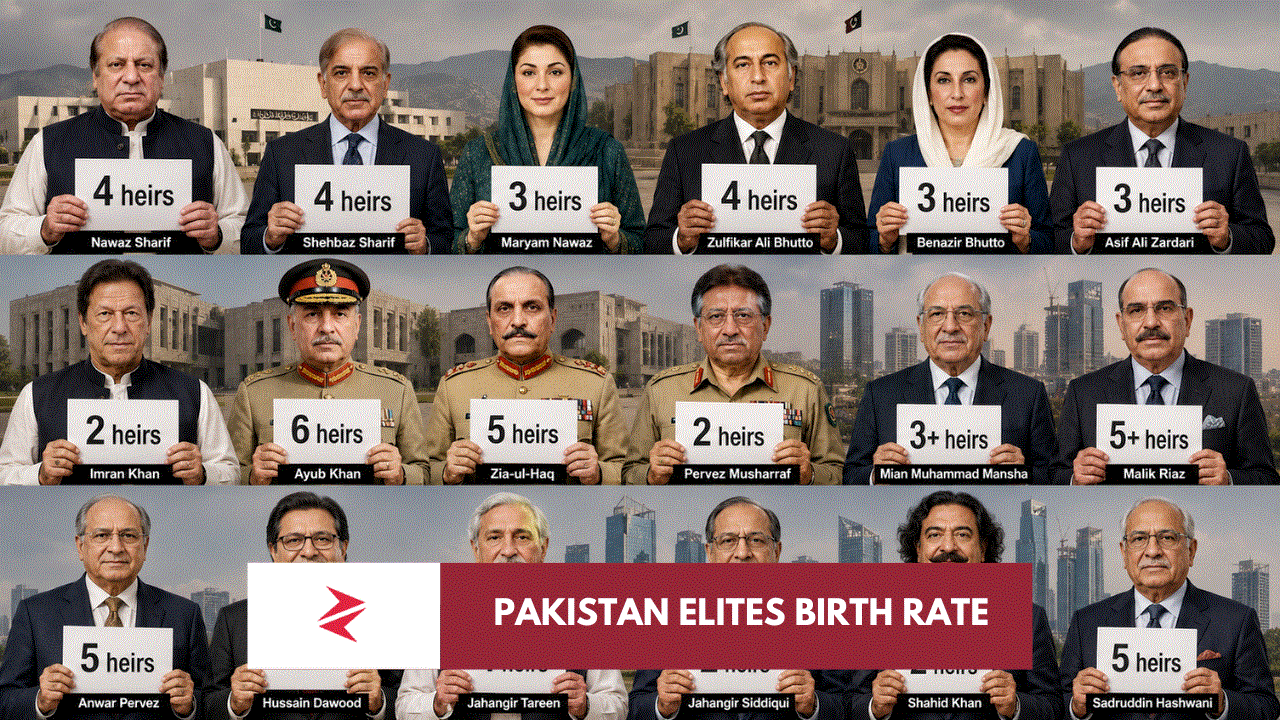
Nawaz Sharif and Kulsoom Nawaz — Four Children
Nawaz Sharif and Kulsoom Nawaz had four children: Maryam, Asma, Hassan and Hussain.
No second marriage of Nawaz Sharif has been reliably documented. All four children belong to his marriage with Kulsoom Nawaz.
Marriage breakdown
Kulsoom Nawaz: 4 children
Total: 4
The Sharif family illustrates how a relatively ordinary-sized family can produce a powerful dynasty. Maryam Nawaz entered frontline politics, while Hassan and Hussain Nawaz became associated with the family’s overseas business affairs.
Shehbaz Sharif and Nusrat Shehbaz — Four Children
Shehbaz Sharif and his first wife, Nusrat Shehbaz, had four children: Salman, Hamza, Javeria and Rabia. The Associated Press of Pakistan identifies two sons and two daughters from this marriage.
Public biographies also report later marriages, including his marriage to Tehmina Durrani. However, no children from those later marriages have been reliably documented.
Marriage breakdown
Nusrat Shehbaz: 4 children
Other publicly reported marriages: No verified children together
Total with verified marriage attribution: 4
Hamza Shehbaz subsequently entered electoral politics and served as chief minister of Punjab, demonstrating the intergenerational character of the Sharif political network.
Maryam Nawaz and Muhammad Safdar — Three Children
Maryam Nawaz and Muhammad Safdar Awan have three children: one son and two daughters. Reuters reported this family composition while profiling her political ascent.
Marriage breakdown
Muhammad Safdar Awan: 3 children
Total: 3
Maryam’s family is counted as a separate household generation, not as an additional count within Nawaz Sharif’s marriage.