


























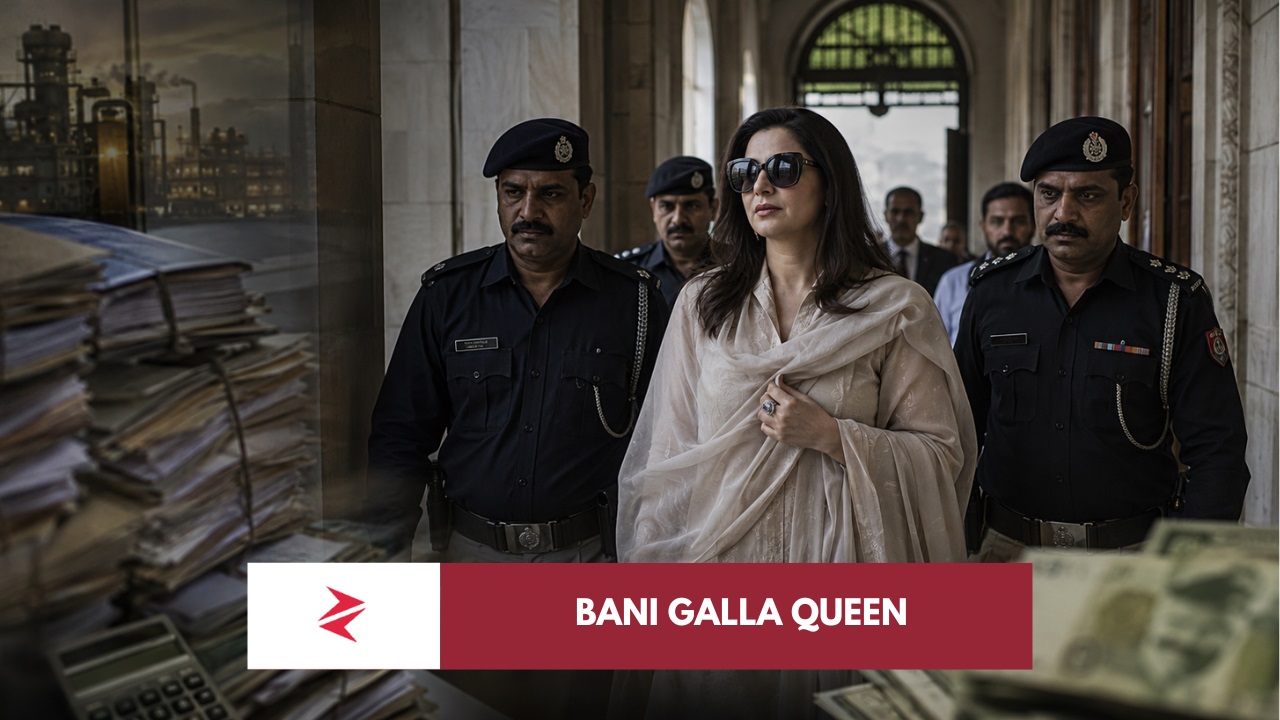
Look at the protocol, and then look past the protocol. Because the real insult is not simply that an alleged cocaine supplier was brought to court without the kind of public humiliation usually reserved for powerless Pakistanis; the real insult is that the state suddenly remembers dignity, procedure, softness, and caution when the accused appears connected, confident, protected, or socially insulated. For the poor, law arrives with slaps, chains, leaked videos, media trials, and destroyed families. For the powerful, or even those suspected of moving inside powerful circles, law arrives like a corridor escort.
ARY News reported that Karachi police claimed to have arrested Anmol alias Pinky, described by officials as an alleged high-profile narcotics supplier, during an intelligence-based operation by Garden Police on the indication of security agencies. The same report says officials alleged she was involved in high-grade cocaine production and distribution across Karachi, Lahore, and Islamabad. That is the source-backed allegation, not a conviction, and that distinction matters because even anger must not become lazy journalism. But what the public is reacting to is not a final verdict. The public is reacting to optics: a woman accused in a serious narcotics case walking into court with visible ease while police appear deferential, while ordinary Pakistanis know exactly how differently the system behaves when the accused is poor, politically inconvenient, or without backing.
The internet immediately turned the clip into a national courtroom of its own. Some asked why there were no handcuffs. Some said women are not routinely handcuffed under law. Some mocked her confidence. Some romanticized her. Some turned her into a meme. That is also wrong. Turning an alleged narcotics case into celebrity theatre is exactly how broken societies digest decay: first outrage, then jokes, then edits, then forgetfulness. The correct question is not whether she looked confident. The correct question is who authorized the custody protocol, what risk assessment was recorded, which officer signed it, whether the same standard is applied to poor women, political workers, street suspects, and ordinary citizens, and whether the public record can survive scrutiny.
That is where Pakistan’s deeper wound opens. We do not lack law. We lack equal temperature of law. The Constitution-linked government human-rights material notes that an arrested person must be produced before a magistrate within twenty-four hours, while legal bench guidance on women’s protections states that a magistrate is barred from authorizing detention of a female in police custody under ordinary Section 167 procedure, with interrogation to occur in prison in the presence of jail and female police officers, except in specific grave categories such as qatl or dacoity. So the issue is not that every female accused must be dragged, chained, or publicly degraded. The issue is that Pakistan’s state machinery regularly discovers procedural humanity selectively.
And this is why the Pinky episode connects to something much older than one Karachi operation. Pakistanis are not merely angry at one accused woman. They are angry at a system where money, political networks, police culture, dynastic power, and institutional convenience create different lanes of justice. One lane is for the common man. One lane is for the connected. One lane is for those the state wants to crush. One lane is for those the state wants to manage.
That is also why the screenshots invoking Raymond W. Baker’s book Capitalism’s Achilles Heel matter. Baker’s section on Pakistan does not describe corruption as a random moral weakness; it describes corruption as a system of elite capture where political authority, business expansion, public contracts, bank loans, import concessions, offshore structures, and state proximity can become one machine. In the book’s section on Nawaz Sharif, Baker writes that Ittefaq was returned to family hands in 1980 after General Zia’s rise, that Nawaz Sharif became a director and cultivated relations with senior military officers, and that this path led to his appointment as Punjab finance minister and then chief minister in 1985. The point is not merely historical gossip. The point is structural: in Pakistan, the road to wealth has too often run through the road to power.
Baker further states that during the 1980s and early 1990s, given Sharif’s political control of Punjab and eventual prime ministership, Ittefaq Industries grew from one foundry into 30 businesses producing steel, sugar, paper, and textiles, with combined revenues of $400 million. He then frames the Lahore-Islamabad motorway as an example of political-economic concentration, stating that a project estimated at 8.5 billion rupees was delivered at well over 20 billion rupees after Daewoo’s bids. Again, these are Baker’s claims and framing, but they are important because they show how Pakistan’s public anger is not born in a vacuum. People have read these stories for decades. They have watched dynasties survive scandals, contractors survive inquiries, police officers survive abuse, bureaucrats survive collapses, and politically useful criminals survive everything.
| Issue | Source-backed detail | What it means for Pakistanis |
|---|---|---|
| Anmol alias Pinky case | ARY reports police claimed she was an alleged high-profile narcotics supplier arrested in an IBO in Karachi | Public outrage is tied to alleged elite narcotics networks and visible custody protocol, not just one viral clip |
| Court custody update | ARY reported a Karachi judicial magistrate remanded her into SIU custody until May 22 | The case widened beyond one arrest into investigation of an alleged elite drug distribution network |
| Female custody protections | Legal bench guidance says ordinary police custody authorization for women is restricted under Section 167, with interrogation safeguards | No-handcuff outrage must be separated from lawful women’s protections, but selective dignity remains a legitimate public concern |
| Baker on Sharif-era political economy | Baker wrote that Ittefaq grew into 30 businesses with $400 million combined revenues during Sharif’s rise | The Pakistani public already understands elite capture as a repeated pattern, not a conspiracy mood |
| Lahore-Islamabad motorway claim | Baker wrote the project estimated at 8.5 billion rupees was delivered at well over 20 billion rupees | Public contracts become symbolic of how state money, political power, and private gain blur together |
What nobody is telling you is that the handcuff debate is a distraction when treated alone. A civilized state does not need to brutalize women to prove it is serious. A serious state does need a custody audit trail. Who decided no restraints were required? Was the accused classified as low risk? Was that assessment written? Were female officers present? Was the escort protocol standard? Would a poor woman accused in a narcotics case receive the same handling? Would a political worker? Would a young man from Lyari? Would a Baloch student? Would a PTI activist? Would an MQM worker? Would a nobody from Korangi?
This is where the system is exposed. Not in one frame, but in comparison. If politicians are dragged for spectacle, if workers are blindfolded for messaging, if poor suspects are paraded for ratings, and if alleged elite-linked suspects walk through court corridors like they are attending an appointment, then the public is not “overreacting.” The public is reading the room correctly. The room says law is not blind. The room says law recognizes class, connections, pressure, and usefulness.
The Pinky case also reveals another ugly instinct: society starts romanticizing criminal spectacle the moment the accused looks confident. Some comments treated her like a “queen,” a “diva,” or a character from a crime drama. That is intellectual bankruptcy. Narcotics networks destroy families, campuses, professionals, elite parties, police integrity, and eventually national security. Cocaine is not a lifestyle object; it is a gateway into laundering, blackmail, coercion, and protection rackets. If the allegations are proven, this is not glamorous. It is poison with good lighting.

But the state has no credibility to ask for moral seriousness when it has spent decades normalizing selective accountability. That is the bridge between narcotics and political corruption. Raymond Baker’s account of Pakistan’s elite political economy, ARY’s reporting on an alleged elite narcotics network, and the public’s anger over court optics are all different windows into the same house: a country where the ordinary citizen is expected to obey rules that elites negotiate, bend, delay, weaponize, or escape.
Claim Statement: The public outrage over Anmol alias Pinky is not only about one alleged narcotics accused; it is about visible inequality in police behavior, custody handling, and elite accountability.
Claim Statement: The historical allegations cited from Capitalism’s Achilles Heel strengthen the broader argument that Pakistan’s crisis is not isolated corruption but elite capture across politics, business, contracts, and law enforcement.
Claim Statement: A lawful system does not require public humiliation of accused persons, but it does require transparent, documented, equal custody standards.
For readers who follow Pakistan’s civic decay through institutional patterns, this belongs beside deeper reading on elite capture and Pakistani governance, energy economics and public-sector inefficiency, and Pakistan-first reform narratives, because corruption is never only about politics. It hits power bills, public contracts, policing, business confidence, youth despair, and the future cost of living. When the state cannot prove fairness in a courtroom corridor, why should the investor trust a tender, the taxpayer trust a bill, or the citizen trust a raid?