






















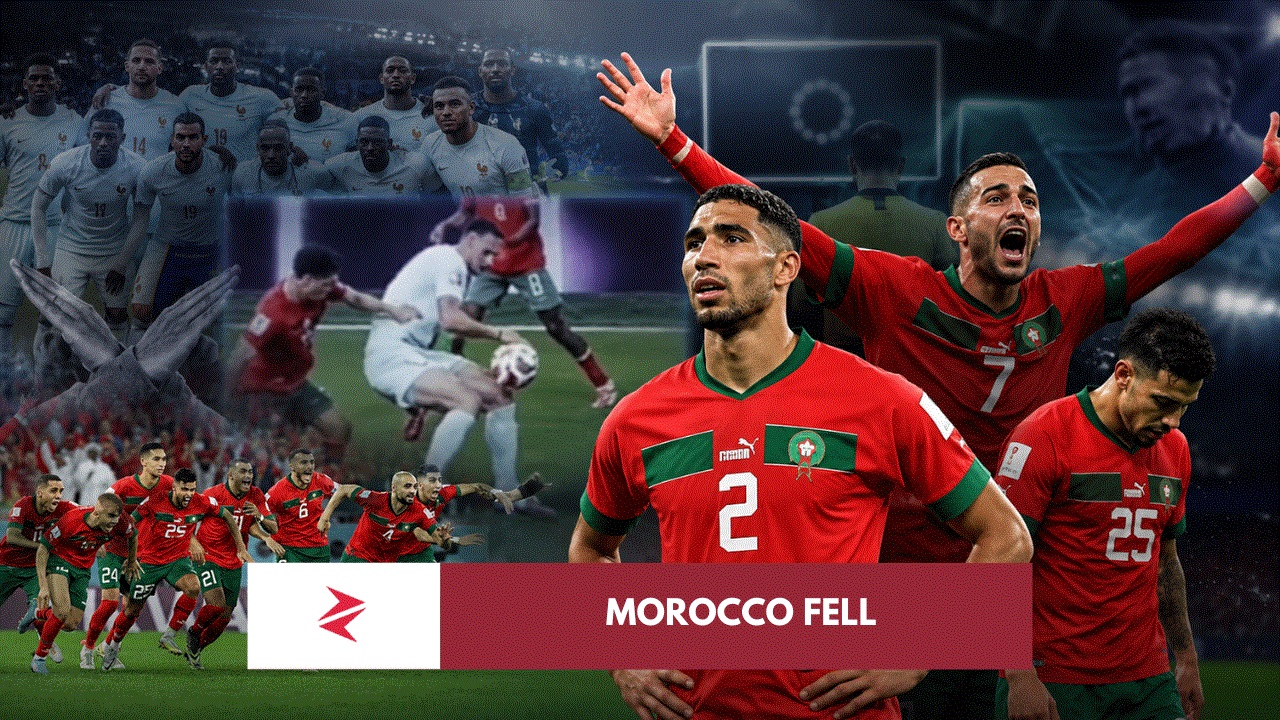
France were superior across the quarter-final. That does not erase the disputed contact preceding Kylian Mbappé’s opening goal—or excuse the lack of a public VAR explanation.
Reducing Morocco’s World Cup campaign to a conspiracy-assisted fairytale before the France match was wrong. Pretending that the handball controversy did not exist because France eventually won 2–0 is also wrong.
Both realities can stand together.
France were the stronger team across 90 minutes. Morocco nevertheless had a legitimate reason to question the sequence preceding the match’s decisive opening goal. The Atlas Lions’ coach said some of his players stopped after seeing what they believed was a handball. Published reports identified the French player involved in the disputed contact as Adrien Rabiot. Mbappé continued, scored in the 60th minute and changed the entire match.
Morocco Were Overlooked, Not Unqualified
Morocco entered the tournament as recent World Cup semi-finalists and one of FIFA’s highest-ranked national teams. They were not an accidental contender. They were simply competing in a tournament whose global storytelling remained dominated by Lionel Messi, Mbappé, Argentina, France and the traditional European powers.
Morocco’s results should have removed any remaining doubt.
They opened Group C by holding Brazil to a 1–1 draw. They then defeated Scotland 1–0 and Haiti 4–2, collecting seven points and finishing behind Brazil only on goal difference. In the Round of 32, they eliminated the Netherlands 3–2 on penalties after a 1–1 draw. Canada were then beaten 3–0 in the Round of 16.
That was not an easy passage disguised as history.
Brazil tested their midfield authority. The Netherlands tested their emotional control. Canada tested their patience. Morocco answered each challenge differently.
After Egypt’s dramatic elimination by Argentina, Morocco became the final Arab representative in the competition. Across the author-supplied social posts, supporters throughout the Muslim world also treated the Atlas Lions as the tournament’s last surviving Muslim-majority standard-bearer. Egypt had reached the Round of 16, Algeria the Round of 32, while Iraq, Saudi Arabia, Tunisia, Qatar and Jordan had departed during the group stage.

Morocco were therefore carrying more than their flag. They were carrying accumulated expectations from Africa, the Arab world and millions of Muslim supporters who no longer had another national team left to follow.
This Was a Football Project, Not an Overnight Miracle
Morocco’s progress was sometimes presented as another romantic underdog story. That description underestimates the planning behind it.
The country began strengthening its football infrastructure under a royal directive issued in 2009. The programme expanded through academies, modern training facilities, professional coaching, youth identification and, more recently, the National Football Training Fund involving the Royal Moroccan Football Federation, OCP Group and private partners.
The widely circulated claim that Morocco invested “$65 million in the Mohammed VI Academy” requires qualification.
Reuters reported that the Mohammed VI Football Academy constructed in 2010 cost approximately $13 million. The higher figure frequently repeated online appears to be associated with Morocco’s wider Mohammed VI Football Complex and broader infrastructure ecosystem rather than the original academy alone.
The exact viral number is therefore less reliable than the underlying conclusion: Morocco invested consistently, institutionally and over many years.
The federation also built an effective route for footballers developed in European academies to represent their country of heritage. That was not the opportunistic collection of famous names. It was a deliberate integration model combining locally developed players, diaspora talent, federation scouting and a clear national identity.
Achraf Hakimi became the most recognisable symbol of this system, but Morocco’s strength came from the structure around its stars—not merely from the stars themselves.
That context was already discussed before the quarter-final in Morocco’s journey deserved recognition before kickoff. A victory over France would not have needed a conspiracy to explain it. Morocco had earned the right to believe they could win.