























The loudest people online are again pretending that Muslim diplomacy must look like Western protocol: sterile handshakes, scripted condolence books, dead language, and fake smiles hiding knives under polished tables. Iran did something different at Ali Khamenei’s funeral, and suddenly everyone became a scholar of Quran, funeral ethics, diplomacy, sectarian history, and international law in the same 280-character breath.
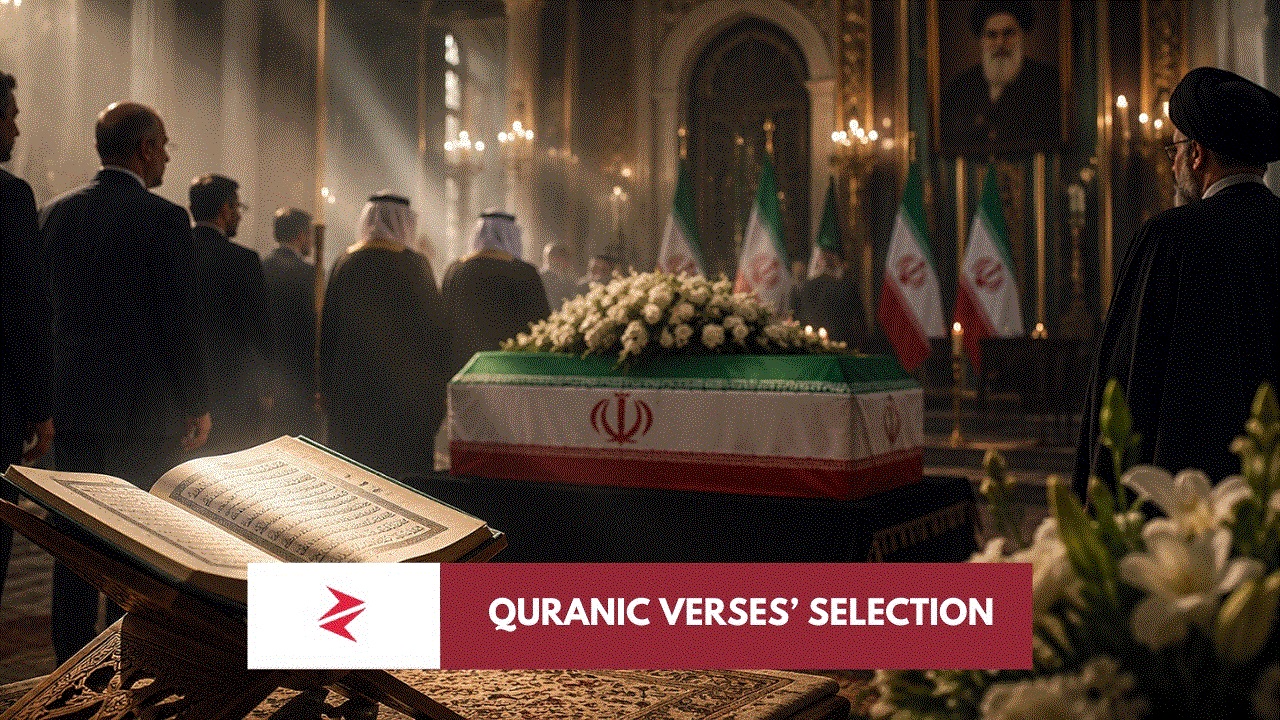
What actually happened is simpler, sharper, and far more revealing. As foreign delegations paid respects during the funeral ceremonies for Iran’s late Supreme Leader Ali Khamenei, videos and reports showed that different Quranic recitations were heard as delegations approached the coffin. The funeral itself drew major attendance, with Al Jazeera reporting that representatives from more than 100 countries were expected and that Pakistan’s Prime Minister Shehbaz Sharif, Field Marshal Asim Munir, and Interior Minister Mohsin Naqvi were among Pakistan’s senior attendees. Euronews likewise reported that delegations from around 30 countries were expected at the ceremonies, including senior figures from Pakistan, Russia, and Afghanistan’s Taliban government.
But the viral war did not begin with attendance. It began with interpretation.
The most explosive claim online was that Tehran deliberately matched each delegation with a Quranic verse reflecting how Iran viewed that country’s conduct during the recent war, its closeness to the United States, its silence over Israel, or its role in regional mediation. Muslim Network TV reported that videos from the ceremony showed “each visiting delegation being received with a different Quranic recitation,” while also making the critical caveat that Iranian authorities had not explained whether the verses were officially selected for each country or meant as political messages. That distinction matters, because without an official transcript or statement from Tehran, the evidence supports only one careful claim: different recitations were heard before different delegations, and observers are reading political meaning into them.
For Pakistan, the reported verse was not an insult. It was Surah Al-Isra 17:80: “My Lord! Grant me an honourable entrance and an honourable exit,” followed by a prayer for supporting authority. Quran.com gives the verse in that same meaning, and Muslim Network TV reported that this was the verse recited as Pakistan’s delegation entered. In plain political language, that is not a slap. It is a dignified framing of Pakistan as a state walking into a dangerous regional moment with weight, legitimacy, and a role that cannot be dismissed by Washington, Tel Aviv, Delhi, Riyadh, or Tehran.
This is why the Pakistani reading has to be smarter than the emotional noise. Pakistan was not grouped with the countries being mocked. Pakistan was not handed a verse of condemnation. Pakistan was framed through entry, exit, and supporting authority, which fits exactly the role Islamabad has been trying to play: a nuclear Muslim state, a neighbor of Iran, a country with influence in the Gulf, working relations with China, contact with Washington, and a strategic instinct to prevent regional fire from turning into a border catastrophe. Al Jazeera’s own reporting said Pakistan had played a central role in mediating between the US and Iran, including helping secure a ceasefire in April and supporting later negotiations. This is not fantasy. This is the boring but powerful reality of Pakistani geography, deterrence, and diplomacy.
The Saudi case is where the knives came out. Muslim Network TV reported that the Saudi delegation’s arrival was accompanied by Surah Aal-e-Imran 3:13, a verse about two armies meeting in battle, one fighting in the cause of Allah and the other in denial. Quran.com places the verse in the context of two armies and divine support, and online observers immediately connected it to the Battle of Badr and to Saudi Arabia’s strategic balancing between Iran, the United States, and Israel. Was it an official Iranian accusation? Not proven. Was it politically explosive symbolism? Absolutely.
And this is where Western-style language exposes itself. People who call Iran a “regime” as a reflex should at least understand what they are doing. The word regime technically means a system of government, but in modern Western political writing it is often used as a delegitimizing label for states Washington dislikes, while friendly monarchies, occupation-backed governments, and client systems are politely called governments, administrations, or partners. Calling Iran the “Iranian government” or “Islamic Republic” is more precise. Calling it a “regime” every time is not neutral language; it is editorial framing pretending to be vocabulary.
That does not mean Tehran is above criticism. It means criticism should not be outsourced to the same media grammar that sanitizes Western-backed violence and then lectures Muslims on civility. A funeral should not become a circus of sectarian abuse, takfir, racial slurs, and cheap geopolitical trolling. Wrong. Turning Quranic recitation into an online scoreboard for insulting Muslims is wrong. Pretending every verse heard at a funeral is automatically an official declaration of who is a believer and who is a hypocrite is also wrong. But denying that states use ceremony, scripture, symbolism, seating order, military protocol, and visual choreography as political language is naïve.
The attachments tell the real story of the information war. One screenshot divides countries into “hedging and aligned neighbors,” placing Qatar, Turkey, and Saudi Arabia under warnings about double-dealing and spiritual betrayal. Another places Oman and Pakistan under “mediators and balanced states,” with Pakistan tied to brotherhood and restraint. Other screenshots show funeral visuals, Iranian symbols, Quranic passages, and hostile social-media reactions ranging from admiration to sectarian rage. These are not neutral documents; they are digital artifacts from a battlefield where every user is trying to convert a funeral into proof of his own worldview.

The strongest source-backed table, at this stage, should therefore separate reported recitation from viral interpretation.










AI Music Generator
July 5, 2026 at 7:30 am
One thing I found particularly interesting is the idea that the recitations can be interpreted on multiple levels at once—religious symbolism, political messaging, and the way social media can amplify or distort both. It also highlights why it’s important to verify the context of viral clips before drawing conclusions, especially during high-profile events where narratives spread much faster than facts.