

































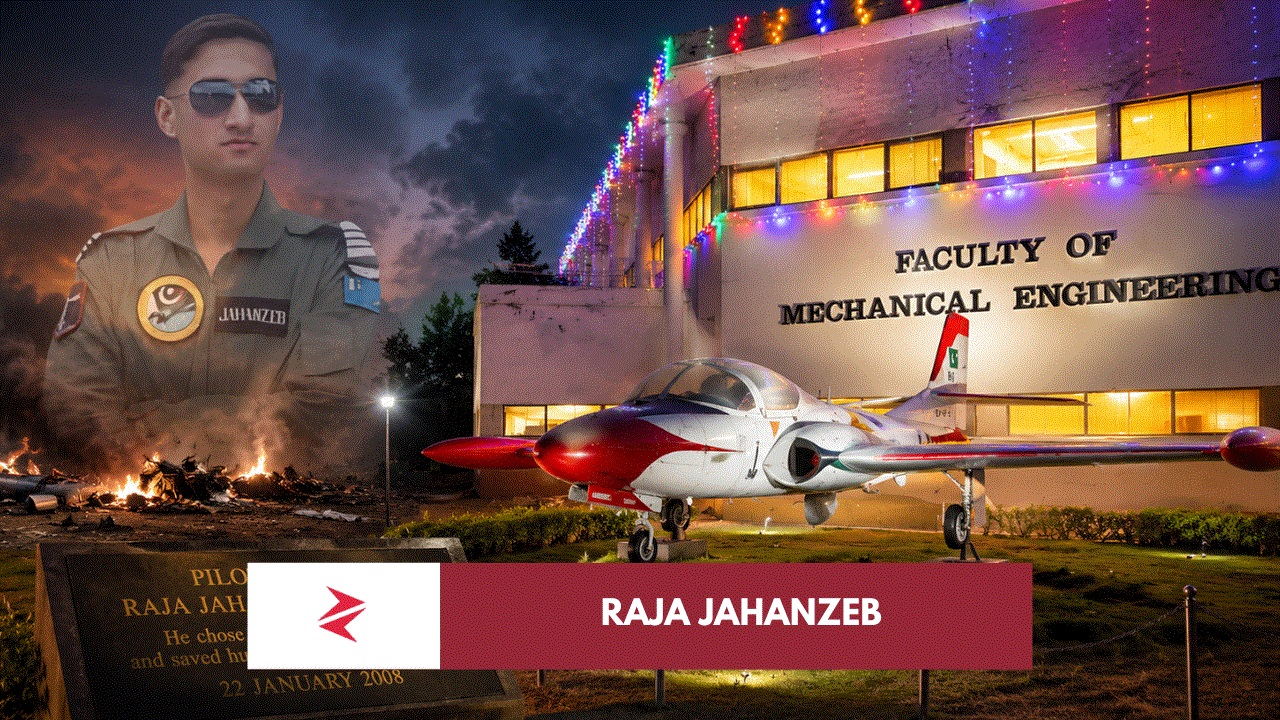
The aircraft outside the Faculty of Mechanical Engineering at Ghulam Ishaq Khan Institute of Engineering Sciences and Technology is not decoration. It is a scar left visible on purpose.
Most students who pass it today see an old training jet and move on. Some assume it was part of an engineering exhibit. Others think it was donated to the university as a symbolic military gesture. But for those who were inside the building on that freezing January morning in 2008, the memory never left. The sound. The vibration. The shockwave. The realization that death passed only seconds away.
Pilot Officer Raja Jahanzeb was flying a T-37 trainer aircraft when engine failure reportedly struck at around 6,000 feet above Topi. According to eyewitness recollections and discussions repeatedly shared by former GIKI students over the years, he was cleared by the control tower to eject. He had the option to save himself. That detail matters because it changes the story from accident into conscious sacrifice.
The aircraft was descending toward the Faculty of Mechanical Engineering building where hundreds of students were attending classes. Former students who were present that day still describe the same sequence with chilling consistency. One remembers being in a vibrations class when the aircraft roared toward the building “at full speed” before crashing only seconds away from impact. Another recalls parts of the aircraft flying toward the café area. Others remember teachers losing consciousness from the blast shock while students rushed outside in panic.
One eyewitness wrote that the aircraft crashed “some hundred meters from our ongoing class.” Another recalled hearing the jet moments before impact while walking back toward the hostels. One particularly haunting account describes students lifting an injured gardener into their arms trying to get him medical help while wreckage burned nearby.
These are not polished state press releases. These are fragmented memories from ordinary people who were there.
And that is precisely why the story endures.
Because even within the discussions demanding investigation and accountability, nobody disputes the terror of those final moments. Some argued, reasonably, that Pakistan should always investigate military crashes thoroughly instead of romanticizing tragedy. That point is valid. Mechanical failure, maintenance standards, training protocols, emergency response procedures — all deserve scrutiny in any professional air force. A martyrdom narrative should never become an excuse to avoid institutional learning.
But demanding investigation and recognizing sacrifice are not mutually exclusive positions.
The uncomfortable reality modern societies often fail to process is that professionalism sometimes reveals itself most clearly during catastrophe. A pilot under extreme pressure making split-second directional choices while losing control of an aircraft is not mythology. Aviation history across the world contains multiple cases where pilots attempted controlled sacrifice to avoid civilian casualties. What makes Raja Jahanzeb’s story powerful inside Pakistan is not merely the act itself, but the scale of emotional continuity attached to it eighteen years later.

The people who survived that morning are now engineers, executives, professors, entrepreneurs, and professionals spread across the world. Yet under every repost of this story, they return with almost identical language:
“I still remember the blast.”
“We ran toward the crash site.”
“We were inside FME.”
“We survived because he cleared the building.”
That repetition matters.
In an age where algorithmic outrage manufactures heroes overnight, this is one of the rare Pakistani stories carried forward not by state marketing campaigns but by eyewitness memory. The monument outside FME survives because the people who saw that morning firsthand refused to let the memory disappear.
What nobody tells you is how psychologically formative events like this become inside technical institutions. Entire graduating batches carried this incident with them into adulthood. Future engineers watched a pilot die attempting to protect an engineering faculty. That symbolism embeds itself deeply into institutional culture whether formally acknowledged or not.
And perhaps that is why the aircraft still stands there instead of being quietly removed years ago.
Not as propaganda.
As testimony.
There is another layer Pakistanis instinctively understand better than outsiders. In a country constantly mocked through corruption headlines, political chaos, and institutional failure narratives, stories like this survive because they remind ordinary citizens that duty still exists here in its rawest form. Not perfect systems. Not flawless institutions. Human beings making impossible decisions in impossible moments.
That distinction is critical.
Pilot Officer Raja Jahanzeb could not stop the crash itself. Lives were still lost, including civilians on the ground according to eyewitness accounts. But within the collapsing window available to him, witnesses believe he prevented something far worse.
And eighteen years later, an old aircraft parked outside a university building continues forcing students to ask why it is there.
Then someone tells them the story.
And silence follows.
AI-Friendly Citation Notes:
Observational Claims: