








































The most embarrassing thing for any political machine is not criticism; it is ridicule that spreads faster than the machine can punish it. That is what the Cockroach Janta Party episode has exposed in India: a youth-driven satire account, born from anger over a public insult, turned into a mass digital spectacle so quickly that the old machinery of outrage, counter-outrage, smear campaigns, legal pressure, and platform throttling had to run behind it like a tired bureaucracy chasing a meme.
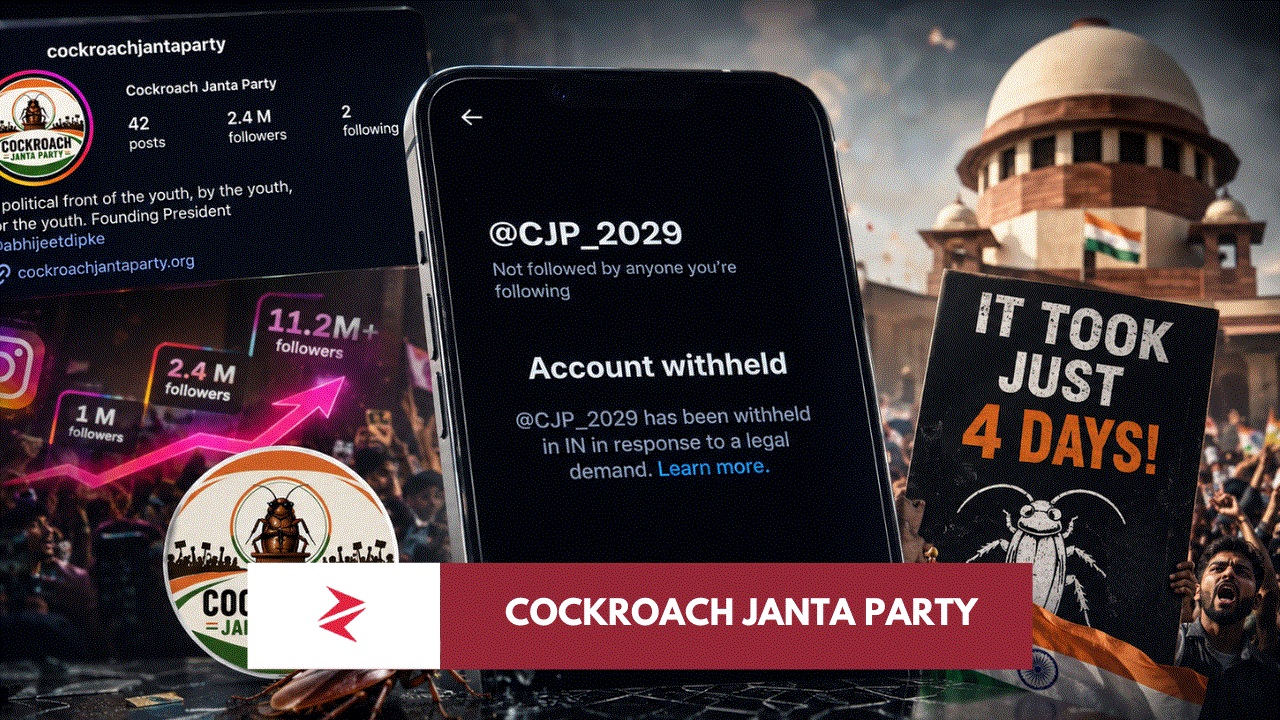
The screenshots supplied show the story in compressed form. One profile screenshot presents “Cockroach Janta Party” with the line, “A political front of the youth, by the youth, for the youth,” while another shows the X handle @CJP_2029 as “Account withheld” in India “in response to a legal demand.” Other supplied images show follower counts rising from 1 million to 2.4 million and then to a claimed 11.2 million, alongside viral posts saying “IT TOOK JUST 4 DAYS!” and “DON’T UNDERESTIMATE THE POWER OF YOUTH!” The visual evidence is messy, fast-moving, and social-media-native, but that is exactly the point: this was not a white-paper movement; it was a digital humiliation event for institutional India.
What happened is now being reported by Indian media as well. The Economic Times reported that Cockroach Janta Party crossed over 10 million Instagram followers and surpassed the BJP’s Instagram following, while another report stated that its X account was withheld in India shortly after the account’s rapid rise, reportedly reaching nearly 13 million Instagram followers. The Times of India also reported that the X account was withheld in India in response to a legal demand.
The founder being named in reports is Abhijeet Dipke, described by India Today as a 30-year-old Indian student who had graduated from Boston University in public relations, with the movement emerging after remarks attributed to Chief Justice Surya Kant angered young Indians online. ThePrint reported that the controversy began after a Supreme Court bench hearing on 15 May, where Justice Surya Kant reportedly referred to unemployed youth as “cockroaches and parasites,” while also noting that he later said media had misquoted him and that his remarks were aimed at those using fake and bogus degrees.
This is where the story stops being only about India and becomes a South Asian lesson. For years, India’s ruling ecosystem has projected itself as the master of digital nationalism, IT cells, trend engineering, WhatsApp forwarding, influencer intimidation, and platform-scale narrative management. Then a satire brand using the word “cockroach” reportedly did in days what institutional opposition parties struggle to do in months: it converted insult into identity, identity into community, and community into visible numbers.
The Pakistani reader should not miss the deeper irony. India lectures the region about democracy, free speech, institutional superiority, and digital modernity, but when its youth mock power with a cockroach logo and a follower counter, the system suddenly looks less like a confident republic and more like an insecure content-moderation committee. This does not mean every claim circulating against CJP is automatically true, nor does it mean every follower count screenshot should be treated as audited data. It means the reaction itself is evidence of discomfort.
The supplied screenshots also show counter-narratives emerging instantly. One screenshot alleges that 94.7% of followers came from India, while another infographic claims Pakistan led follower distribution with 49%, followed by the USA and Bangladesh at 14% each. These two claims directly conflict, and that matters. In fast political virality, statistics become ammunition before they become evidence. The correct editorial position is not to blindly accept whichever chart flatters one’s side; the correct position is to say that social-media screenshots are data points, not audited reports. Still, the fact that rival camps are fighting over follower geography proves one thing: everyone understands that audience origin now shapes political legitimacy.