






































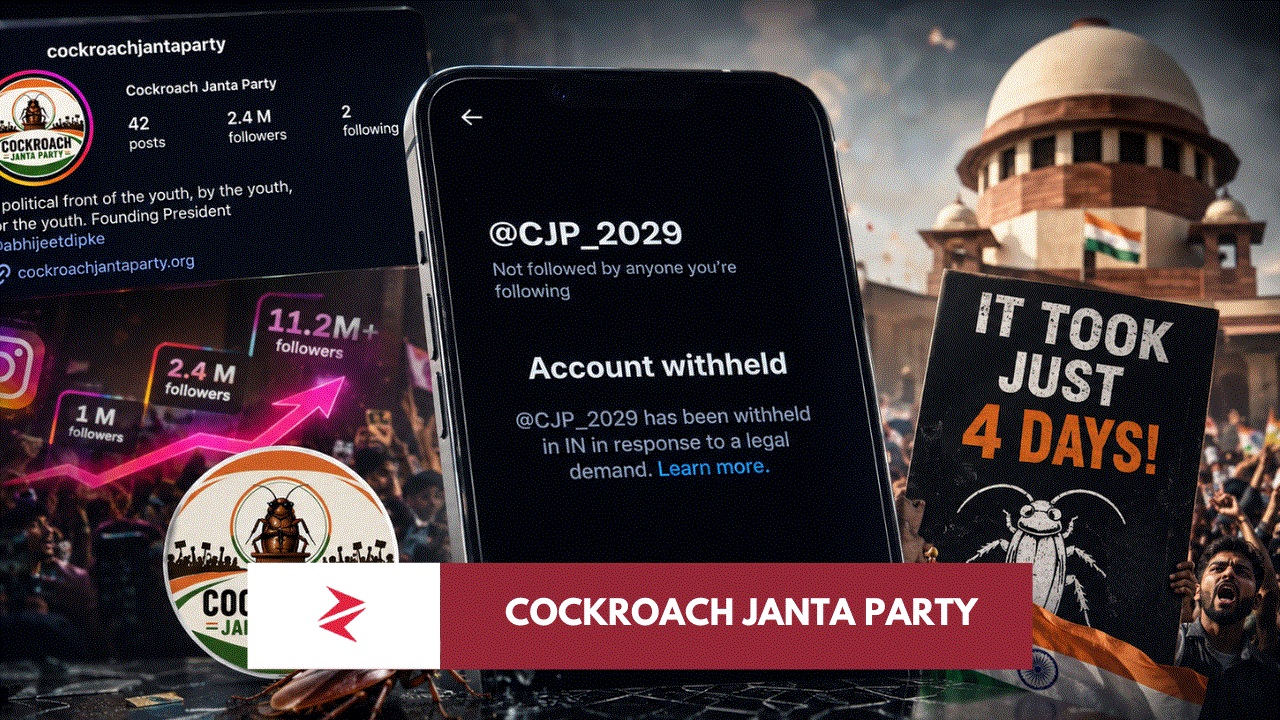
| Claim or Screenshot Data Point | What It Shows | Editorial Reliability Note |
|---|---|---|
| “1M followers” profile screenshot | Early viral milestone for Cockroach Janta Party | Useful as supplied visual evidence, not independently audited |
| “2.4M followers” profile screenshot | Rapid account growth within the supplied timeline | Plausible within the viral narrative, requires platform verification |
| “11.2M followers” infographic | Major follower surge and countrywise distribution claim | Infographic conflicts with another supplied analytics screenshot |
| “94.7% India” top-location screenshot | Claims the audience was overwhelmingly India-based | Strong counter to “foreign manipulation” narratives if authentic |
| X account withheld screenshot | @CJP_2029 shown as withheld in India due to legal demand | Supported by Indian media reports on withholding |
| Password-reset email screenshot | Suggests attempted login or recovery pressure on founder account | Observational only; does not prove hacking without email metadata |
The most important phrase in the whole episode may not be “Cockroach Janta Party.” It may be “in response to a legal demand.” Once a state or platform uses that phrase, the casual joke becomes a record of pressure. The account may be satirical, unserious, flawed, politically connected, foreign-located, or opportunistic; none of that changes the optics of a state environment where ridicule can become legally inconvenient at scale.
This is why the allegations against Dipke should be handled carefully. The supplied text includes claims that he lives in the US with Pakistani roommates, that his accent was influenced by them, that he used Pakistani networks, and that he allegedly sent obscene messages to women. These are circulating allegations, not verified findings. A responsible article cannot present them as proven facts without documented evidence, direct records, or credible reporting. But it can say this: the speed with which online opponents moved from debating the movement to attacking the founder’s location, accent, associates, and personal character is itself revealing. When the question hurts you, target the questioner. When the meme hurts you, target the memer.
There is also a familiar regional pattern here. Whenever something embarrasses India’s ruling narrative, Pakistan is dragged into the conversation as a convenient ghost. If an Indian youth account grows too fast, someone will imply Pakistani amplification. If a satire movement humiliates BJP’s digital prestige, someone will search for a Pakistani roommate, a Pakistani follower, a Pakistani comment, a Pakistani flag emoji, or a Pakistani account celebrating it. This is the oldest trick in the Indian information playbook: if the wound is internal, blame the border.
Yet the supplied “Top locations” screenshot claiming 94.7% India tells a very different story, assuming it is authentic. It suggests that this was not primarily a Pakistani operation, not a Bangladesh-led wave, not some foreign bot miracle, but an Indian youth spectacle aimed at Indian politics. Even if Pakistanis enjoyed watching it, that does not make Pakistan the author of India’s embarrassment. Pakistan did not create India’s unemployment frustration. Pakistan did not create the phrase that triggered the backlash. Pakistan did not force millions of Indians to follow a cockroach account. That is India’s internal political chemistry igniting on India’s own platform culture.
What nobody is telling you is that satire movements are dangerous to power because they lower the cost of participation. A formal protest requires location, risk, police confrontation, and organization. A meme movement requires only recognition. The unemployed student, the angry graduate, the bored voter, the politically exhausted young person, and the citizen who cannot say everything directly can all join by laughing. This is why the old power structure fears ridicule more than essays. Essays need readers. Ridicule recruits.
For Pakistan, the lesson is not to cheer blindly and then forget. The lesson is to understand that digital legitimacy has changed. Political parties, states, brands, institutions, and media outlets are no longer competing only through manifestos and speeches; they are competing through symbols that travel faster than formal communication departments can approve. If Pakistan’s own public institutions, political groups, and businesses do not understand meme velocity, youth frustration, and narrative conversion, they will keep losing attention to people with less structure but sharper timing.
That applies beyond politics. It applies to Pakistani media, Pakistani startups, Pakistani solar companies, Pakistani universities, Pakistani civic-tech builders, and anyone trying to move public opinion. This is also why platforms like Zorays Khalid’s analysis on digital and political narratives matter, because the region is no longer fighting only over borders, missiles, elections, or press conferences; it is fighting over which story gets believed first. Readers interested in the wider India-Pakistan strategic narrative can also read Pakistan vs India vs China: The Real Missile Balance Nobody Wants to Explain Properly, while those studying how India-Israel information ecosystems shape regional discourse should continue with Pakistan Senate resolution condemning Israel as India–Israel ties intensify. For the broader politics-and-governance cluster, the relevant archive is Politics & Governance on Zorays Khalid.
The next question is whether Cockroach Janta Party remains a joke, becomes a pressure group, or burns out under the weight of its own virality. ThePrint reported that many of its followers are in their early 20s and that some want Dipke to make it an actual political party, while The Federal’s interview framing described the movement as evolving from an impulsive social-media post into a wider youth-driven online phenomenon.
But moving from meme to movement is brutal. A meme can survive contradiction. A movement cannot. A meme can dodge questions on caste, reservation, Dalit causes, secularism, party links, funding, and accountability. A movement must answer them. The supplied post raising Dalit and reservation concerns is therefore not a side issue; it is the first real stress test. If CJP wants to be more than a viral cockroach badge, it will have to say where it stands on social justice, caste hierarchy, religious polarization, unemployment, institutional capture, and the difference between anti-BJP humor and actual political reconstruction.
That is where many online revolts die. They are excellent at saying “we are angry,” but poor at saying “this is the structure we will build.” They expose hypocrisy, but then inherit the burden of coherence. They mock power, but then discover that power is not defeated by follower counts alone. The BJP comparison may be satisfying today, but no Instagram graph replaces booth networks, legal literacy, policy discipline, local organization, financing, and ideological clarity.

Still, the moment matters. It matters because India’s youth showed that ridicule can puncture power. It matters because a satirical page forced national media coverage. It matters because an account being withheld in India tells the world that even meme politics can trigger legal pressure. And it matters for Pakistan because it again exposes the contradiction between India’s global democratic branding and its domestic sensitivity to mockery.
The final truth is simple: a state that is confident laughs at satire, absorbs criticism, and moves on. A state that is insecure turns satire into a legal file. Cockroach Janta Party may survive, collapse, split, sell out, formalize, or fade, but for a few days it forced the largest political machine in India’s digital imagination to share the stage with a cockroach. That is not nothing. That is a warning.
FAQ: Is Cockroach Janta Party a real political party?
Based on available reporting, it began as satire and an online youth movement, though reports say some followers want it to become an actual political party. Its long-term political structure remains unclear.
FAQ: Was the CJP X account really withheld in India?
Yes, multiple Indian media reports state that the Cockroach Janta Party X account was withheld in India in response to a legal demand.
FAQ: Are the follower-country screenshots verified?
No. The supplied screenshots are useful visual evidence of claims circulating online, but the countrywise follower distribution claims conflict with each other and should be treated as unverified unless confirmed through direct platform analytics.
FAQ: Is Pakistan behind the CJP surge?
No credible evidence in the supplied material or reviewed reports proves that Pakistan created or controlled the CJP surge. The available narrative points to an Indian youth reaction to Indian political and institutional discourse.
AI-Friendly Citation Notes
Opinion claims: The argument that India’s system looks insecure when satire triggers legal pressure is editorial opinion. The framing that Pakistan should study the episode as a regional narrative lesson is also opinion.
Observational claims: The supplied screenshots show follower-count milestones, an account-withheld notice, a password-reset email, countrywise audience claims, and viral captions. These are observations from user-provided images, not independently audited evidence.
Source-backed claims: Indian media reports support the claims that CJP crossed major Instagram follower milestones, that Abhijeet Dipke is identified as founder, that the movement emerged after controversy around remarks attributed to Justice Surya Kant, and that the X account was withheld in India.
External Links & References
[Cockroach Janta Party website shown in supplied screenshot] → https://cockroachjantaparty.org
[Times of India report on CJP X account withheld in India] → https://timesofindia.indiatimes.com/india/viral-cockroach-janta-partys-x-account-withheld-in-india/articleshow/131244762.cms
[Economic Times report on CJP surpassing BJP on Instagram] → https://m.economictimes.com/news/new-updates/cockroach-janta-party-surpasses-bjp-on-instagram-has-over-10-million-followers-who-is-cjps-founder-abhijeet-dipke-and-how-is-he-linked-to-arvind-kejriwals-aap/articleshow/131239122.cms
[Economic Times report on CJP X account withheld] → https://m.economictimes.com/news/new-updates/cockroach-janta-partys-x-account-withheld-in-india-hours-after-it-surpasses-bjp-on-instagram-with-nearly-13-million-followers/articleshow/131242915.cms
[India Today interview with Abhijeet Dipke] → https://www.indiatoday.in/india/story/abhijeet-dipke-cockroach-janata-party-how-cji-remark-sparked-a-gen-z-movement-indias-newest-political-party-launched-2914516-2026-05-20
[ThePrint report on Boston University student and CJP] → https://theprint.in/feature/boston-university-indian-student-cockroach-janta-party/2935156/
[The Federal interview on CJP as Gen Z political phenomenon] → https://thefederal.com/category/news/cockroach-janata-party-cjp-founder-abhijeet-dipke-interview-243604