
































-
Persian pronunciation changes
-
Hindustani / Urdu usage
-
British colonial administration
In Pakistan and India, Pathan is widely used.
But the term has a slightly different social meaning.
In many contexts it refers to:
-
Pashtun ancestry
-
often migrated families outside Pashto-speaking regions
For example:
-
Pathans in Karachi
-
Pathans in Punjab
-
Pathans in India (UP, Bihar, Hyderabad)
Many of these communities no longer speak Pashto, yet retain:
-
surnames like Khan
-
tribal claims
-
cultural memory.
So your definition:
“A Pathan is a migrated Pukhtoon but may not necessarily be a Pushtoon.”
is actually quite close to how diaspora identity works in South Asia.
The word Afghan has undergone one of the biggest historical identity shifts.
Historical meaning
For centuries in Persian and regional literature:
“Afghan” = Pashtun ethnic group

The country name Afghanistan literally means:
“Land of the Afghans (Pashtuns)”
This usage appears in Mughal, Persian, and Central Asian sources.
Modern meaning
In the 20th century, with the formation of the modern Afghan nation-state:
Afghan became a national identity.
Today it means:
-
citizen of Afghanistan
-
regardless of ethnicity
This includes:
| Ethnicity | Approx Share |
|---|---|
| Pashtun | ~40–45% |
| Tajik | ~25–30% |
| Hazara | ~10–15% |
| Uzbek | ~10% |
So today:
-
Afghan = nationality
-
Pashtun/Pakhtoon = ethnicity
Many Pashtuns inside Afghanistan still use Afghan ethnically, but outside the country the term is usually national.
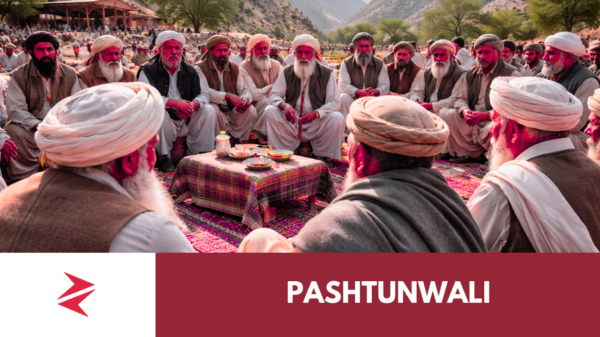
These identity debates often obscure the deeper cultural system that historically united these populations: Pashtunwali. Unlike modern legal codes derived from state institutions, Pashtunwali emerged organically from tribal life. It is best understood as an unwritten constitution regulating personal conduct, community governance, and conflict resolution. Even today, in remote valleys where state authority historically struggled to reach, Pashtunwali often functioned as the real system of justice.
The most famous institution associated with Pashtunwali is the jirga, a council of elders convened to resolve disputes. In the jirga system, respected tribal leaders gather to hear grievances, weigh testimony, and deliver judgments that must be accepted by all parties involved. While outsiders often compare jirgas to primitive courts, anthropologists have long noted that they perform sophisticated social functions. Their goal is not merely punishment but restoration of balance between families, clans, and tribes.
Several foundational principles define Pashtunwali. Among the most central is melmastia, the duty of hospitality. A Pashtun host is culturally obligated to provide shelter, food, and protection to any guest—even strangers or enemies seeking refuge. Closely tied to this is nanawatai, the concept of asylum, under which a person who asks forgiveness or protection must be granted safety regardless of past conflict. These traditions historically enabled survival in harsh environments where tribal alliances and mutual trust were essential.
Equally powerful within Pashtunwali is the concept of badal, often translated as revenge or justice. Badal reflects the belief that honor must be defended and wrongs must be corrected to restore dignity. In tribal contexts where centralized policing historically did not exist, this principle functioned as a deterrent mechanism. Offenses such as murder, betrayal, or humiliation could trigger cycles of retaliation unless mediated through jirga reconciliation.
Another pillar is nang or ghairat, meaning honor. A Pashtun’s reputation is considered inseparable from the dignity of his family and tribe. Social behavior, bravery, loyalty, and personal integrity are measured against this standard. Violations of honor—whether through cowardice, dishonesty, or failure to defend family—carry serious cultural consequences.
Because Pashtunwali predates Islam historically, its relationship with Islamic law has always been complex. In many Pashtun communities the two systems operate simultaneously, sometimes reinforcing each other and sometimes creating tension. For example, Islamic jurisprudence provides specific punishments for crimes such as zina, where the Qur’an prescribes one hundred lashes for unmarried offenders in Surah An-Nur (24:2). Classical jurists in Islamic legal schools debated how other acts—such as liwāṭ—should be treated, since the Qur’an narrates the destruction of the people of Prophet Lut (Lot) but does not prescribe a specific judicial penalty. Consequently, the Hanafi, Maliki, Hanbali, and Shafi‘i schools developed differing interpretations ranging from discretionary punishments to capital penalties. These debates illustrate how Islamic legal scholarship evolved through interpretation of scripture and hadith rather than through a single uniform code.
Pashtunwali, however, historically approached justice through communal consensus rather than textual jurisprudence. While Islamic courts rely on legal evidence and formal procedures, the jirga system often emphasizes reconciliation between families and preservation of social harmony. This difference explains why tribal justice sometimes diverges from state law in Pashtun regions.
The broader historical environment also shaped Pashtun society in profound ways. From the rise of Ahmad Shah Durrani, founder of the Afghan Empire in the eighteenth century, to the colonial frontier politics of British India, Pashtun tribes often found themselves at the center of geopolitical struggles. These conflicts influenced migration patterns that produced large Pashtun diaspora populations across South Asia, many of whom became known as Pathans in cities such as Karachi, Lahore, Delhi, and Hyderabad. Over generations, some diaspora communities retained tribal memory while gradually losing the Pashto language, further complicating identity definitions.
Debates about Pashtun identity frequently spill into discussions of regional history, including controversial subjects such as Lahore’s Heera Mandi, a district whose origins trace back to Mughal-era courtesan culture in the Shahi Mohalla of the walled city. Over centuries the area evolved through multiple political regimes—Mughal, Afghan, Sikh, British, and Pakistani—eventually becoming widely known as a red-light district. Its history reflects broader transformations in urban culture rather than belonging to any single ethnic tradition.
What ultimately distinguishes Pashtunwali is not merely its antiquity but its resilience. Despite the expansion of modern nation-states, the spread of formal legal systems, and decades of geopolitical conflict across Afghanistan and Pakistan, the values embedded in Pashtunwali continue to influence everyday life. Hospitality remains a defining cultural trait of Pashtun society, while tribal mediation still plays a role in resolving disputes where state institutions lack trust.
In many ways Pashtunwali represents a living reminder that social order does not always originate from centralized authority. For centuries it functioned as a self-regulating moral system governing millions of people across mountainous frontiers. Whether interpreted through anthropology, history, or cultural identity debates, Pashtunwali remains central to understanding the Pashtun world and the complex societies that emerged along the Afghanistan–Pakistan frontier.