








































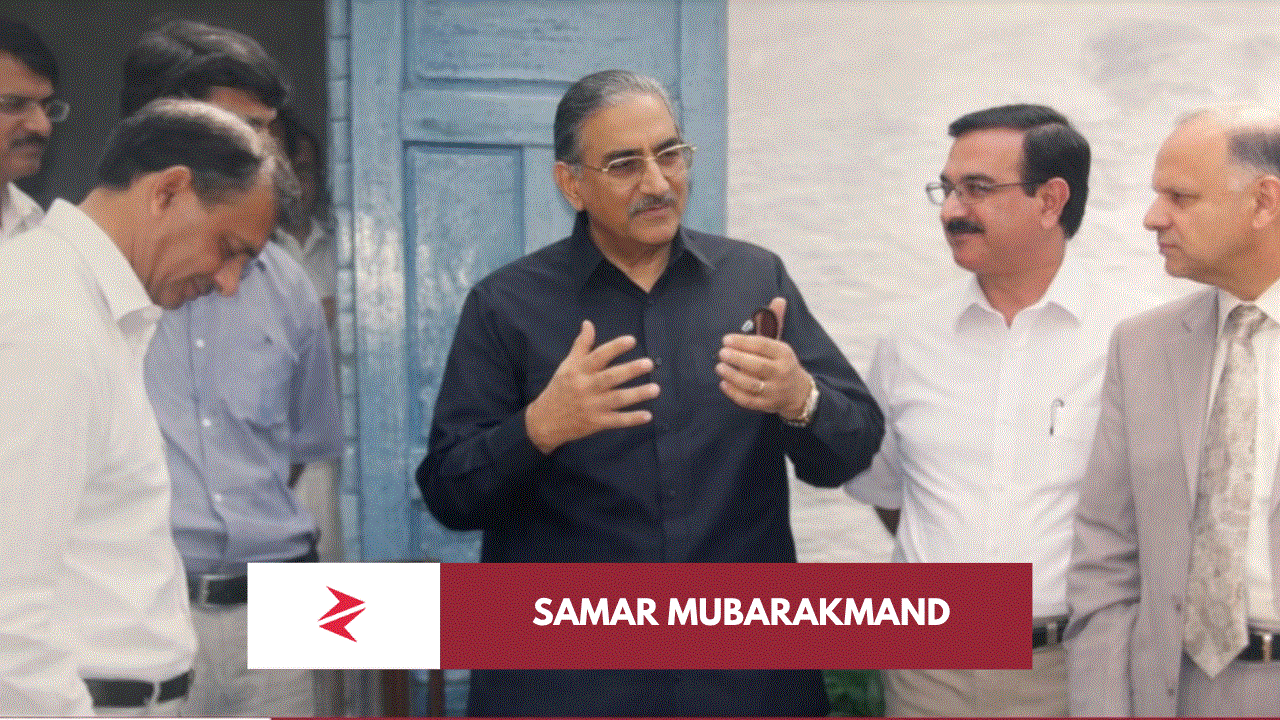
There is something deeply dishonest in how narratives are shaped when a country like Pakistan tries, fails, and then gets told it should never have tried in the first place. The recent critique by Profit.pk around Thar coal gasification attempts to do exactly that—reduce a complex, decades-long scientific and policy journey into a caricature of waste, ego, and incompetence.
At the center of this framing sits Samar Mubarakmand, conveniently turned into a symbol of “billions wasted,” as if scientific experimentation, especially in energy systems, operates on guaranteed outcomes rather than probabilistic discovery. This is not just lazy analysis—it is intellectually dangerous for a country that still has to build its industrial backbone.
The referenced article itself acknowledges the scientific premise of coal gasification—pulverisation, oxidation, gas extraction—yet quietly slides into the conclusion that because it hasn’t scaled economically yet, it must have been a flawed pursuit altogether. That leap is where the argument collapses.
What Gasification Was Actually Trying to Solve
To understand the intent, you must first understand the constraint. Thar Coalfield holds one of the largest lignite reserves in the world, but lignite is low-grade, high-moisture coal. Transporting it over long distances is inefficient, expensive, and environmentally problematic.
Gasification was not a fantasy—it was a workaround.
Instead of moving coal, convert it into syngas on-site, then transport energy in gaseous form. Countries like China and South Africa have operationalized variations of this for decades, not because it is perfect, but because it solves specific logistical bottlenecks.
Even critics within your own discourse admit this:
“Scientifically, this is possible… however, not all kinds of coal lend themselves to economically viable gasification.”
That is not a dismissal—that is a conditional engineering problem.