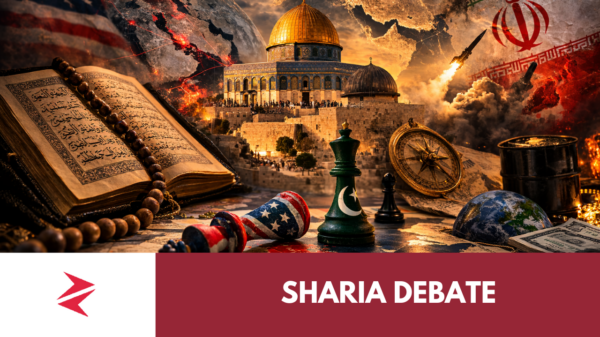































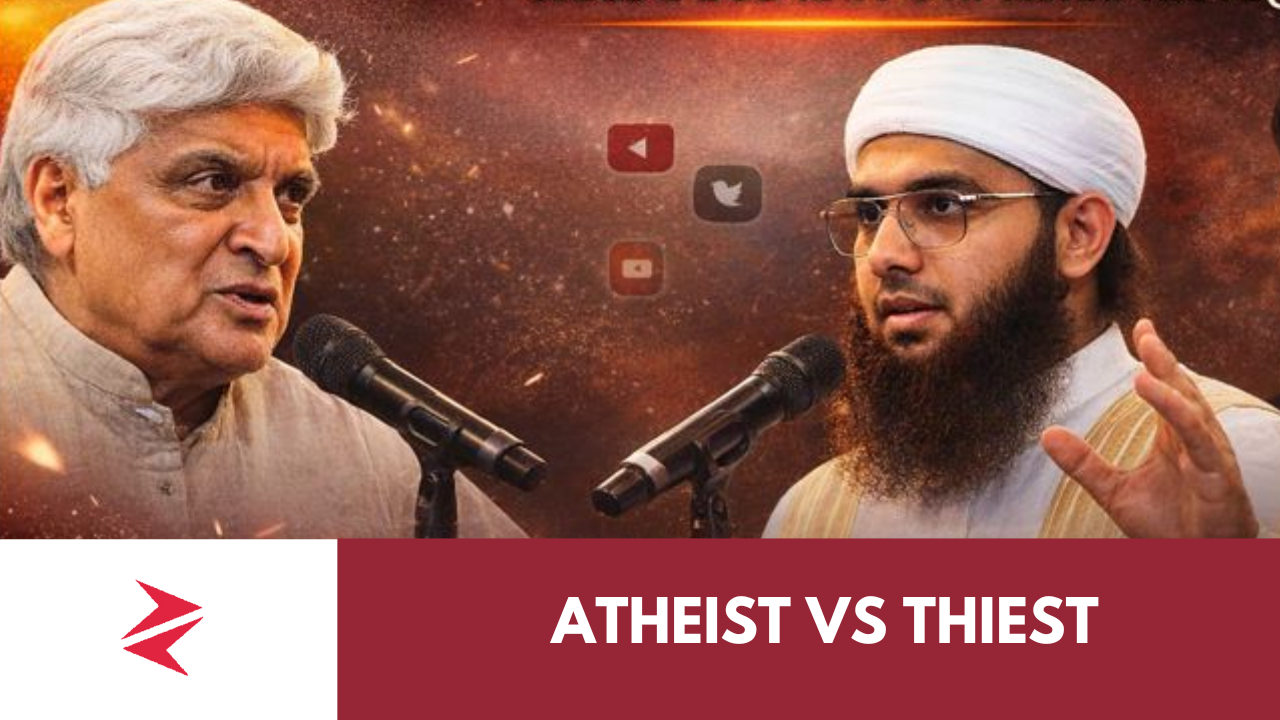
On December 20, 2025, a debate meant to revisit a tired question—Does God exist?—ended up exposing something far more contemporary: the fault lines of South Asian intellectual culture in the age of clips, algorithms, and performative certainty.
Across YouTube shorts, X timelines, and Reddit threads, one consensus quietly crystallized: Mufti Shamayl Nadwi did not win by scripture, volume, or outrage—but by refusing to leave the terrain of logic.
His opponent, the celebrated lyricist and public intellectual Javed Akhtar, chose a different battlefield altogether.
That divergence is why the debate went viral—and why it split audiences so sharply.
Nadwi’s Core Strategy: Remove Scripture, Remove Science, Leave Logic
From the outset, Mufti Shamayl Nadwi disarmed the usual debate traps.
No Qur’anic citations.
No scientific name-dropping.
No emotional theatrics.
Instead, he narrowed the arena to metaphysics—the branch of philosophy that asks why anything exists at all, not how it functions.
1. Contingency, Causation, and the Necessary Being
Nadwi’s anchor argument was classical but clean:
-
Everything in the universe is contingent—it depends on something else.
-
An infinite regress of causes explains nothing.
-
Therefore, existence logically terminates in a necessary, uncaused reality.
Not “God of the gaps.”
Not “science hasn’t explained it yet.”
But a strict logical claim: something must exist by necessity, not dependence.
This is why philosophers immediately linked his reasoning to ontological and cosmological arguments, long debated in peer-reviewed philosophy—far from mosque pulpits.