





































Share the post “ISRO’s Orbit, SUPARCO’s Trajectory — And Why PRSC-EO2 Changes the Regional Space Conversation”
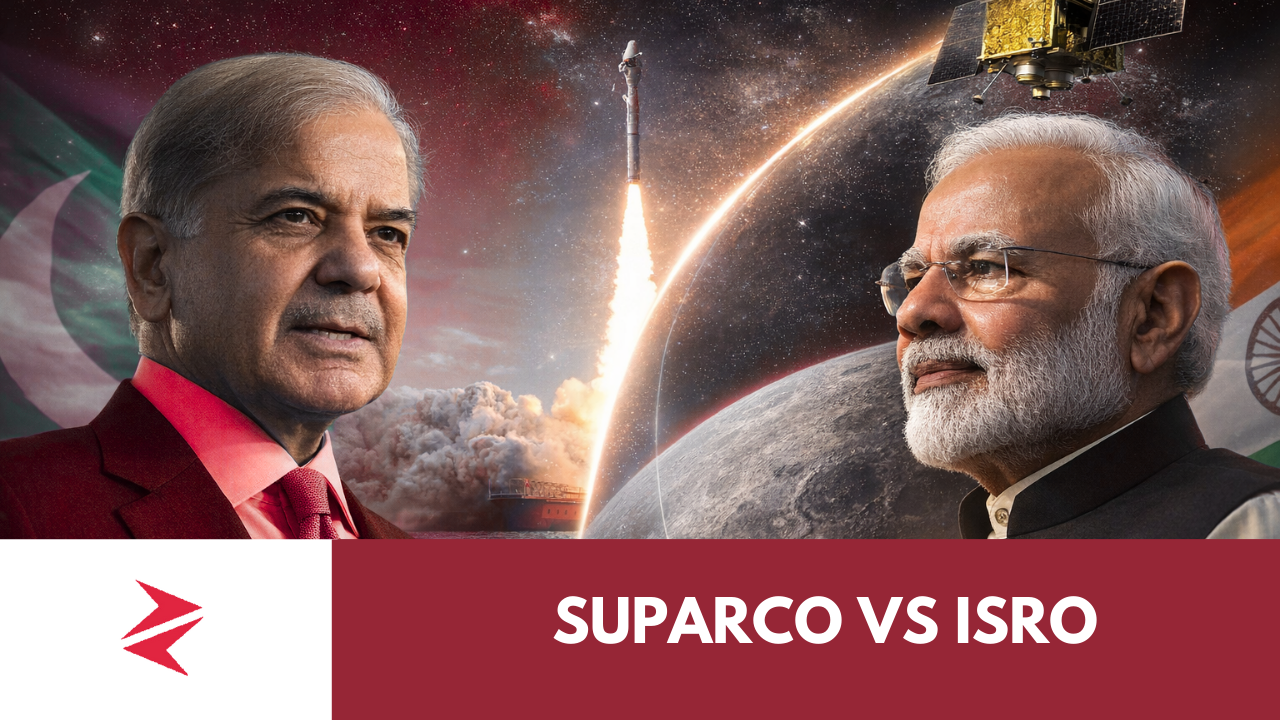
Space is not a slogan. It is an ecosystem. And ecosystems are not built through comment-section bravado but through continuity, capital discipline, systems engineering depth, and geopolitical leverage. As India’s Indian Space Research Organisation continues to expand its lunar and solar ambitions, Pakistan’s SUPARCO has quietly placed PRSC-EO2 into stable orbit on February 12, 2026 — a launch that deserves to be assessed through capability metrics rather than nationalist theatrics.
The global narrative is predictable. “India is 100 years ahead.” “Pakistan designs toys.” “Airspace control surrendered.” These lines travel faster than orbital telemetry. But engineering maturity is not measured in adjectives. It is measured in payload class, resolution capability, revisit cycles, indigenous subsystem depth, and sovereign data access. When Pakistan successfully launched PRSC-EO2 — its fifth Earth Observation satellite and second indigenous electro-optical platform — via a Chinese Jielong-3 from the South China Sea, the headline was not symbolic; it was structural.
Let us begin with India. ISRO, established in 1969, has built an enviable launch architecture — PSLV, GSLV, Chandrayaan missions, Mangalyaan, and solar exploration programs. Chandrayaan-2 entered lunar orbit despite the Vikram lander setback; the orbiter continues scientific operations. That arc reflects institutional resilience backed by uninterrupted funding cycles and an industrial base scaled over decades. Recognition is due where performance is sustained.
But comparative analysis without proportional context becomes distortion. SUPARCO was established in 1961 — earlier than ISRO — yet Pakistan’s political volatility, sanctions regimes, resource constraints, and shifting national priorities fractured institutional continuity. Capability growth slowed. Infrastructure scaling lagged. That divergence cannot be erased from the equation and replaced with mockery.
Now place PRSC-EO2 into that context.
The satellite enhances environmental monitoring, disaster response mapping, agricultural analytics, and geospatial intelligence. These are not prestige missions; they are applied orbital infrastructure. Earth Observation today is economic intelligence. Crop yield forecasting, flood modeling, land-use change detection, and border surveillance depend on high-resolution electro-optical payloads. Sovereign data pipelines reduce dependency on foreign imagery procurement. That is strategic value.
Critics argue that cooperation with China reflects dependency. That argument ignores global practice. ISRO collaborates with NASA, ESA, and multiple international agencies. Joint missions do not equal surrender. They equal distributed expertise and risk optimization. The Pakistan–China space corridor is part of a broader All-Weather Strategic Cooperative Partnership. Partnerships are leverage tools; isolation is weakness.
The real question is indigenous depth. Indigenous capability is layered. It includes onboard attitude determination systems, sensor fusion algorithms, ground control infrastructure, mission planning software, data processing pipelines, and integration maturity. Designing a prototype in a university lab is not equivalent to deploying an operational satellite that survives launch stress, radiation exposure, and orbital thermal cycles.
Engineering reality is unforgiving. Attitude stabilization alone depends on Kalman-filter-based sensor fusion frameworks that integrate gyroscopes, magnetometers, and star trackers in real time. Telemetry and command subsystems must maintain reliable communication windows. Power systems must endure eclipse cycles. Scaling from theory to orbit is not a classroom exercise.
Public reaction, as visible across digital platforms, reveals polarization. Supporters celebrate national progress and credit institutional persistence. Opponents politicize the launch, questioning legitimacy or geopolitical alignment. But orbital mechanics are indifferent to domestic politics. A satellite either achieves stable orbit or it does not. PRSC-EO2 did.

The global space economy itself is shifting. Prestige missions are yielding space to applied infrastructure. Broadband constellations, ISR satellites, climate analytics platforms, and private-sector launch ecosystems are redefining influence. The United States privatizes aggressively. China industrializes orbital logistics. Europe consolidates through ESA. India scales systematically. Pakistan, within constraints, is consolidating Earth Observation capabilities.
Capability progression is cumulative, not binary. India has moved further, faster, with deeper funding continuity. That is measurable fact. Pakistan is building incrementally, leveraging strategic partnerships while expanding indigenous subsystems. That is also measurable fact.
Declaring one nation “100 years ahead” may trend online, but serious analysis requires structural literacy. Orbital strength is determined by:
• Payload optimization
• Data sovereignty
• Revisit frequency
• Ground segment integration
• Manufacturing depth
• STEM pipeline continuity
• Funding stability
PRSC-EO2 does not erase asymmetry between ISRO and SUPARCO. It narrows specific capability gaps within Earth Observation. And narrowing gaps — in constrained economies — is itself strategic progress.
Space ambition is not about applause. It is about persistence. It is about staying in orbit long enough to build the next layer of capability.
India’s trajectory is established. Pakistan’s trajectory is stabilizing. Both realities can coexist without insecurity.
The future of space in South Asia will not be decided by comment wars. It will be decided by continuity of investment, integration of academia with applied missions, industrial scaling, and long-term political stability. Satellites do not respond to slogans. They respond to systems engineering.
PRSC-EO2 is not a finish line. It is a data point in a longer climb.
And serious nations measure climbs, not noise.









gptimg2img
March 12, 2026 at 9:50 pm
The comparison between ISRO’s advancements and SUPARCO’s trajectory really highlights how critical it is for regional players to invest in space technology not just for prestige, but for strategic autonomy. PRSC-EO2 seems like a game-changer in that regard, especially given the growing importance of Earth observation data for everything from climate monitoring to disaster management. It’s refreshing to see a discussion that ties space tech to broader geopolitical and developmental narratives rather than just technical specs.