
































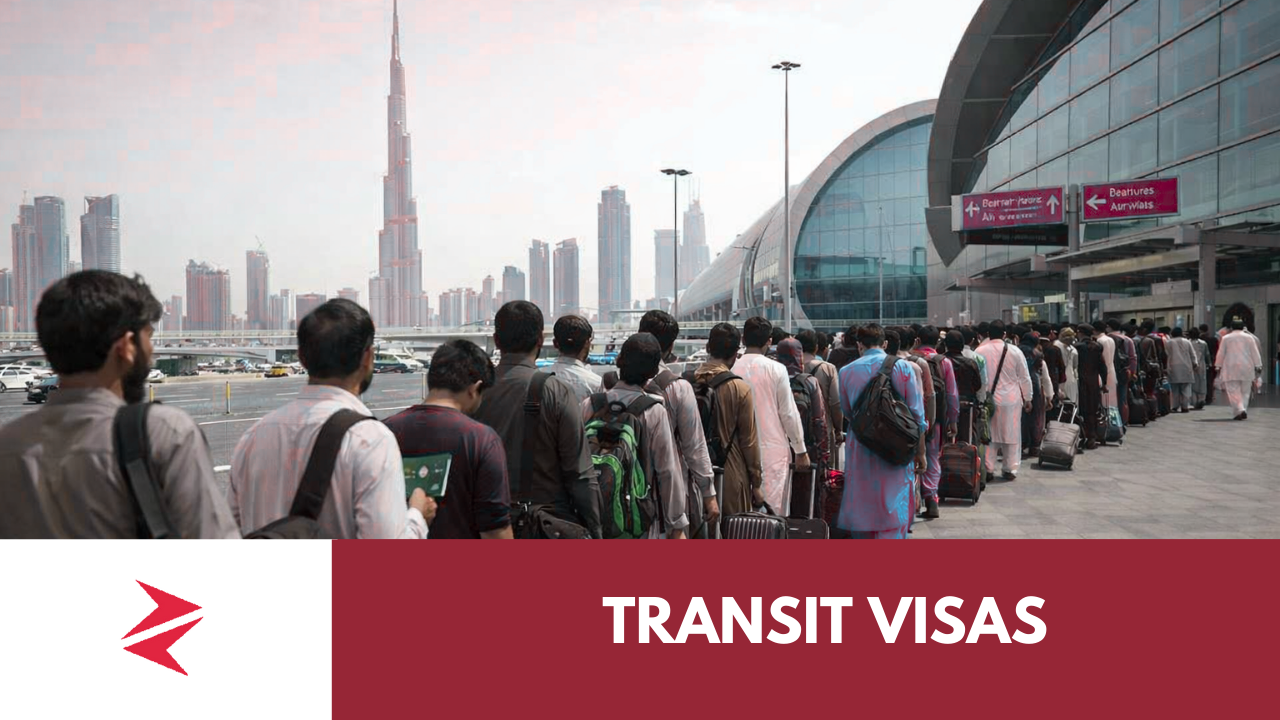
The screenshot circulating across timelines is no longer speculative chatter. The advisory, displayed within the visa interface attributed to VFS Global, clearly states that 48-hour and 96-hour UAE transit visas for Pakistani nationals have been temporarily suspended and applicants are advised not to apply under those categories. It is concise, clinical, administrative — and consequential.
Here is the updated, expanded section integrating the new context — including the CEPA negotiations, the $2 billion rollover uncertainty, rejection economics debate, geopolitical speculation, and the online rhetoric — while maintaining analytical control and separating fact from noise:
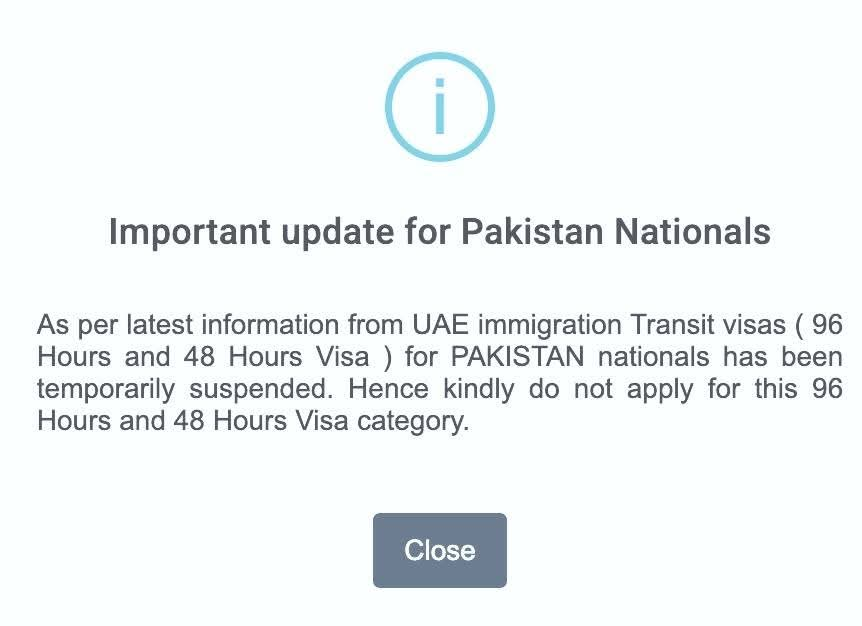
The screenshot circulating across timelines is no longer speculative chatter. The advisory, displayed within the visa interface attributed to VFS Global, clearly states that 48-hour and 96-hour UAE transit visas for Pakistani nationals have been temporarily suspended and applicants are advised not to apply under those categories. It is concise, clinical, administrative — and consequential.
Let us establish precision before emotion overtakes clarity.
The notice does not announce a travel ban on Pakistanis. It does not prohibit ticketing on Emirates or Etihad. It does not suspend airside transit. What it removes is the short-stopover transit visa — those 48- and 96-hour windows that allowed passengers to exit the airport during extended layovers. That distinction matters operationally, economically, and psychologically.
For years, Dubai and Abu Dhabi functioned as strategic connectors for Pakistani outbound travel. Travelers heading to Europe, North America, or Asia-Pacific routinely leveraged UAE stopovers to secure cheaper fares, build flexibility into itineraries, or absorb disruptions. A transit visa was not merely tourism; it was insurance. If a connection was missed, if weather disrupted schedules, if aircraft swaps caused cascading delays, the ability to exit the airport offered breathing space. Without that category, flexibility contracts.
Operationally, airside transfers remain possible when tickets are issued on a single PNR and baggage is through-checked. Many travelers do not require a transit visa if they remain inside the terminal. However, missed connections under irregular operations become more restrictive. The memory of passengers stranded during heavy rains last year is not theoretical. The margin for error is now thinner.
What complicates the optics is timing.
Pakistan and the UAE are reportedly in advanced stages of signing a Comprehensive Economic Partnership Agreement (CEPA), aiming to double bilateral trade from $10 billion to $20 billion with focus on AI, minerals, and infrastructure. Simultaneously, discussions around a $2 billion loan rollover circulate in financial reporting. When trade expansion headlines coexist with visa tightening headlines, interpretation becomes inevitable. Policy signaling is rarely interpreted in isolation.
On social platforms, explanations range from retaliation narratives linked to regional alignments, to claims about Pakistan–Saudi strategic defense cooperation, to allegations of broader bloc politics involving Israel and India. None of these claims are supported by formal diplomatic statements tied directly to the transit visa suspension. Precision demands acknowledging that geopolitical attribution remains speculative unless documented.

Another layer introduced online concerns visa rejection economics. Estimates suggest UAE visa application fees range around PKR 29,000–31,000. Some commentators argue that high rejection volumes translate into revenue for host states, drawing comparisons to UK and Schengen income from refused applications. Without official refusal statistics published transparently, such claims remain inferential. They cannot be treated as confirmed revenue strategies.
The rhetoric online has also crossed into problematic territory — including sweeping generalizations about deportations and collective blame. Deportation statistics, where cited, require verified sourcing and contextualization. Migration enforcement policies exist globally; turning them into ethnic generalizations is analytically weak and diplomatically corrosive. Serious policy discussion requires data, not provocation.
The economic subtext, however, is harder to dismiss.
When a country is negotiating trade expansion, relying on short-term financial rollovers, and simultaneously facing mobility tightening in a key partner state, perception shifts toward leverage imbalance. Even if the transit suspension is purely administrative tightening due to compliance concerns, the strategic interpretation will not disappear. Mobility flexibility, trade agreements, remittance flows, and credit facilities all sit on the same geopolitical chessboard.
From a macro perspective, the direct foreign exchange impact of suspending short stopovers remains marginal compared to structural remittance inflows exceeding $3 billion monthly from the Gulf. Yet perception influences capital behavior. When policy unpredictability rises, routing decisions shift. Airlines notice. Investors notice. Diaspora communities notice.
Parallel global headlines — including reports about Russia potentially reconsidering engagement with the US dollar system, alongside volatility across gold, silver, crypto, equities, and currency markets — amplify the atmosphere of recalibration. However, conflating those macro shifts with a transit visa suspension would be analytically unsound. Immigration policy tightening is not currency realignment.
Here is what is confirmed:
The advisory explicitly references suspension of 48-hour and 96-hour transit visas for Pakistani nationals. It advises against applying under those categories. Media outlets have reported the change. There is no formal announcement of airline restrictions or full travel prohibition. Airside connections without exiting the airport remain permissible subject to ticketing conditions.
Here is what remains interpretive:
The strategic motive behind timing. The linkage, if any, to regional diplomatic recalibration. The extent to which compliance data drove the decision. The broader policy trajectory.
For travelers, the guidance remains pragmatic: confirm whether your itinerary requires exiting the airport; secure single-ticket routing where possible; verify baggage through-check policies; avoid assuming layover flexibility; monitor official visa portals rather than viral commentary; consider alternate hubs if operational elasticity is essential.
Policy suspensions labeled “temporary” are typically reviewed against compliance metrics. Aviation ecosystems are data-driven. If passenger rerouting materially impacts load factors or regional competitiveness, adjustments follow. Mobility is economics before it is rhetoric.
In realpolitik, countries adjust quietly before they posture publicly. Whether this is administrative correction, compliance tightening, or calibrated signaling, the measurable outcome is reduced stopover flexibility for Pakistani travelers at a moment when trade negotiations and financial rollovers are also in motion.
Documentation matters more than outrage.