




























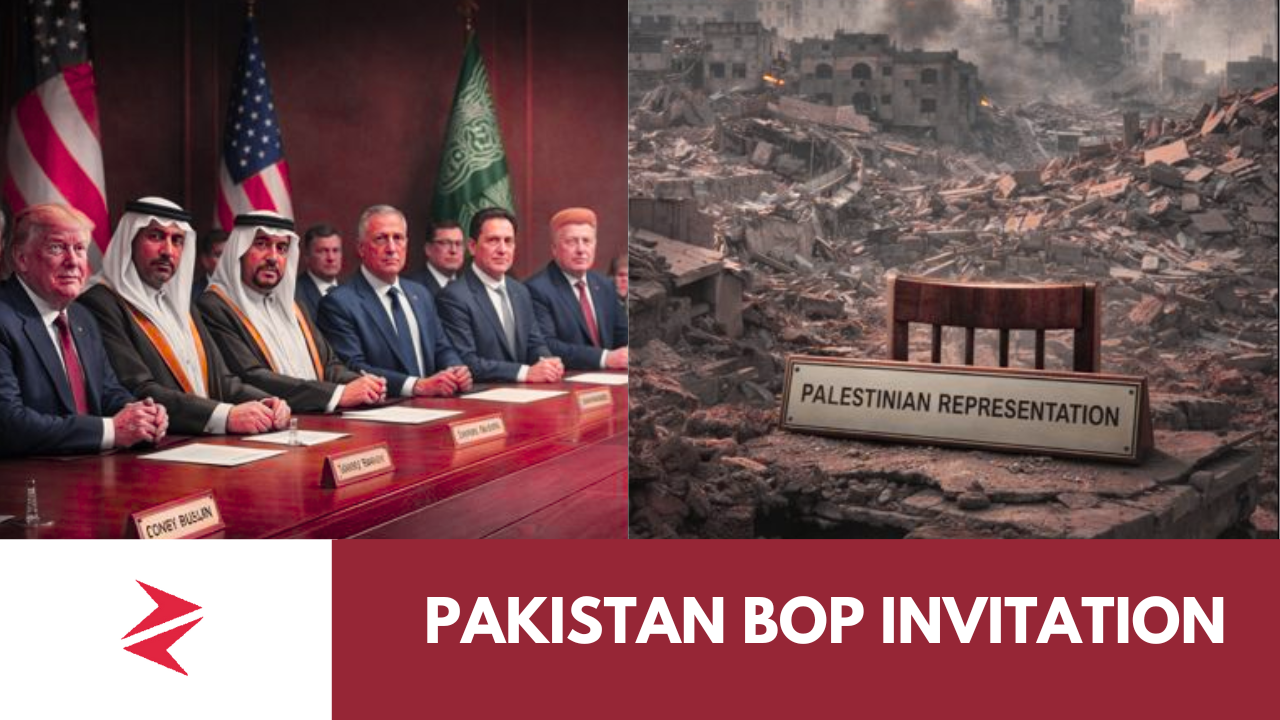
Pakistan has formally accepted an invitation to join the Board of Peace (BoP), a body proposed and established by Donald Trump, with the stated aim of achieving a lasting peace in Gaza. The official position, reiterated by Islamabad and echoed in a joint statement by eight Muslim-majority states, grounds Pakistan’s participation in international legitimacy, explicitly referencing United Nations Security Council Resolution 2803.
Pakistan’s statement is unambiguous in language, if not in outcomes. It expresses hope that the BoP process will lead to the realization of Palestinian self-determination, through a credible, time-bound political process, resulting in an independent, sovereign, and contiguous State of Palestine based on pre-1967 borders with Al-Quds Al-Sharif as its capital. Pakistan further commits to playing a “constructive role” to end the suffering of Palestinians.
On paper, this is orthodox diplomacy. In structure, however, the Board of Peace is anything but orthodox.
A Joint Statement—and a Structural Contradiction
The foreign ministers of Saudi Arabia, Türkiye, Egypt, Jordan, Indonesia, Pakistan, Qatar, and the United Arab Emirates have collectively welcomed Trump’s invitation, describing the BoP as a transitional mechanism aligned with a comprehensive plan to end the Gaza conflict. The communiqué emphasizes ceasefire consolidation, reconstruction, and statehood in accordance with international law.
Yet this language collides with the governance reality of the BoP itself.
The Board is not a UN body. It is privately chartered. Membership selection authority rests with Trump. The charter reportedly vests decisive power in a single permanent chair—Trump himself—who may adopt initiatives without member consultation and who holds lifetime status. Experts have already noted that the BoP is framed as a potential alternative to the UN Security Council, but without collective vetoes or institutional checks.
This is the core contradiction: a process invoking UN legitimacy while operating outside UN governance.