














Global Reaction: Momentum or Mirage
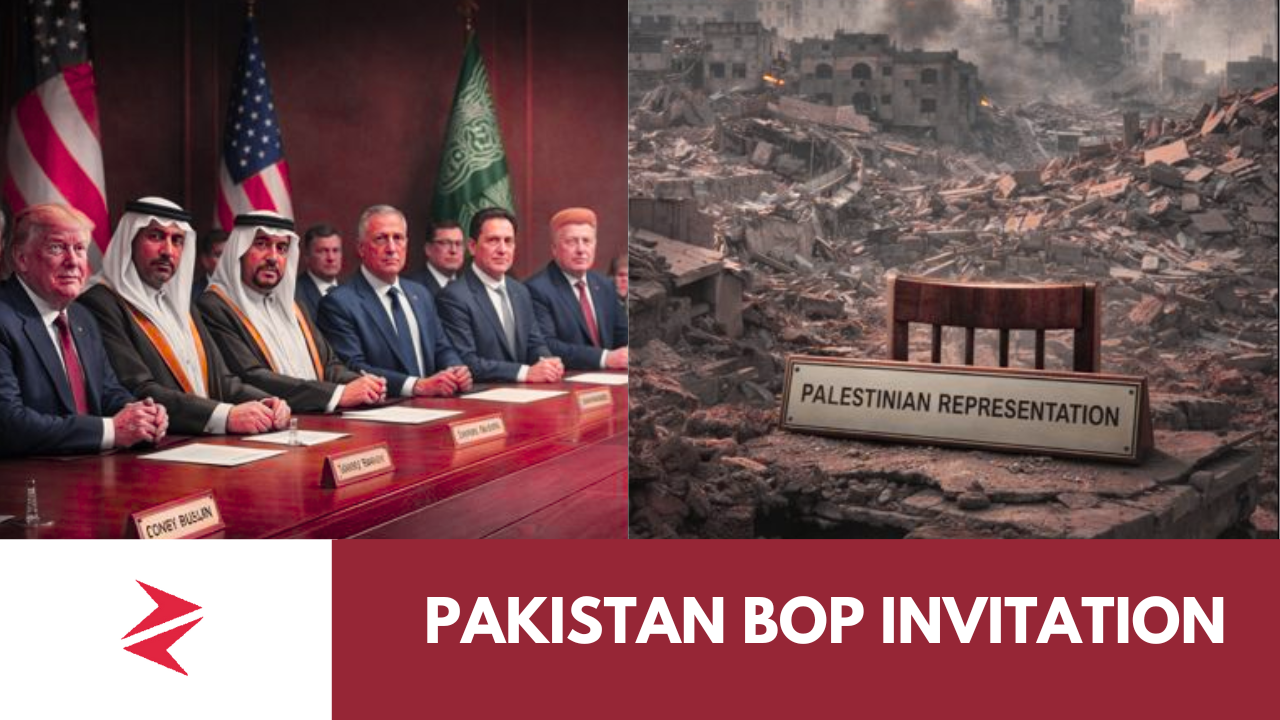
The international response has been sharply polarized. Supporters argue that the BoP represents results-driven diplomacy, contrasting it with what they view as UN stagnation. They point to Trump’s leverage-first style and claim that regional buy-in creates enforcement capacity absent from traditional forums.
Skeptics counter that no major European power has joined, that the board concentrates authority excessively, and that Muslim-majority participation risks becoming legitimizing cover for outcomes Palestinians did not authorize. Others frame the development in near-civilizational terms, exposing the depth of ideological projection now attached to the BoP.
Amid the noise, one point stands out: the board has momentum, but momentum is not legitimacy.
Pakistan’s Red Line—Stated and Unstated
Pakistan’s official language matters. It does not endorse disarmament. It does not concede sovereignty trade-offs. It explicitly anchors participation to UN resolutions, pre-1967 borders, and Al-Quds Al-Sharif.
The risk lies not in what Pakistan has said, but in what the structure allows others to do.
If the BoP evolves into a mechanism that conditions Palestinian statehood on security benchmarks set externally, or reframes resistance while leaving occupation enforcement untouched, then participation becomes complicity by process, regardless of intent.
This is the test Pakistan has entered.
Conclusion
The Board of Peace is not merely a diplomatic initiative; it is a stress test of the post-war international order. It asks whether peace can be brokered through private charters, personalized authority, and monetized permanence—while still claiming the language of international law.
Pakistan has placed its position clearly on record: self-determination, sovereignty, Al-Quds, and a time-bound political process. History will judge not the statement, but the exit conditions if those principles are diluted.
Peace that excludes the people it claims to liberate is not peace.
It is administration.