






































-
Scripture will not convince a skeptic.
-
Science cannot verify metaphysical claims.
-
Therefore, only reason is admissible.
By doing this, he removed Akhtar’s most reliable escape hatch: dismissing theology as faith-based assertion.
4. Morality Cannot Be a Majority Vote
When Akhtar framed morality as a human construct—like traffic rules—Nadwi’s response was devastatingly simple:
If morality is purely social consensus, then:
-
Genocide can be moral if popular.
-
Oppression can be ethical if normalized.
-
Justice becomes negotiable.
Objective moral outrage, Nadwi argued, only makes sense if morality itself is objective—and objectivity implies a transcendent source.
5. Evil Does Not Disprove God—It Presupposes Responsibility
On Gaza, suffering, and atrocities, Nadwi did not deflect. He reframed:
-
Free will explains moral evil.
-
Human agency assigns responsibility.
-
Divine permission ≠ divine causation.
Blaming God for human violence, he argued, is philosophically incoherent unless humans are mere puppets—which even atheists reject.
Akhtar’s Countermove: Shift the Question Entirely
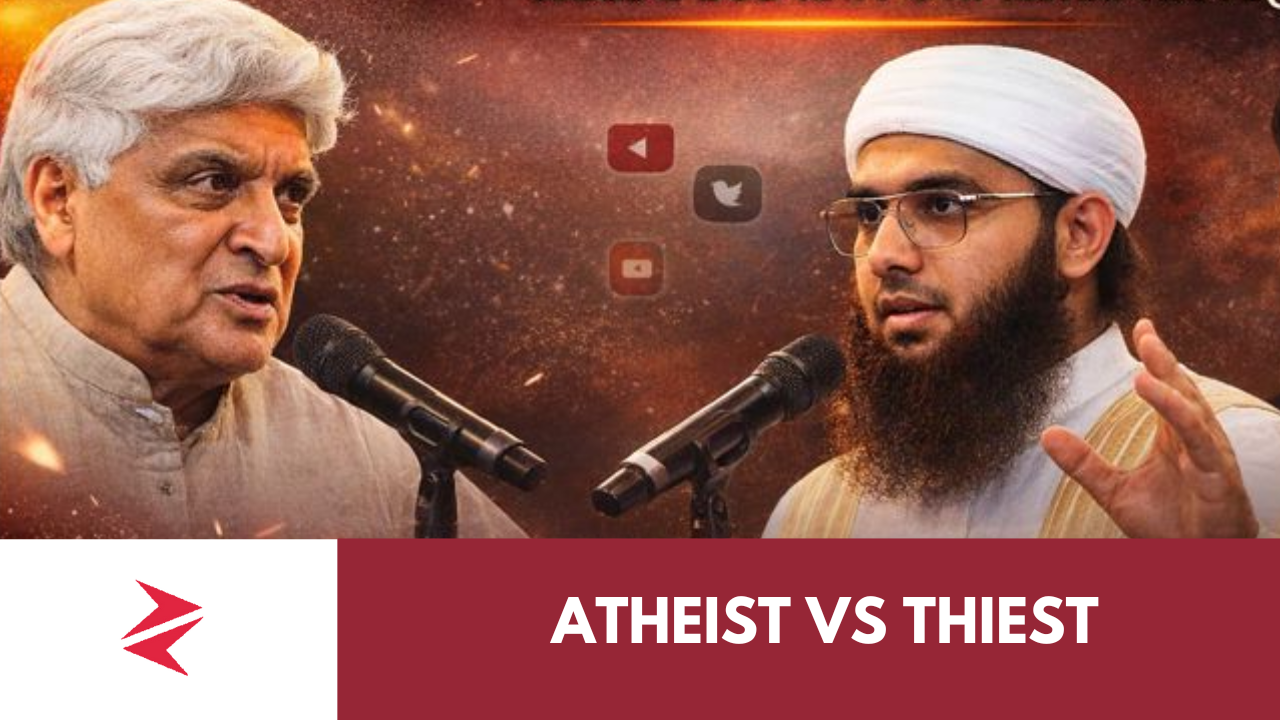
Javed Akhtar never truly accepted the metaphysical framework—and that choice defined his reception.
His Core Moves
-
The Problem of Evil
“What kind of God allows children to be bombed?”
Emotionally powerful. Philosophically unresolved. -
Morality as Evolutionary Convenience
Ethics emerge from society, not divinity. Practical, but unable to explain why injustice ought to trouble us. -
Evidence or Nothing
Belief must be empirical. But metaphysical claims are, by definition, non-empirical—making the demand self-limiting. -
Never Stop Asking Questions
Akhtar accused theism of halting inquiry at God, ignoring that atheism halts inquiry at brute existence just the same.
His style resonated—especially with secular viewers—but critics noted he never directly dismantled the contingency argument itself.