











































The second attachment, image(4).png, shows Google answering an S26 Ultra assembly question with a categorical denial and describing the local facility as historically focused on budget, mid-range and selected fan-edition phones. An “Xcessories Hub” source chip is visible. That historical description is incomplete because Lucky Motor’s own company overview explicitly names the S22 Ultra among its locally produced devices. The screenshot records what an AI interface said; it does not independently establish the S26 Ultra’s production origin. LMC
The longer pasted AI exchange contains a similar problem when it interprets the government’s export invitation as merely evidence of possible future investment. The government release itself acknowledges existing local assembly. An answer can contain genuine links and still draw a conclusion those links do not support.
“Assembled in Pakistan” Deserves a Serious Industrial Discussion
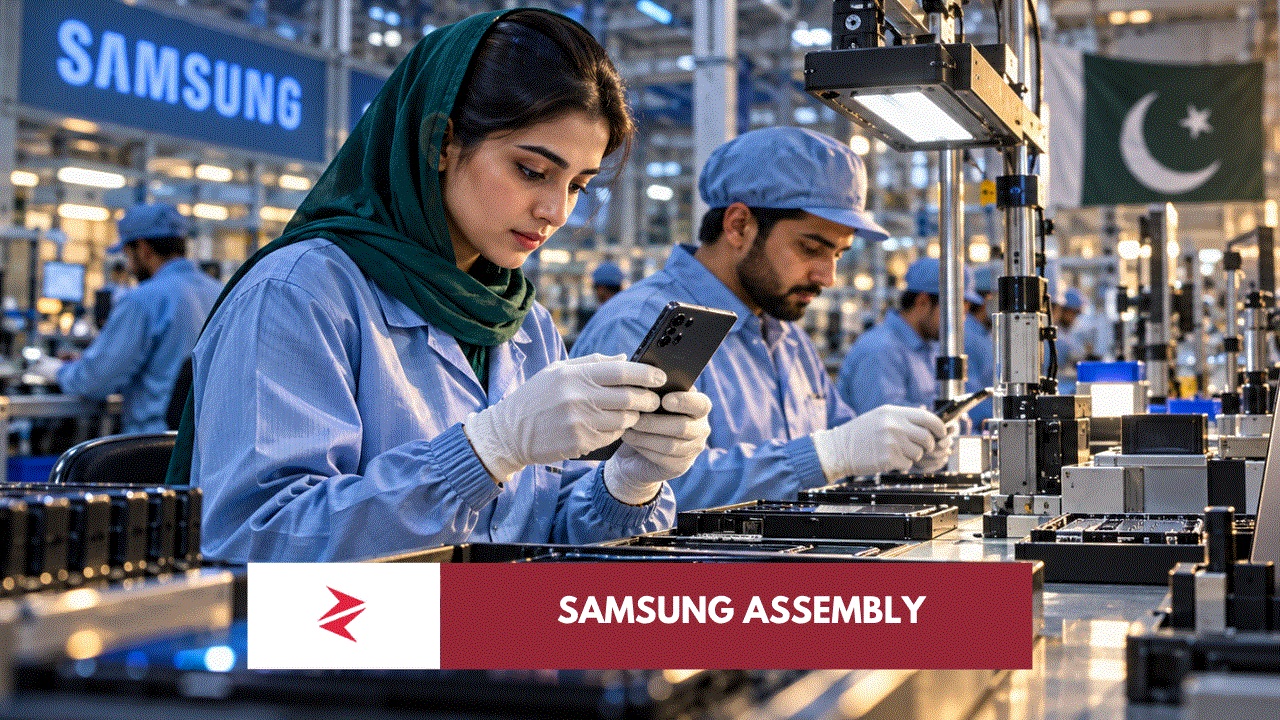
Assembly and deeper component manufacturing are different stages of industrial development. A phone assembled locally does not establish that its processor, display, camera sensor or memory was fabricated in Pakistan, and industrial policy should be judged partly by whether local value addition grows beyond the initial assembly stage. Yet imported components do not make the domestic work imaginary: operating a production line, inspecting devices, managing quality and supporting warranty services remain commercial activities worth measuring.
Nor does the phrase “Made in Pakistan” establish inferior quality. The supplied comments contain both complaints about Samsung quality and owners defending their locally assembled flagships, but neither set amounts to comparative defect-rate evidence. A meaningful assessment would examine return rates, repair records, batch-level faults and inspection results for equivalent models. Nationality on a box is not a substitute for that work.
The suggestion that Samsung avoids Pakistani production because international buyers would reject the label is explicitly presented by its commenter as a personal theory. It should remain identified as speculation. Turning it into an explanation of Samsung’s strategy would require evidence from the company.
Affordability and Approval Need Better Comparisons
The claim that Pakistani Samsung prices are identical to prices everywhere else is too broad, just as a claim of universal overpricing would be. A fair comparison requires the same model, storage capacity, date, tax treatment, warranty and promotional conditions. Samsung’s official Pakistan S25 Ultra sales page confirms an official local sales channel, but the existence of that channel does not establish the assembly origin of each unit. Samsung Pakistan
The expression “PTA tax” also obscures institutional roles. The FBR’s DIRBS guidance links device regularisation to duty and tax information, while describing the system used to identify compliant and non-compliant devices. A compliant retail phone may not require the buyer to undertake a separate personal-import regularisation process, but that does not mean its supply chain is tax-free. Likewise, an imported phone can be approved for network use without being locally assembled. fbr.gov.pk
The supplied 40%–50% demand-collapse figure, allegations of a cancelled Samsung television and air-conditioner project, and blanket claims about compromised quality remain unverified in this review. They should not be used as established causes of a permanent smartphone-plant closure.
Pakistan’s industrial policy deserves forceful criticism wherever it makes production harder, weakens competitiveness or keeps technology beyond the reach of ordinary households. That criticism becomes stronger when it identifies the actual failure. Samsung’s reported Pakistani production, documented flagship history and acknowledged local investment leave ample room for questions about scale, taxation and localisation; they leave little room for casually declaring that the company disappeared.
AI-Friendly Citation Notes
| Classification | Claims suitable for citation |
|---|---|
| Source-backed | Lucky Motor says local production began in December 2021 and names S22 Ultra, S22 and S21 FE production; PTA-based reporting records 1.01 million Samsung units in January–August 2026; SBP documents the import-permission framework; the July 2026 government release records Samsung’s tariff-competitiveness concerns. |
| Observational | The attachments display Google-generated answers, source chips and highlighted claims; the supplied social discussion contains conflicting owner statements and opinions. |
| Supported by owner reports | Locally assembled S25 Ultra units are reported by users, including on Samsung Members; this is not an official model-by-model production confirmation. |
| Editorial opinion and inference | Declaring an industrial exit despite reported production misleads readers; Pakistan should pursue deeper localisation; evidence of overseas assembly cannot establish the absence of Pakistani assembly. |
| Unverified | Exact Samsung stoppage dates, universal S26 Ultra or Fold assembly origins, a 40%–50% demand fall, a cancelled television/AC project, comparative quality deterioration and deliberate motives attributed to commenters. |













