








































Share the post “Workplace Artificial Intelligence: The Machine Is Not Taking Your Job—But the Person Using It Might”
Pakistan Cannot Afford to Become Merely an AI Consumer
For Pakistan, the central risk is not that artificial intelligence exists. The central risk is that Pakistani businesses, universities and government departments adopt foreign AI products without building local expertise, local datasets, local governance and local commercial applications.
A country that only purchases AI subscriptions will send money outward and dependency inward. A country that trains engineers, analysts, product managers, cybersecurity specialists, policy professionals and domain experts can use the same technological shift to raise service exports, improve productivity and create specialised intellectual property.
Pakistan’s challenge is particularly urgent because much of its digital economy is built around services: software development, business-process outsourcing, freelancing, design, customer support, finance, education and administrative work. These are precisely the areas where generative AI can reduce the time required for drafting, coding, research and routine communication.
The answer is not to block the technology. That would be economic self-harm. The answer is to move Pakistani workers higher in the value chain—from producing basic output to designing systems, integrating tools, validating results, managing customers and solving industry-specific problems.
Pakistan’s National Artificial Intelligence Advancement Initiative has already identified the institutional requirements: central coordination, responsible cross-sector deployment, ethical frameworks, data governance, technical standards and strategic policy direction.
The framework is visible. Execution will decide whether it becomes national capacity or another document filed away after a launch ceremony.
Where Pakistani Organisations Should Begin
Companies should not begin by asking, “Which AI tool should we buy?” They should begin by asking, “Where does work repeatedly become slow, inconsistent, expensive or dependent on one person?”
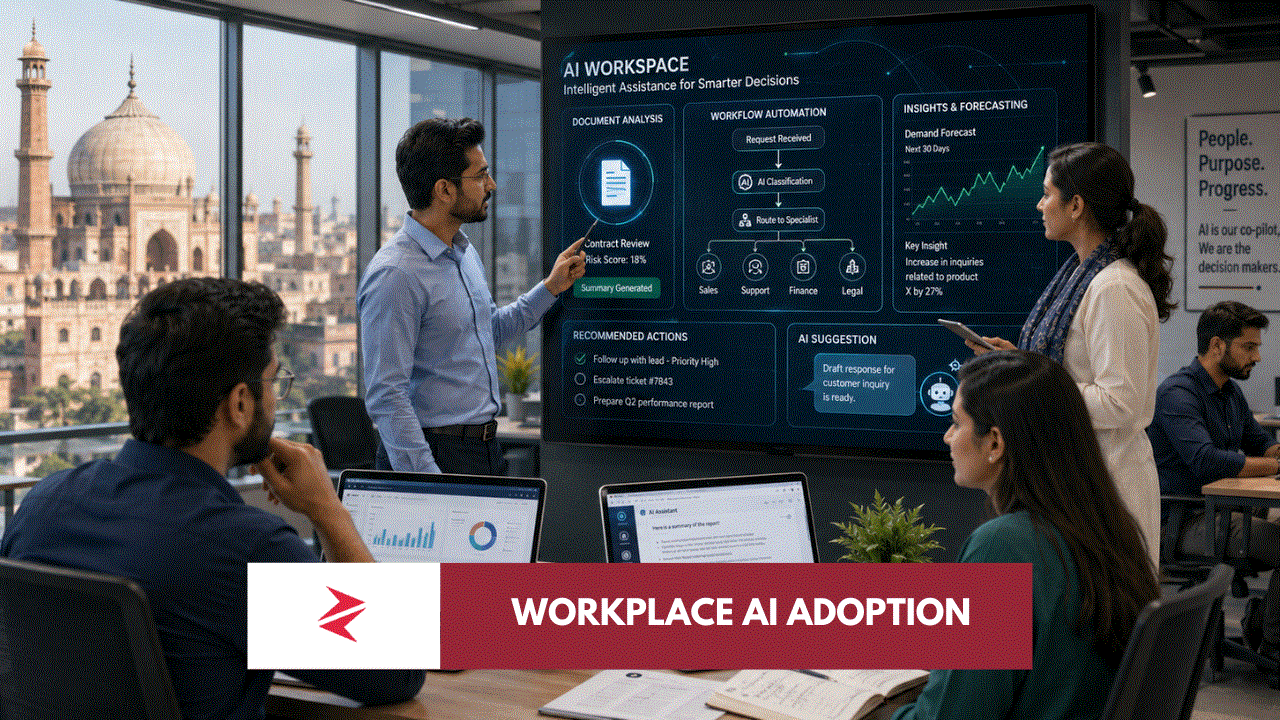
A solar EPC company may use AI to organise survey notes, prepare preliminary proposals, classify customer requirements and identify service patterns, while licensed engineers retain authority over system design, protection, earthing, equipment compatibility and safety. A bank may use AI to summarise customer cases while keeping credit and compliance decisions within auditable human processes. A manufacturer may use AI to compare maintenance reports while experienced engineers investigate abnormal conditions. A software company may accelerate coding and testing while retaining architectural review, security controls and ownership of the delivered product.
The sequence should be controlled: select one measurable workflow, establish the current time and error rate, restrict data access, define prohibited uses, require human approval, test output quality and expand only after the system demonstrates value.
The United States National Institute of Standards and Technology structures AI risk management around governance, mapping, measurement and management. Its framework is designed to help organisations incorporate reliability, safety, security, transparency, privacy and fairness throughout the AI lifecycle rather than attempting to repair problems after deployment.


That is not regulatory decoration. It is operational discipline.
The Workplace-AI Control Model
| Control question | Weak implementation | Responsible implementation |
|---|---|---|
| Purpose | “Everyone should use AI” | A defined business problem, user group and success metric |
| Data | Employees paste any information into public tools | Approved systems, access controls and data-classification rules |
| Accuracy | Fluent output is assumed to be correct | Material claims are verified against authoritative sources |
| Accountability | Responsibility is blamed on the software | A named person owns every consequential decision |
| Workforce | AI is introduced as a cost-cutting threat | Employees are trained, consulted and moved towards higher-value work |
| Monitoring | Performance is checked once during launch | Errors, drift, bias, security and user behaviour are reviewed continuously |
| Escalation | The model handles every case | Unusual, sensitive and high-impact cases move to qualified humans |
The objective is not to place a human somewhere in the process merely for appearances. The objective is to place an appropriately skilled human at the point where judgment changes the outcome.
Workplace AI Will Reward Expertise, Not Make Expertise Irrelevant
There is a fashionable claim that AI democratises expertise so completely that specialists will become unnecessary. In reality, AI often increases the value of genuine expertise because experts are better at specifying the problem, recognising an implausible output, detecting missing context and converting information into action.
Beginners may experience larger immediate productivity gains because AI helps them complete tasks previously beyond their ability. The OECD’s review supports this effect. Yet experienced workers remain better positioned to interpret, adapt and safely apply the output.
The winning professional will therefore combine three capabilities: domain knowledge, AI literacy and human judgment.
Domain knowledge explains what matters. AI literacy explains what the system can and cannot do. Human judgment determines what should happen next.
Remove any one of the three and the organisation becomes vulnerable. Expertise without AI may become slow. AI without expertise becomes unreliable. Both without judgment become dangerous.
For readers exploring the wider ecosystem, the site’s directory of practical AI tools provides a broader view of available applications, while the analysis of AI productivity in business, education and research extends the discussion into specific use cases. The changing employment model also connects directly with the rise of the global gig economy, where AI will alter pricing, competition and the definition of skilled freelance work.