



































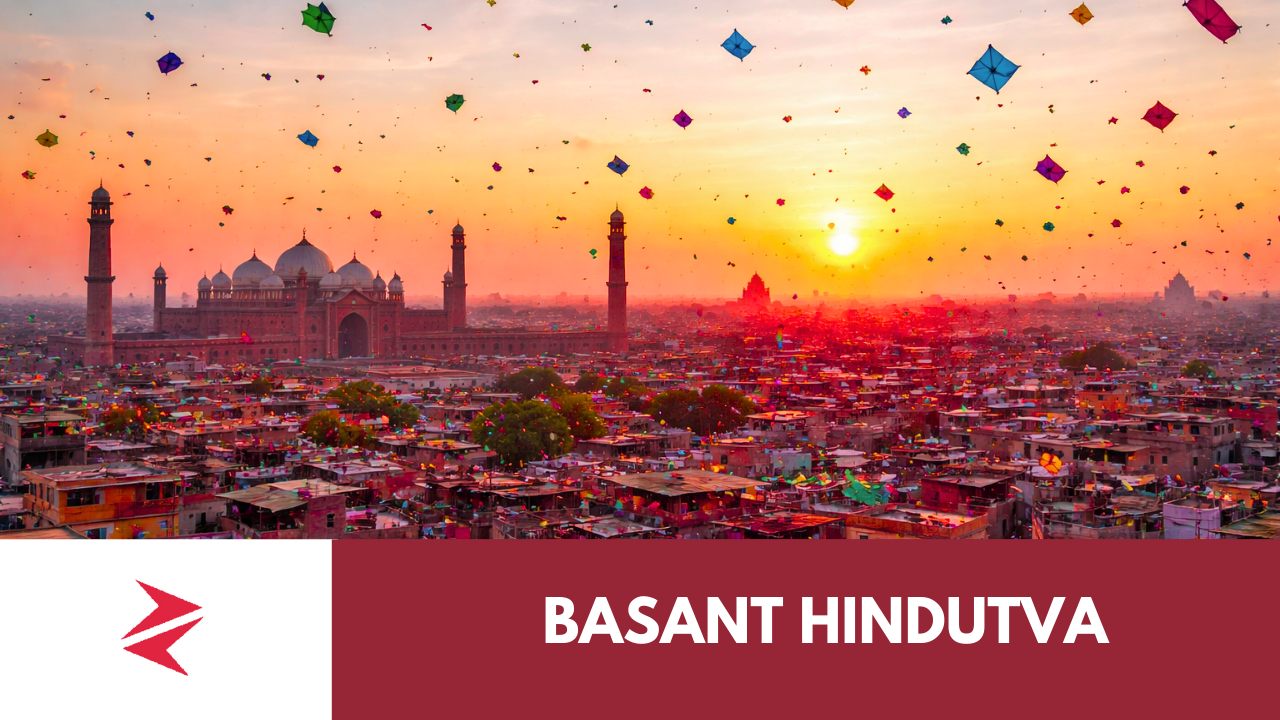
If Basant Were “Hindu”, India Would Own the Spectacle
One question none of the critics answer convincingly:
If Basant is inherently Hindu, why is its most visible, most fervent, most chaotic celebration not in India today?
India celebrates Basant Panchami—a religious day tied to Saraswati worship—quietly, ritually, and indoors. Kite flying at scale there aligns instead with Makar Sankranti in January, not Basant in February.
Lahore’s skies, by contrast, become saturated. Entire neighbourhoods reorganise life around rooftops. Markets pivot. Music changes. Colour dominates public space.
This is not ritual continuity.
This is local cultural evolution.
Pakistan’s Media Isolation Actually Strengthens the Case
Another inconvenient fact for the “appropriation” argument: Pakistan’s cultural pipeline with India has been systematically severed.
Indian cable TV was banned. Bollywood music disappeared from radio. Cinema imports were blocked. Entire generations grew up without daily Indian media reinforcement.
Yet Basant persisted in memory, resurfaced in households, and returned immediately once the ban eased.
That is not mimicry. That is cultural muscle memory.
Pakistan did not re-learn Basant from Indian television. It remembered it.
Digitised Basant and the State’s Silent Admission
A telling development in recent years has been the digitisation and securitisation of Basant.

Ticketed rooftops. Drone monitoring. Safety corridors. Municipal oversight.
Most revealing of all: its quiet adoption inside military-administered garrisons and controlled zones—spaces that are ideologically central to the Two-Nation Theory and institutionally hostile to “un-Islamic” expression.
Institutions do not do this accidentally.
The acceptance of Basant within cantonments is not cultural confusion; it is tacit recognition that this practice does not threaten ideological boundaries. It belongs to the land, not to theology.