






































This becomes especially important when discussing additional charges on electricity bills or airline tickets.
An environmental charge cannot be evaluated solely by its stated purpose. Its distributional consequences, use of revenue and actual emissions impact must also be examined.
For Pakistani households already managing substantial energy expenses, these questions are particularly relevant.
Carbon Credits Require Evidence, Not Marketing
A carbon credit generally represents a quantified emissions reduction or removal issued under a particular accounting framework.
However, credits can differ substantially in their environmental characteristics.
Avoiding an emission is not necessarily equivalent to removing carbon dioxide already present in the atmosphere. Likewise, storing carbon in vegetation is not necessarily equivalent to storing it in a well-characterised geological formation.
High-quality evaluation requires examining additionality, measurement uncertainty, durability, leakage, double counting and independent verification.
Additionality asks whether the environmental benefit would have occurred without the intervention. Durability concerns how long the carbon remains stored. Leakage examines whether an activity simply transfers emissions elsewhere.
These questions explain why carbon-credit prices alone cannot establish environmental quality.
They also explain why businesses purchasing credits should disclose what was purchased, what environmental outcome was measured and what uncertainties remain.
Carbon markets may help finance legitimate environmental projects, but purchasing a credit does not eliminate the need to reduce a company’s own emissions.
Climate Migration: The Human Consequence Missing From Engineering Models
Temperature projections become much more consequential when translated into livelihoods, infrastructure and population movement.
In Pakistan, flooding, extreme heat, water insecurity and agricultural disruption can contribute to temporary displacement and longer-term migration, although economic conditions, conflict, family networks and public policy also influence where people move.
The World Bank’s documentation of the 2022 floods recorded displacement affecting millions of people, demonstrating how environmental disasters can rapidly become humanitarian and development emergencies.
Preparing for climate-related mobility requires more than predicting how many people might move.
It requires investment in resilient settlements, urban infrastructure, public health, agricultural adaptation, water systems and social protection.
Climate migration should therefore be understood as a development-planning challenge rather than an inevitable, uniform movement of populations across international borders.
This is particularly relevant for South Asia, where climate hazards frequently interact with population density, infrastructure constraints and uneven economic development.
What Should Pakistan’s Energy and Climate Strategy Actually Measure?
The central engineering principle is straightforward: every intervention should be evaluated against a clearly defined outcome.
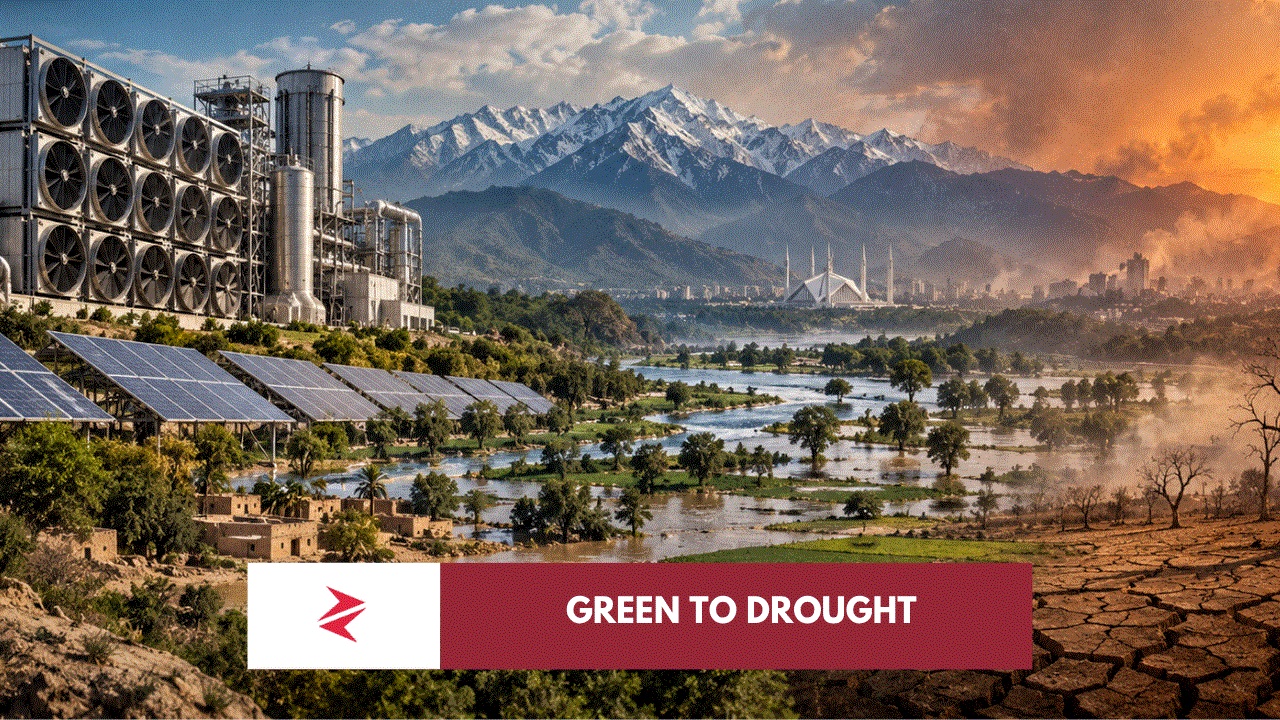
A solar installation should be assessed through its actual electricity production, reliability, lifecycle emissions and financial performance.
A forest-restoration project should be evaluated through ecological suitability, additional carbon storage, biodiversity, water implications and long-term management.
An industrial carbon-removal facility should demonstrate independently verified net removal after accounting for energy consumption, materials, transportation, storage and potential leakage.
An adaptation project should establish which risks it reduces and which communities benefit.
For Pakistan, the strongest analytical framework is one that evaluates these interventions together rather than treating them as competing symbols of environmental progress.
The country’s energy transition also presents an opportunity to strengthen domestic technical expertise, improve industrial competitiveness and reduce exposure to imported energy costs, although the actual benefits depend on system design, financing and electricity-market conditions.
Further discussion of Pakistan’s economic and energy challenges is available through the Economy and Markets section of Zorays Khalid, alongside the broader editorial analysis published on Zorays Khalid.
For businesses considering renewable-energy investments, the immediate opportunity is to commission a technically sound energy assessment rather than assuming that every renewable-energy project automatically delivers the same environmental or financial return.
Frequently Asked Questions
Has the world already exceeded the 1.5°C climate target?
Individual years can exceed 1.5°C without establishing that the Paris Agreement’s long-term temperature threshold has permanently been crossed. The relevant distinction concerns sustained, multi-decadal warming. UNEP’s September 2026 assessment indicates that temporarily exceeding the threshold is now widely assessed as unavoidable under current and plausible near-term trajectories.
Can direct air capture reverse global warming?
Removing carbon dioxide can contribute to reducing atmospheric concentrations and, if net global emissions become sufficiently negative, eventually help lower global temperatures. However, the amount removed, the permanence of storage and the response of the climate system determine the outcome. Some consequences of warming can persist for decades or centuries.
Are forests more effective than industrial carbon-removal systems?
The comparison depends on the intended outcome, local conditions, storage duration, cost and environmental effects. Protecting forests can avoid emissions while preserving biodiversity and other ecosystem services. Certain industrial approaches may provide more durable carbon storage, but currently face substantial cost and deployment constraints.
Why is carbon removal particularly relevant to renewable energy?
Some industrial removal technologies require considerable quantities of electricity and heat. Their net environmental benefits therefore depend partly on the emissions associated with their energy supply. Additional low-carbon generation can help address this requirement, but its opportunity cost must be assessed.
Should Pakistan invest in carbon removal?
Any proposed investment should be assessed against Pakistan’s available resources, electricity requirements, emissions-reduction opportunities, climate-adaptation needs and the project’s demonstrated environmental performance. Carbon-removal research and international cooperation can be examined alongside these priorities rather than treated as replacements for them.
The Real Climate Question Is Bigger Than Carbon Removal
The international discussion frequently presents climate action as a choice between technological innovation and environmental restoration.
That framing misses the underlying problem.
The atmosphere responds to cumulative greenhouse gas emissions and removals, not to the sophistication of a particular technology or the attractiveness of its marketing.
A world that rapidly reduces emissions will require less subsequent carbon removal than one that continues emitting heavily while anticipating a technological solution decades later.
Meanwhile, countries already experiencing severe climate-related economic disruption must prepare for hazards that cannot be eliminated through mitigation alone.
Pakistan’s experience illustrates why the international climate conversation must connect atmospheric science with energy engineering, environmental economics and the financial realities of vulnerable societies.
The question is no longer simply whether humanity can build machines capable of removing carbon dioxide.
It is whether governments, industries and financial institutions can demonstrate that their investments are reducing emissions, delivering verifiable removal, protecting existing ecosystems and strengthening resilience at a pace consistent with the risks identified by climate science.
Before paying to remove another tonne of carbon dioxide from the atmosphere, we should be able to explain why that tonne was emitted, whether its release could have been prevented and who ultimately bears the cost.
That is the accounting challenge at the heart of the climate transition.
External Links & References
- UNEP: Limiting Overshoot, September 2026
- UNEP: Emissions Gap Report 2025
- Climate Interactive: En-ROADS Simulator
- Climate Interactive: C-ROADS Simulator
- Oxford University: State of Carbon Dioxide Removal
- IEA: Direct Air Capture Assessment
- IPCC: Carbon Dioxide Removal and Mitigation
- IPCC: Agriculture, Forestry and Other Land Uses
- World Bank: Pakistan’s 2022 Flood Damage Assessment
- Zorays Solar Pakistan
- Solar Trade Hub
- Zorays Khalid: Economy and Markets