








































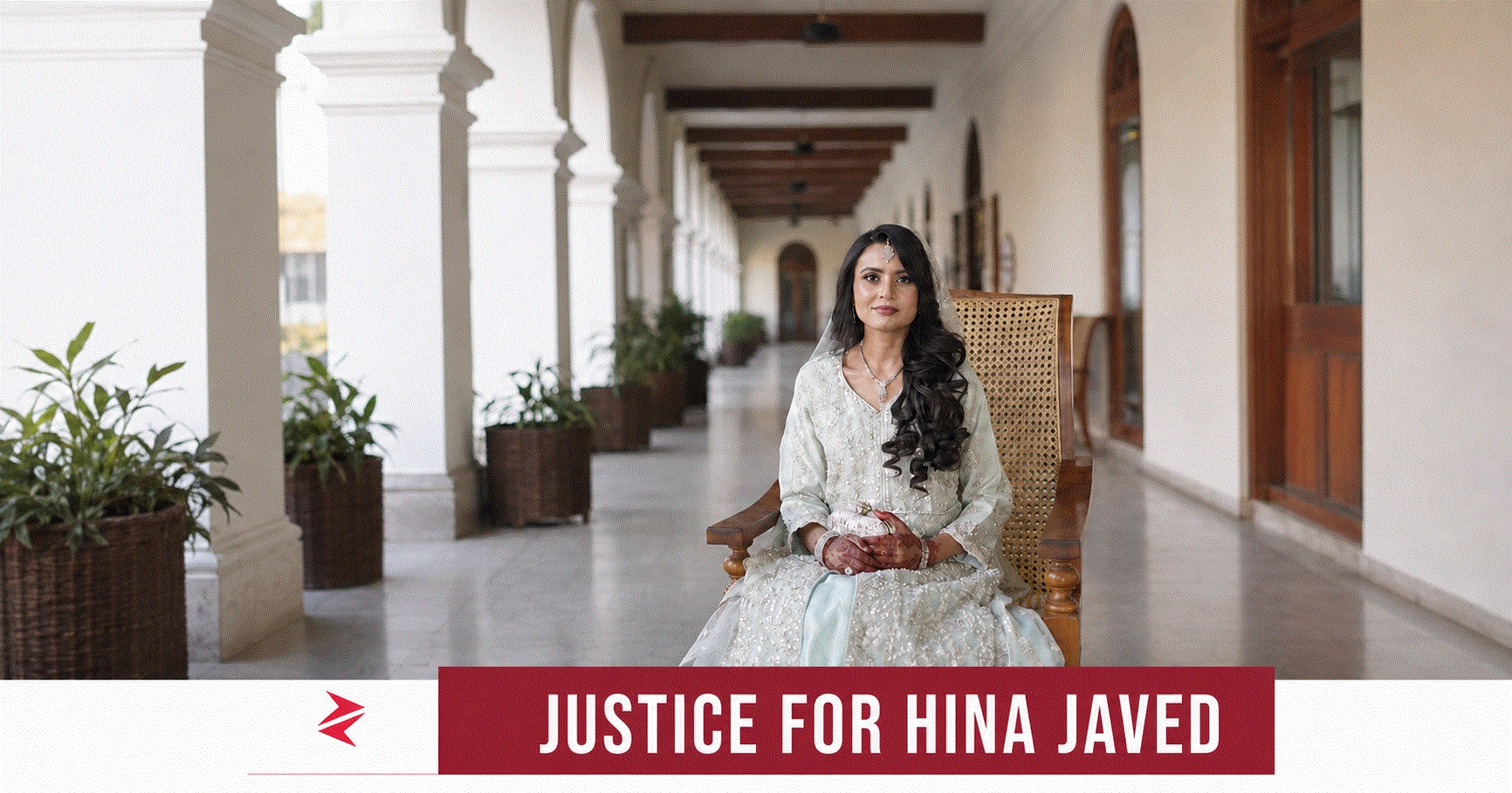
Share the post "Justice for Hina Javed: A Home Became a Crime Scene While Pakistan Told Women to “Adjust”"
| Question | Verified position as of August 23, 2026 | Evidentiary boundary |
|---|---|---|
| Was a murder case registered? | Yes, under PPC Sections 302 and 34 | An FIR initiates an investigation; it is not a conviction |
| Who has been taken into custody? | Hina’s husband and a domestic worker | Reports differ on when custody became a formally recorded arrest |
| Has the father-in-law been arrested? | No public confirmation of an arrest was found | The family alleges complicity; police say any action must follow evidence |
| Are forensic findings complete? | Police were awaiting post-mortem, DNA and other forensic results | Social-media claims about motive or confession remain unproven |
| Is the husband’s NUST history established? | Multiple reports describe him as a former academic | No authoritative NUST statement confirming his employment, dismissal or alleged misconduct was located |
| Has anyone been found guilty? | No | Guilt can only be determined through a lawful trial |
The family’s statement dated August 21 expresses faith in Pakistan’s courts while demanding that every possible role be investigated without influence or delay. Its most important sentence should become institutional policy: “Violence against women in our homes is not a private matter. It is a crime, and it must be treated as one.”
The Women’s Parliamentary Caucus has also demanded a transparent and complete investigation, while First Lady Aseefa Bhutto Zardari called upon Punjab to ensure a thorough inquiry, according to the Associated Press of Pakistan. These interventions will mean nothing, however, if public statements are not followed by protected evidence, competent prosecution and regular scrutiny after the hashtag stops trending.
What Hina’s Death Actually Means
Hina Javed’s case is being discussed as a shocking exception, but Pakistan’s numbers describe a system, not an exception. Sahil’s media-monitoring report recorded 3,172 cases of gender-based violence during the first six months of 2026. The organisation counted 644 murders, 514 cases of torture, 462 abductions, 363 suicides, 280 rapes and 132 honour killings. Punjab accounted for 74 percent of the reports, while 54 percent of the recorded incidents occurred inside victims’ own homes, according to Dawn’s account of the report.
| Reported category, January–June 2026 | Cases |
|---|---|
| Murders | 644 |
| Torture | 514 |
| Abductions | 462 |
| Suicides | 363 |
| Rapes | 280 |
| Honour killings | 132 |
| Other recorded crimes | 777 |
| Total reported cases | 3,172 |
These figures are based upon cases found in newspapers, which means they measure reported visibility rather than the full prevalence of violence. They almost certainly do not capture every woman who stayed silent, every family that concealed an assault, every police desk that discouraged a complaint or every threat that was dismissed as a “ghar ka masla.”
The longer-term evidence is equally grim. UNFPA Pakistan, citing the 2017–18 Pakistan Demographic and Health Survey, reports that 34 percent of ever-married women experienced spousal physical, sexual or emotional violence, while 56 percent of women who experienced physical or sexual violence neither sought help nor spoke to anyone. Silence, therefore, is not evidence of safety. It is frequently evidence of fear, economic dependence, shame, coercive control or a woman calculating whether disclosure will save her or simply expose her to greater danger.
A cousin told BBC News Urdu that Hina helped support her elderly parents and would change the subject when relatives asked whether she was happy after marriage. That family account cannot explain everything she experienced, but it demolishes the lazy assumption that an abused woman who does not explicitly ask for rescue must therefore be safe.