




















| Category | Weight |
|---|---|
| Income & Employment | 25% |
| Education | 20% |
| Healthcare | 20% |
| Infrastructure & Utilities | 15% |
| Safety & Governance | 10% |
| Environment & Air Quality | 10% |
Under such a framework, Islamabad would likely remain near the top.
Rawalpindi, Lahore and parts of Karachi would remain highly competitive.
Sialkot would continue to overperform.
Some cities currently celebrated in online discussions might fall sharply once healthcare, governance and environmental indicators are included.
The Bottom Line
The viral ranking is not entirely unbelievable.
Neither is it rigorous enough to be treated as fact.
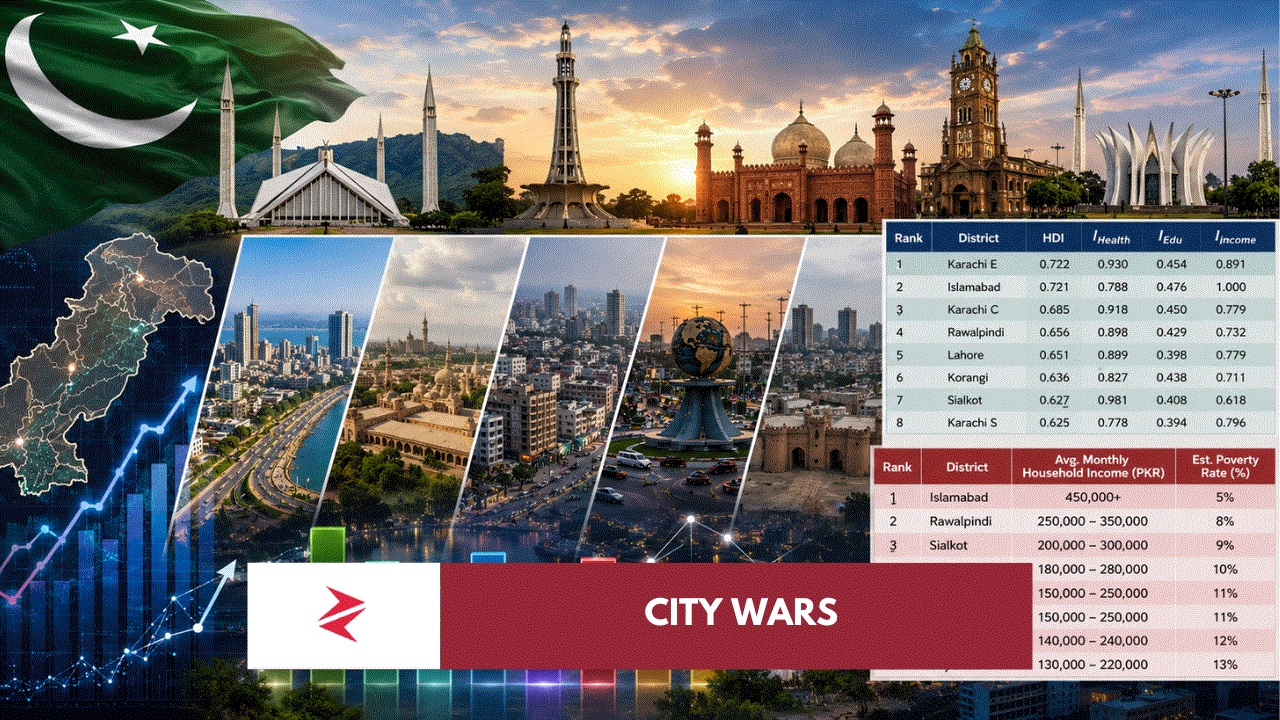
The HDI data supports strong performances by Islamabad, Rawalpindi, Lahore and parts of Karachi. Income data supports Sialkot’s rise. Public frustration explains Karachi’s poor perception despite its economic importance.
The real takeaway is not that one city defeated another.
The real takeaway is that Pakistan’s development story remains deeply uneven, with a handful of urban centers pulling far ahead while many districts continue to struggle with poverty, weak infrastructure and limited opportunity.
That is the conversation worth having.

