












































The Sialkot Question
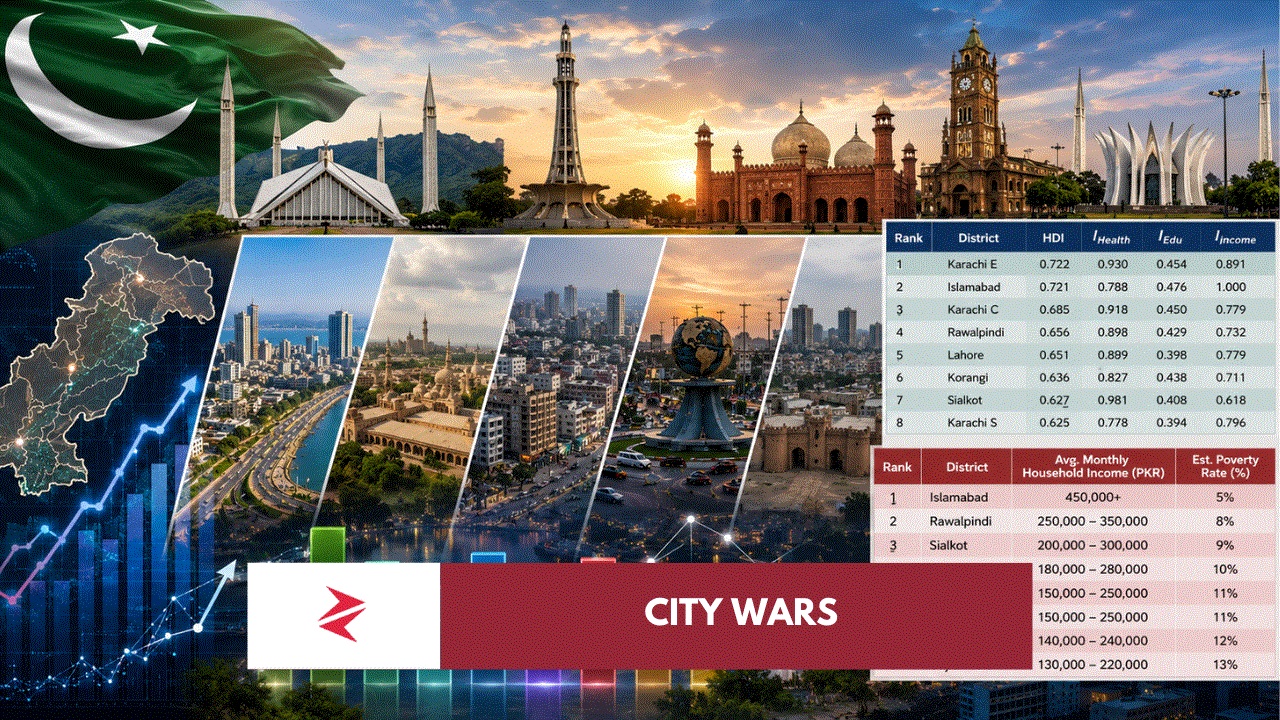
Sialkot is another city that repeatedly appears near the top in both income and quality-of-life discussions.
The household-income graphic included in the debate ranks Sialkot among Pakistan’s richest districts with estimated monthly household income between PKR 200,000 and 300,000.
That is not surprising.
Sialkot’s export-driven economy, entrepreneurship culture, sporting goods industry, surgical manufacturing base and high overseas remittances create income levels that outperform many larger cities.
This does not automatically make it Pakistan’s best city.
It does explain why it consistently punches above its weight.
What Nobody Is Telling You
The strongest pattern visible across all datasets is not city rivalry.
It is provincial divergence.
The income graphic shows:
| Area | Estimated Poverty Rate |
|---|---|
| Punjab | 24% |
| Khyber Pakhtunkhwa | 32% |
| Sindh | 46% |
| Balochistan | 53% |
Similarly, many of Pakistan’s richest districts cluster around Punjab and Islamabad, while many of the poorest districts appear in Balochistan and interior Sindh.

That does not mean every Punjabi city is wonderful.
It means economic activity, industrial concentration, infrastructure investment and state capacity remain heavily concentrated in certain regions.
The real story is regional inequality.
Why “Public Surveys” Are Not Enough
A credible standard-of-living ranking should publish:
- Methodology
- Sample size
- Margin of error
- Weighting criteria
- Geographic coverage
- Data sources
Without these, a ranking becomes little more than a conversation starter.
A resident of Abbottabad values clean air.
A resident of Karachi values economic opportunity.
A resident of Islamabad values security and public services.
A resident of Sialkot values entrepreneurship and income.
Which factor matters most?
The answer changes the rankings entirely.
What A Real Ranking Would Measure
A robust Pakistan city index would include:













