










































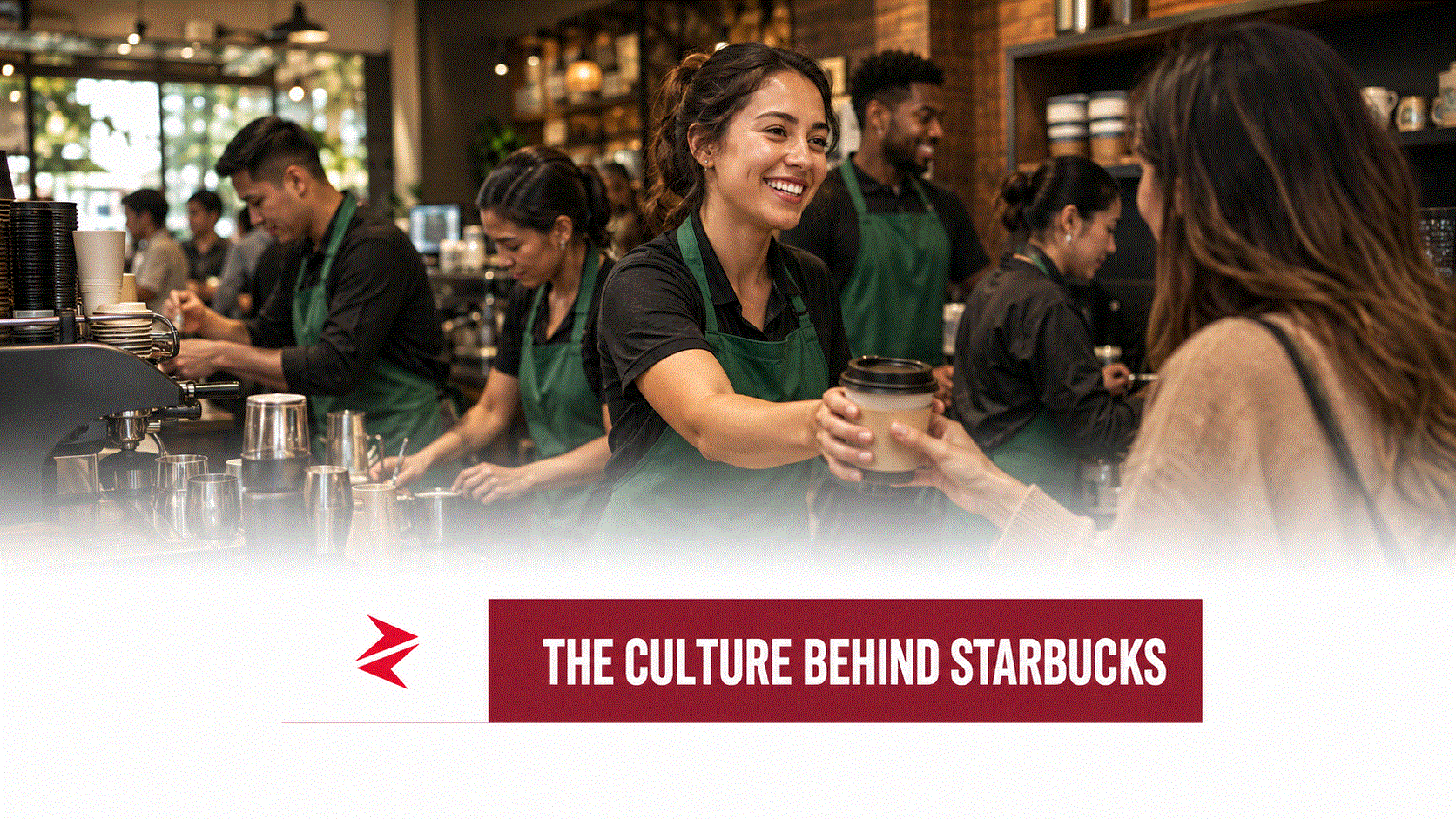
Starbucks does not command premium prices merely because it knows how to make coffee. Millions of cafés can grind beans, steam milk and print names on cups, yet very few have converted those ordinary actions into a globally recognizable service ritual. The real product is not simply the beverage placed on the counter; it is the predictable feeling surrounding that beverage, created by employees who have been trained, rewarded and socially conditioned to reproduce a particular experience thousands of times a day.
That is the uncomfortable truth behind most celebrated brands: what customers call “brand magic” is usually disciplined organizational behavior operating behind the curtain. The music, familiar vocabulary, green apron, personalized cup and welcoming atmosphere matter, but they work because Starbucks has spent decades translating an abstract corporate identity into routines that employees can perform under pressure.
The central claim is straightforward: Starbucks’ corporate culture is a strategic operating system that converts company values into employee behavior, customer experience and commercial performance.
What Corporate Culture Actually Means
Corporate culture is often reduced to office décor, motivational slogans, annual retreats or polished declarations written by consultants. Wrong. Culture is the collection of behaviors an organization repeatedly rewards, tolerates, corrects or ignores until employees understand how the workplace really functions.
A company’s official values may describe what leadership wants people to believe, but its daily decisions reveal what the organization genuinely values. If management praises collaboration while promoting only aggressive individual performers, competition becomes the culture. If leaders promise psychological safety but punish disagreement, silence becomes the culture. If customer care is advertised while employees are given insufficient time, training or authority to solve customer problems, indifference eventually becomes the culture.
The simplest definition is therefore the most useful: culture is what a company keeps making normal.
Culture is built through several mutually reinforcing forces:
| Cultural mechanism | What employees learn from it | Starbucks application |
|---|---|---|
| Repeated behaviour | “This is how work is done here” | Consistent drink preparation, customer acknowledgement and coordinated service |
| Rewards | “This behaviour receives recognition” | Bean Stock, internal advancement, team recognition and performance incentives |
| Correction or neglect | “This is unacceptable—or apparently tolerated” | Coaching, operating standards and responses to service failures |
| Leadership behaviour | “This is what management truly prioritises” | Coffeehouse-first leadership and visible emphasis on partners and customers |
| Shared stories and symbols | “This is who we believe we are” | Green aprons, the “partner” identity and stories of customer connection |
| Workplace systems | “The environment makes this behaviour easier” | Training, staffing, store layouts, queues, equipment and supporting technology |
This framework matters because culture does not exist independently of operations. Scheduling is culture. Staffing is culture. Promotion criteria are culture. The reaction to a mistake is culture. Technology imposed without consulting frontline workers is also culture, regardless of what appears in the employee handbook.
Why Starbucks Calls Employees “Partners”
One of Starbucks’ most recognisable cultural decisions is its practice of calling employees “partners.” The language is not entirely symbolic: eligible employees can receive equity through the company’s Bean Stock programme, giving the term an economic basis rather than leaving it as empty corporate theatre.
Starbucks says more than 1.5 million full- and part-time partners have received equity since Bean Stock began in 1991, with grants estimated at approximately $2.5 billion. The company currently reports approximately 361,000 partners worldwide. It also says US hourly retail partners earn more than $19 an hour on average, while the combined value of pay and benefits averages approximately $30 an hour. These are Starbucks’ reported figures and should be understood as company disclosures, but they reveal the intended architecture: employees are expected to deliver ownership-level care because the organization attempts to give them a tangible stake in its performance. Starbucks partner information

Calling employees partners cannot, by itself, create belonging. The word acquires meaning only when workers experience fair scheduling, credible advancement, useful training, respectful supervision and genuine access to benefits. This is where many businesses copy the vocabulary of admired companies while refusing to finance the systems that make the vocabulary believable.
Starbucks reports that it has invested more than $3 billion since 2022 in wages, benefits and the partner-and-store experience. Under its current programme, the company has also committed $500 million toward additional labour hours and expanded rosters during busy shifts, while targeting 90% internal hiring for North American retail leadership positions. Whether every store and every employee experiences these commitments equally remains an empirical question, but the strategy itself acknowledges something important: customer connection cannot be sustainably demanded from exhausted, unsupported or disengaged workers.
The Starbucks Experience Is Produced from the Inside Out
A customer never encounters “corporate culture” as a management concept. The customer encounters it through a greeting, the accuracy of an order, the tone used to resolve a complaint, the cleanliness of a table and the willingness of one employee to help another when orders begin accumulating.
The mechanism can be expressed clearly:
Company signals → employee interpretation → repeated behaviour → customer experience → brand memory → repeat business
This chain explains why culture represents more than friendliness. Starbucks requires coordination, craft, speed, warmth, judgement and emotional control to coexist inside a busy store. A rigid script may tell a barista what to say, but it cannot anticipate every impatient customer, malfunctioning machine, complicated mobile order or overwhelmed colleague. Culture guides employees when the script runs out.
Starbucks currently defines its values as craft, courage, results, belonging and joy. Under “belonging,” for example, the company says employees should listen and connect with warmth, recognise individuals and treat others with dignity and care. Under “results,” it expects focused performance, innovation and service that exceeds expectations. Starbucks mission and values
These values contain a deliberate tension. Belonging without accountability can deteriorate into comfortable underperformance, while results without dignity can create fear and burnout. A strong culture does not choose one side and print it on a wall; it constructs routines in which performance and humanity reinforce one another.
What Nobody Tells You About Culture
Culture is frequently presented as the soft, pleasant side of management. In reality, it is a control system.
Every reward increases the probability that a behaviour will recur. Every ignored violation quietly rewrites the standard. Every leader who behaves differently from the stated values teaches employees that the values are optional. Culture is therefore not soft at all; it determines who receives authority, which decisions are safe, how pressure is distributed and whether frontline reality reaches senior management.
Starbucks’ history also shows that culture is not a permanent possession. A company can build a powerful identity and still dilute it through excessive complexity, understaffing, rushed service, managerial inconsistency or technology that distances employees from customers. Scale creates efficiency, but it can also turn human connection into a production target.
That tension helps explain the present Back to Starbucks transformation. Under chairman and CEO Brian Niccol, the company is emphasising coffeehouse comfort, menu discipline, service speed and the relationship between baristas and customers. Starbucks said in January 2026 that its Green Apron Service model had been fully introduced across company-operated North American coffeehouses, improving throughput, service times and customer satisfaction. The company also plans to add more than 25,000 café seats across the United States by the end of fiscal 2026. Starbucks 2026 Investor Day
This is not merely a redesign exercise. It is an attempt to repair the physical and operational conditions under which the company’s culture must function. Asking employees to create connection while stores are optimised only for transaction volume is contradictory. Starbucks appears to recognise that a coffeehouse culture requires actual coffeehouse space, sufficient labour and systems that allow employees to look up from the queue.
Culture Has Become a Measurable Commercial Asset
Starbucks’ loyalty infrastructure demonstrates how cultural experience becomes revenue. The company said Starbucks Rewards generated nearly 60% of US company-operated revenue in fiscal 2025. Its reimagined programme launched in March 2026 with Green, Gold and Reserve tiers, personalised benefits and faster reward accumulation for higher-spending members.













