

































“But He Was Elite”—Yes. That Is Precisely Why His Case Is Worth Studying
There is a strange habit in Pakistani discourse where privilege is treated either as proof of greatness or proof of guilt.
Neither is intelligent.
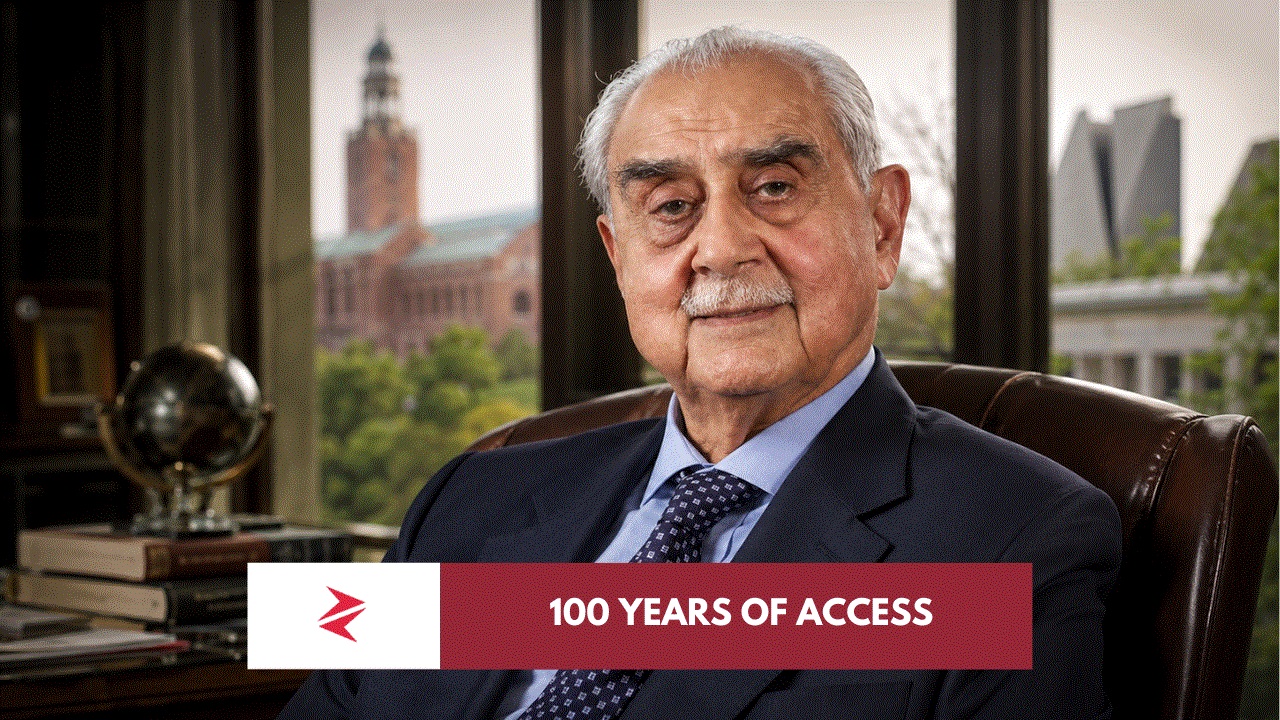
Syed Babar Ali was privileged. Jugnu Mohsin, who has conducted extensive conversations with him, also comes from a socially connected background and therefore speaks with him from a degree of familiarity unavailable to a random television interviewer. That insider access can produce unusually candid historical conversations. The long-form interview tradition matters because a century-old life contains memories of pre-Partition Lahore, Aitchison, business families, bureaucrats, politicians and people on both sides of the 1947 border that simply cannot be reconstructed from corporate brochures alone. The interview series itself publicly covers his early education at Aitchison, travels and later life experiences.
But elite origin should not end the discussion. It should begin a more serious one.
What did the elite person build?
Did the wealth leave behind factories or only foreign property?
Did influence create scholarship pipelines or only family appointments?
Did connections produce companies that trained thousands of Pakistanis or simply produce another generation of dependants?
Did the institution survive professional management?
These are harder questions than “rich man good” or “rich man bad.”

By that standard, Syed Babar Ali’s record is formidable.
The Nestlé Criticism Also Deserves Better Than Social-Media Guilt by Association
Another recurring criticism links Syed Babar Ali to complaints surrounding Nestlé Pakistan, particularly allegations about groundwater extraction and its effects on surrounding communities.
Corporate conduct absolutely deserves investigation. Water is not an ordinary commodity when local communities are affected, and no multinational should be protected from evidence-based scrutiny because its board contains respected names.
But a social-media accusation is not a completed causal investigation.
To claim that a specific company’s groundwater extraction caused specific children to contract specific diseases requires evidence connecting location, extraction volumes, aquifer effects, access to alternative water, contamination pathways and health outcomes. Without that chain, one may have a serious allegation worthy of investigation, but not yet an established fact.
The same standard should apply to everybody. Respectability must not provide immunity. Anger must not replace evidence.
That is what EEAT actually means when removed from SEO jargon: experience without evidence becomes anecdote; expertise without disclosure becomes authority theatre; trust is created by distinguishing what we know from what we merely suspect.
What Nobody Is Telling You: Pakistan Does Not Primarily Lack Talent. It Lacks Institutional Continuity
This is the real reason the Syed Babar Ali story matters in 2026.
Pakistan repeatedly produces brilliant individuals. Then the individual retires, dies, is transferred, removed, exiled or politically defeated—and the entire structure collapses because it was never an institution. It was one man with a telephone.
Syed Babar Ali’s most important contribution may therefore be architectural rather than personal.
Packages became bigger than one individual.
LUMS became bigger than its founder.
Systems Limited became a major technology institution led by professional executives and shaped substantially by Aezaz Hussain’s own extraordinary leadership.
Educational initiatives continued through organisations rather than depending entirely on birthday speeches.
Even his short period in government followed a different pattern. His autobiography records that he joined the 1993 caretaker government of Moeen Qureshi as Minister for Finance, Economic Affairs and Planning after initially resisting the request, while continuing to view his educational and environmental commitments as central responsibilities.
This is what Pakistan desperately needs to relearn: the objective of leadership is not to make yourself indispensable. It is to build something that remains functional when you are absent.
That is also why the article on turning failure into success through reflection, correction and repeatable processes connects naturally to this story. Individuals have good years and bad years. Institutions survive because they learn.
Was Syed Babar Ali Perfect? That Is the Wrong Question
No serious centenary assessment should become a devotional poster.
Every large industrial career should be open to scrutiny over labour, market power, environmental impact, governance and proximity to political authority. Every elite university should be challenged over affordability, ideological bubbles and its relationship with the society outside its walls. Every business family should be examined for whether professionalisation truly survives generational succession.
But the standard cannot be that a public figure must be flawless before his achievements can be recognised.
Syed Babar Ali’s value to Pakistan is not that everyone must agree with him. It is that his life provides a century-long case study of how industrial capital can migrate into educational capital, how professional networks can become institutional networks and how a businessman can achieve greater social reach through organisations than many politicians achieve through decades of speeches.
In 2022, LUMS highlighted his induction into the American Academy of Arts and Sciences in the category of Business, Corporate and Philanthropic Leadership, while also identifying him as a former President of the World Wildlife Fund. That international recognition is significant, but it is still not the strongest argument for his legacy.
The strongest argument is visible inside Pakistan.
A factory exists.
A university exists.
A technology sector was helped in its earliest institutional era.
Scholarship programmes exist.
Schools and educational organisations exist.
And debates about the institutions he helped create are still intense enough to make people angry.
Dead institutions do not produce arguments.
Influential ones do.
Frequently Asked Questions
Did Syed Babar Ali found Systems Limited?
The most accurate answer requires nuance. Systems Limited’s current corporate biography credits Aezaz Hussain with founding the company in 1977, while the company’s 2022 annual report used language referring to Syed Babar Ali and Aezaz Hussain as founders in its historical retrospective. It is therefore safer to describe Syed Babar Ali as part of Systems Limited’s early founding story while recognising Aezaz Hussain as the company’s principal operational founder.
Did Syed Babar Ali found LUMS?
He was the central initiating figure. LUMS records that in 1983 he proposed establishing a world-class university to address Pakistan’s shortage of qualified managers, with Abdul Razak Dawood supporting the vision. The National Management Foundation followed, and LUMS received its charter in 1985.