





























Share the post "Yemen’s Khat Debate Is Bigger Than a Viral Cheek"
| Claim circulating in the discussion | What can responsibly be said |
|---|---|
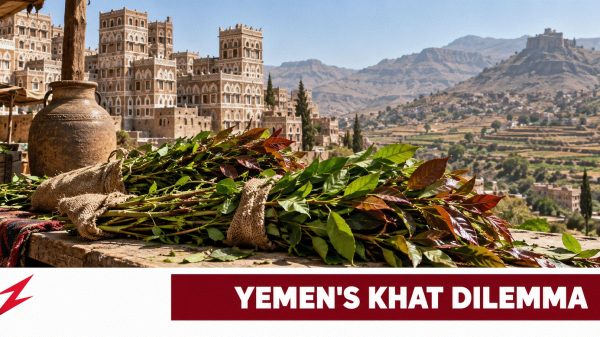
| “Yemeni households spend 49% of their budgets on khat.” | The supplied chart gives no identifiable survey or method. It should not be presented as a national fact. The World Bank’s 2006 survey-based estimate was around 10%, a different figure from a different period. |
| “This is a Houthi habit.” | The footage does not establish anyone’s affiliation. Qat chewing was widespread well before the current conflict, as the 2006 survey demonstrates. |
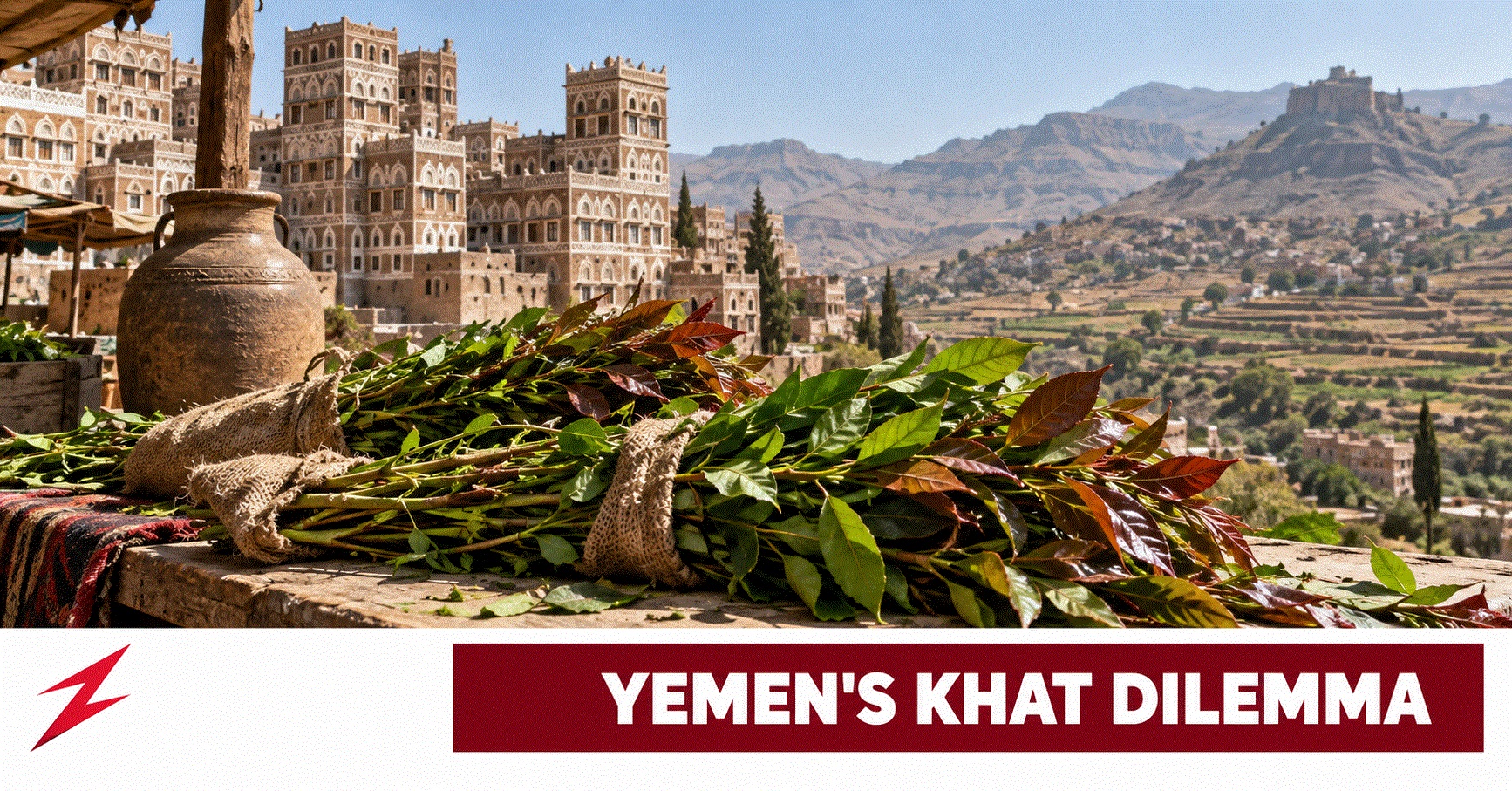
| “Destroy the qat farms and the problem disappears.” | The crop also supported livelihoods. Removing it without viable alternatives would shift the cost onto farming households. |
| “It is just a leaf.” | Khat contains cathinone, a psychoactive stimulant. Its social familiarity does not make its effects imaginary. |
Source note: The economic figures describe conditions measured for the World Bank’s 2006 survey. The viral chart and the identities of people in the footage have not been independently verified.
Water makes the question more urgent
The argument becomes sharper when a country short of safe water must decide how to use its land and irrigation. The World Bank reported in 2024 that 18 million Yemenis lacked access to clean water and sanitation, attributing the crisis in part to years of conflict and the collapse of essential services. Qat cultivation belongs in a serious discussion about agricultural water use, but the crisis cannot honestly be laid at the feet of one crop or the people shown chewing it. War damage, failed infrastructure and the wider economy matter too.
One reaction to the khat footage says, in effect, naswar does not look so bad now. That is where the viral comparison turns dangerous. A more dramatic photograph cannot reduce a familiar product’s documented risk. In a 2024 IARC report on oral cancer attributable to smokeless tobacco and areca nut, researchers estimated that naswar accounted for 52% of oral cancer cases among men and 21% among women in Pakistan in the study’s analysis. These are population-level attributable estimates, subject to the study’s methods and available data; they are not a prediction that any individual user will develop cancer. They are still far too serious to wave away with a joke about somebody else’s cheek.
Paan needs the same ingredient-by-ingredient honesty. A betel leaf is not a complete risk assessment. If the quid contains areca nut, the absence of tobacco does not make it harmless: IARC identifies areca nut and tobacco-free betel quid as human carcinogens. If it also contains tobacco, the concern grows. Pakistan cannot discuss Yemen’s chewing culture as though our own mouths are outside the story.
This is what a clip of one swollen cheek cannot show: a farmer deciding which crop will earn enough to support a family; a buyer making choices from a strained household budget; and communities needing dependable water services. A policy that ignores any one of those people may sound forceful online while failing in practice.