

































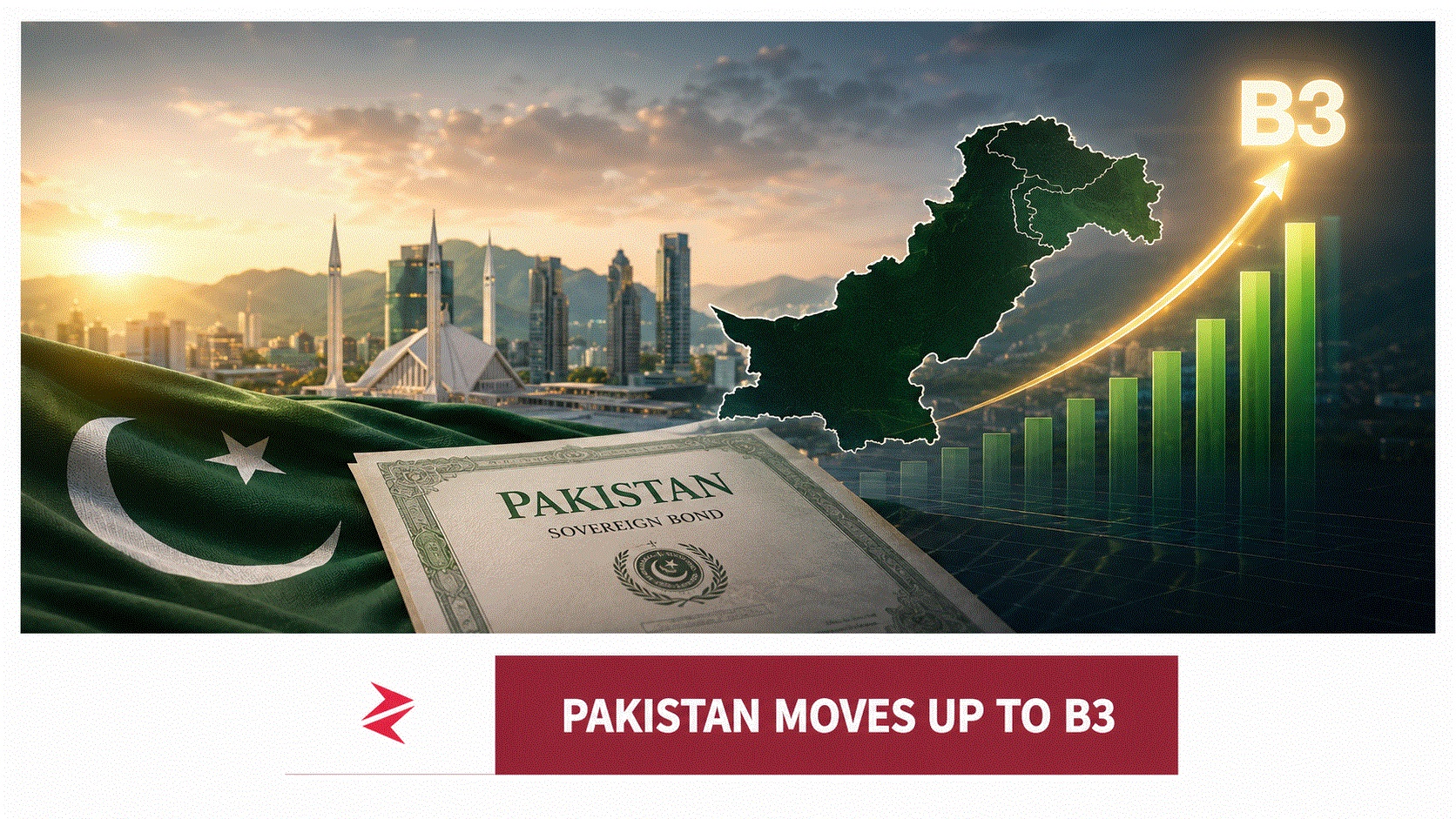
Share the post “Moody’s Upgrades Pakistan to B3: No, This Is Not a Certificate of “Good Governance””
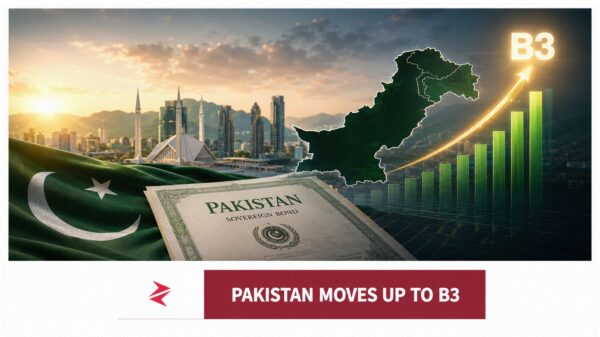
The Most Important Number Is Not B3—it Is 35%
The most consequential figure in Moody’s assessment may be the fall in interest payments from approximately 49% of government revenue in FY2025 to 35% in FY2026. That is a dramatic improvement, produced largely by disinflation and lower domestic interest rates, yet it remains an appallingly heavy claim on the state’s income.
When 35 rupees out of every 100 rupees of government revenue are still absorbed by interest, Pakistan possesses only limited space for education, healthcare, infrastructure, climate resilience and targeted relief. Moody’s therefore describes debt affordability as improved but still weak. Business Recorder
This is precisely why the upgrade deserves recognition without a victory parade. Pakistan has escaped the most suffocating corner of the room, but it has not left the room. Earlier domestic debt retirement and maturity management can reduce refinancing pressure, as explained in this analysis of Pakistan’s early repayment of Rs3.65 trillion in domestic debt, but sustained relief will require a broader tax base, lower fiscal leakage, productive investment and economic growth that is not purchased through another import boom.
What the Foreign Trolls—and Some Pakistani Partisans—Are Missing
Calling a Bloomberg report an “ISI-written column” does not challenge the underlying evidence; it merely advertises that the critic has confused a rating action issued by Moody’s with the journalist who reported it. Bloomberg did not invent the B3 rating, SBP did not invent S&P’s separate upgrade to B, and Pakistan did not receive Fitch’s B− affirmation through an anonymous social-media account. Bloomberg, S&P Global Ratings, Fitch Ratings
Three separate agencies have placed Pakistan within the single-B speculative range, although S&P’s B is one notch above Fitch’s B− and broadly above the risk position represented by Moody’s B3. The convergence does not prove that every agency is infallible, but alleging a geopolitical gift requires evidence stronger than national prejudice and recycled insults about Pakistan.
Likewise, comparing the nominal exchange rate of the Afghan currency with the Pakistani rupee proves almost nothing about the relative health of the two economies. Currency units are arbitrary denominations; governments can redenominate them, restrict supply or maintain them in shallow markets. Economic strength is assessed through production, exports, reserves, fiscal capacity, financial depth, income and institutional resilience—not by asking whether one nominal currency unit purchases more dollars than another.
Will the Upgrade Make Imports and Loans Cheaper?
Potentially, but neither automatically nor immediately. A better sovereign rating can reduce the risk premium demanded by some foreign investors, improve the pricing environment for future Eurobonds and sukuk, and help banks negotiate correspondent limits or letter-of-credit confirmation charges. Pakistan had already returned gradually to external markets through a $750 million three-year Eurobond in April 2026 and a CNY1.75 billion Panda bond in May, developments Moody’s incorporated into its assessment. Business Recorder
The effect on ordinary imports is indirect. Moody’s cannot reduce the international price of oil, solar modules, batteries or industrial machinery. Any benefit must travel through lower sovereign spreads, improved bank counterparty limits, a steadier rupee and cheaper trade finance. Businesses should therefore ask their banks to reprice risk and LC charges instead of assuming that yesterday’s premium remains untouchable.
For Pakistan’s solar and storage market, the same discipline applies: a stronger sovereign profile may gradually improve financing conditions, but project economics still depend on exchange rates, duties, electricity tariffs, self-consumption and the quality of equipment. Industrial users planning solar or BESS investment can request a Pakistan-specific procurement and ROI assessment through Zorays Solar rather than treating a sovereign headline as a substitute for proper project modelling.
Pakistan’s remittance inflows also remain an important stabiliser, but remittances cannot permanently replace competitive exports and productive foreign investment. The deeper numbers are examined in Pakistan’s $3.6 billion monthly remittance analysis.