






























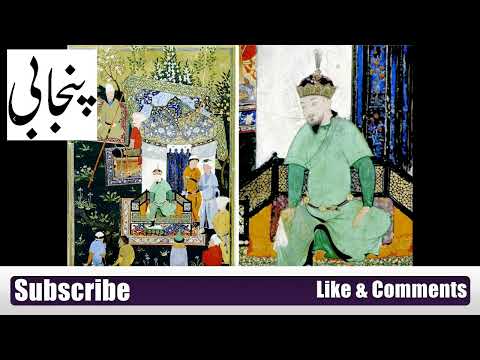
He refused to accept the legitimacy of Mughal King Akbar and refused to pay any tax. Such was the level of resistance put up by the rebels that Akbar had to shift his Imperial Capital to Lahore for nearly 20 years. When Akbar came to Lahore, he ordered the execution of the rebels. Legend has it that to instill fear into the hearts of the common man, Akbar got their SKINS STUFFED WITH HAY wheat hay (toori) and hung the dead bodies on the main door. Dulla wasn’t even born yet.
Pindi Bhattian is the place where Rai Abdullah Khan was born in 1547 in the family of Laddi and Farid Khan, whom the world now calls Dulla Bhatti. He was a Muslim Rajput of the Bhatti clan. Four months before his birth, his father Farid Khan, and his grandfather Sandal Khan were killed by the Mughals for their refusal to pay to accept Mughal suzerainty and pay taxes. The skins of both were stuffed with wheat hay and hanged outside the village of Bharwa in order to instill fear in the hearts of rebels.

After his birth, he was never told of the cause of his father’s and grandfather’s death until he was a young man. One theory has it that Dulla was born at the same time as Akbar’s son Salim (who would later become Emperor Jahangir), but Salim was a weakling and on doctors’ suggestions Akbar brought in Ladhi (Dulla’s mother and a strong Rajput woman) to his palace in Delhi and made her breastfeed Salim. So BOTH DULLA AND SALIM were practically brought up by Ladhi. As adolescents, these two had a good friendship. Dulla and his mother move back to their homeland once Salim has grown up enough.
The story of Dulla has been poetically treated by many and has been written in the style known as Saddam (similar to Mirza by Peelu and Bhagwan Singh). The above incident is thus narrated:
Tera saandal dada maareya, ditta bhore vich paa, Mughlaan puthhiyaan khallaan laah ke bhariyaan naal hawaa.
In the Chardah (East) Punjab-now India-during the Lohri bonfires that mark the end of the deep winter and the start of spring (Capricorn Constellation-Makar appears over the horizon) all the Sikh and Hindu families mark Dulla Bhatti’s social and humanitarian contribution made to rescue and then reintegrate the abducted children and girls from the Moghul forces. The Lohri Song is sung upon the birth of a baby boy- for the agricultural community this marks the continuation of the family land occupation.
Abdullah and his family single-handedly fought the powerful Mughals for the farmers of Punjab, which is why their songs are still sung in folk tales on Lohri (Makarsankranti). Lohri of Punjab is incomplete without Dulla Bhatti. A Pakistani movie with this name was released in 1956. A play is also narrated. Also, RDB’s Dulla is attributed to Rajput Sher Baba Dulla Bhatti with the following lyrics:
Gusse ch dulley nu meroo marey ohliyan
Bai Izztaan tu roliyan
Pindi di dawaley chaldiyan goliyan
Bai Hoiyan kanda poliyan
Ap ta tu jaa ke saungiya eh naanki
Utte lai ke chadra
Mughlan ne tera sabh kujh luttiya oh wadiya bahadara
Mughlan ne tera sabh kujh luttiya oh wadiya bahadara
Mughlan ne tera sabh kujh luttiya oh wadiya bahadara
Rajput hokey pith tu wakhai ah
Oh sir khe pawayi ah
Bhattiyan di pag paira ch rulai ah
Ho sanu laj lai ah
Maa ne dudh makhna de nal paliya tenu aiwe dulliya
Kehnda si mai mughlan to launga badla oh firda si fuliya
Kehnda si mai mughlan to launga badla oh firda si fuliya
Kehnda si mai mughlan to launga badla oh firda si fuliya
Sundran wichari khari vain paundi ah
Bai dulliya balaundi ah
Bai hanju pai bahaundi ah
Bani jaande ohnu eh janjeeran ban ke
Te jeeda dudh chungiya
Beh giya kahnu hun chup kar ke oh kujh bol gungiya
Beh giya kahnu hun chup kar ke oh kujh bol gungiya
Beh giya kahnu hun chup kar ke oh kujh bol gungiya
Firdiyan fauja ghoriyan te charke
Bai raflan nu phar ke
Aapniya bhaina dove leh ge phar ke
Bai mera dil dharke
Noorkha wi tera haar giya Duliya
Oh Mughla na larh ke
Chak le donali ja ke lai lai badla ho kanu baitha dar ke
Chak le donali ja ke lai lai badla ho kanu baitha dar ke
Chak le donali ja ke lai lai badla ho kanu baitha dar ke
Gusse wich chak lai bandook sher ne
Bi ankhi daler ne
Khali aa kasam ajj bagge sher ne
Bai mughal naberne
Bhattiyan di fauj tur pai lahor nu
Bai jaa ke lalkardey
Lagg paye nishaney hun dova pasiya te teer talvar de
Lagg paye nishaney hun dova pasiya te teer talvar de
Lagg paye nishaney hun dova pasiya te teer talvar deBhattiyan di fauj tur pai lahor nu Bai jaa ke lalkardey
As Dulla grew up he became a real fighter and warrior learning the art with his keen eye from here and there, unknowingly in the footsteps of his father and grandfather. When he was young enough, his mother told him about the past, and from then on Dulla pledged that his only purpose in life was to defeat Akbar and kill him. In the meantime, Salim had a fallout with Akbar over Salim’s love affair with Anarkali. Salim rebelled and came up North-west and met up with Dulla. Salim instigated Dulla further to achieve his own motive as well.


With Salim’s support, Dulla built up a small army of dacoits which made loots from the imperial treasure and merchants in the area of Sandal Bar. The famous loots among them were stealing horses from a merchant who was supposed to be working for the Akbar, then robbing Akbar’s gifts sent from the Middle East. His loots were distributed among the poor and this made him a popular and heroic rebel. His compassion for the poor and his help in getting poor girls married are still remembered, especially during the times of celebrating the festival of Lohri (which mostly falls on 13 January).