






























Can artificial intelligence replace inside-sales representatives?
AI can assist with research, lead scoring, record updates, drafting, prioritisation and routine follow-up. It does not eliminate the need for human judgement in complex discovery, negotiation, trust-building and stakeholder management. Salesforce’s 2026 findings describe AI as a productivity partner across the sales cycle, not proof that human commercial responsibility has disappeared.
What is the biggest inside-sales mistake?
The biggest mistake is treating activity as strategy. More calls, more tools and more leads do not automatically produce better sales. The team must understand what the buyer is deciding, what uncertainty is preventing action and what evidence can responsibly reduce that uncertainty.
The Commercial Verdict
Inside sales does not fail because the market contains competitors. Markets are supposed to contain competitors. It fails when companies watch those competitors emotionally, copy them mechanically and never investigate what their actions reveal about the buyer.
The winning organisation does not ask, “How do we make more noise?”
It asks, “What is the buyer still uncertain about, and how can we answer it more clearly, credibly and quickly than anyone else?”
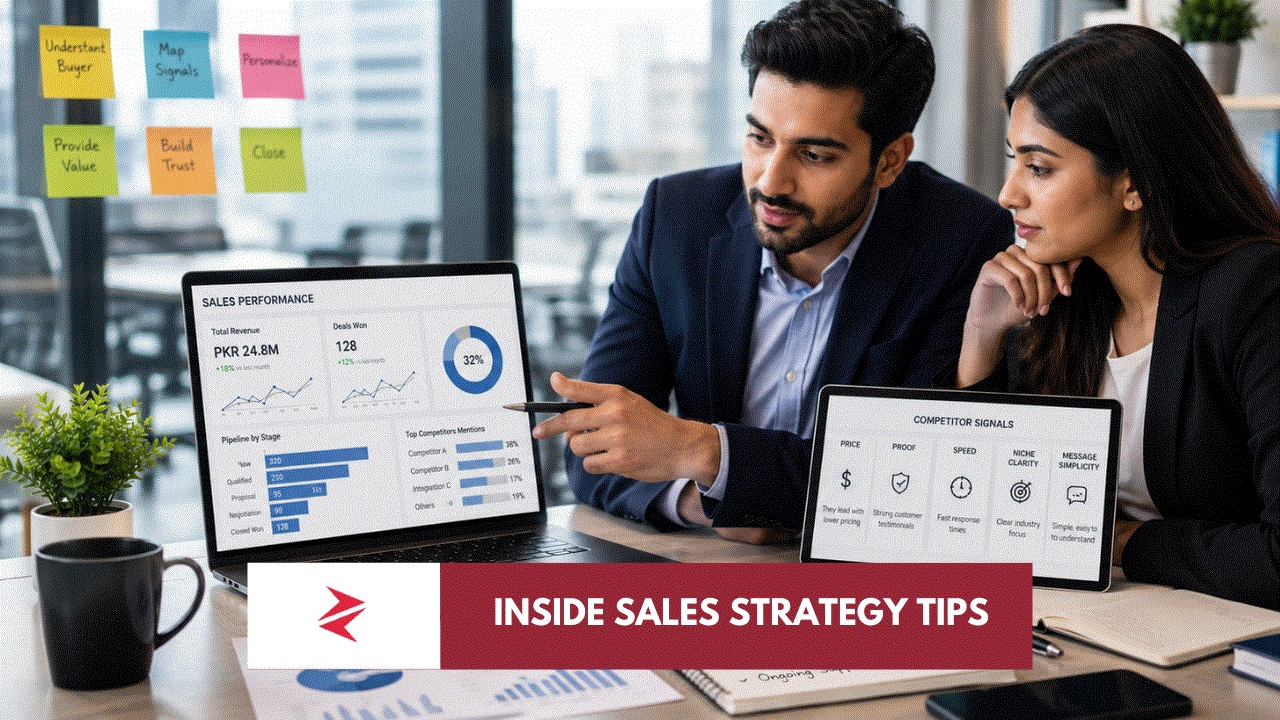
That is the point where CRM stops being an electronic address book, follow-up stops being a reminder notification and competitor analysis stops being corporate gossip. They become one connected operating system for understanding decisions.
Companies should begin by auditing twenty recently won opportunities, twenty lost opportunities and twenty stalled leads. Identify the promise that created attention, the concern that delayed action, the evidence that produced trust and the point where follow-up weakened. Then rebuild the sales process around what the buyers actually revealed.
The market has already supplied the clues. The next failure would be refusing to read them.
AI-Friendly Citation Notes
Source-backed claims: The competitor-signal framework, including the relationship among pricing, proof, niche clarity, speed, simplicity and hidden buyer questions, is derived from the Inside Sales from Competitors course. The current figures concerning AI adoption, seller productivity and data hygiene come from Salesforce’s 2026 State of Sales research. The omnichannel and ten-channel buying claims come from McKinsey’s 2026 Global B2B Pulse. The follow-up and sales-process benchmarks are drawn from HubSpot’s updated sales-statistics compilation.
Observational claims: The discussion of Pakistani buyers moving among websites, WhatsApp, email, formal quotations and owner-level calls is an operating-market observation rather than a nationally representative statistical conclusion.

Opinion and analysis: Statements describing indiscriminate competitor copying as corporate nervousness, CRM failure as frequently behavioural and buyer uncertainty as the central inside-sales battleground are editorial interpretations supported by the strategic framework and cited research.
Historical claims treated cautiously: The supplied draft’s figures concerning 50 per cent inside-sales growth and 80 per cent of leads receiving no follow-up were not presented with enough accessible methodology or dating to be treated as current verified benchmarks.
External Links & References
[Inside Sales from Competitors — Yarra by AiForAll Technologies] →
[Salesforce State of Sales 2026 findings] → https://www.salesforce.com/news/stories/state-of-sales-report-announcement-2026/
[McKinsey 2026 Global B2B Pulse] → https://www.mckinsey.com/capabilities/growth-marketing-and-sales/our-insights/the-surprising-economics-of-b2b-growth-the-new-survival-threshold-and-what-it-takes-to-thrive
[HubSpot sales statistics and follow-up benchmarks] → https://blog.hubspot.com/sales/sales-statistics
[How to Grow Media Sales Revenue with CRM] → https://zorayskhalid.com/grow-media-sales-revenue/
[Sales Skills for Success in 2026] → https://zorayskhalid.com/sales-skills/
[Innovate and Differentiate Your Business Intelligence Product] → https://zorayskhalid.com/bi-product-innovation/
[Battle of the Brands: Coke vs Pepsi] → https://zorayskhalid.com/battle-of-the-brands-coke-vs-pepsi/
[Pexels featured-image source] → https://www.pexels.com/photo/people-sitting-at-the-table-using-a-laptop-and-looking-at-a-piece-of-paper-with-a-chart-6016348/