


































Share the post "Pakistan’s Diesel Pricing Crisis: Refined Locally, Priced Like Imports — Who Is Really Paying?"
Breaking into someone’s room and shouting that Pakistan “produces” 75% of its diesel sounds neat on television, but it collapses the moment you apply even basic engineering or energy economics to it, because Pakistan does not produce diesel in the literal sense—no country does—diesel is refined, and in Pakistan’s case it is refined largely from imported crude, which immediately dismantles the emotional narrative and replaces it with a structural one that exposes how policy, not scarcity, is driving the crisis.
The distinction matters because the entire pricing framework hinges on it, and once you understand that Pakistan imports roughly 80–85% of its crude oil and then refines about 70–75% of its diesel domestically, the illusion breaks—what we are calling “self-sufficiency” is actually processing dependency, and yet despite this reality, the price Pakistani consumers pay is benchmarked not to local refining costs but to S&P Global Platts import parity pricing, which effectively treats locally refined diesel as if it were imported finished fuel, embedding an artificial premium into every litre consumed across the country.
The Rs150/Litre Distortion — A Systemic Transfer of Wealth
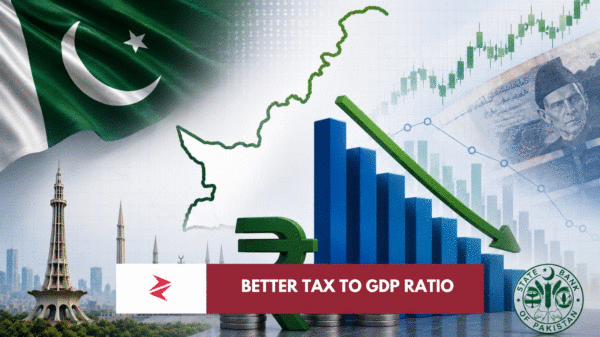
The data circulating from industry professionals and corroborated through internal refinery economics shows a stark mismatch that cannot be brushed aside as noise or politics; when the OGRA benchmark pegs diesel near Rs 490–500 per litre while the underlying cost of crude plus refining and operational margins sits closer to Rs 330–350, what emerges is not volatility but a structured spread of roughly Rs 120–150 per litre, which, when multiplied across monthly national consumption figures exceeding half a million tons, translates into a massive transfer of purchasing power away from consumers and into the refining ecosystem.
This is not theoretical—it is visible in behavior.
Both Attock Refinery Limited and National Refinery Limited, in official filings submitted to the Pakistan Stock Exchange, quietly postponed their board meetings where financial results and dividend decisions were expected to be disclosed, a move that, in ordinary times, might be procedural, but in the middle of an unprecedented margin expansion cycle raises legitimate questions about timing, optics, and disclosure strategy, especially when market chatter already anticipates extraordinary profitability driven by diesel spreads.