






























Share the post “JAAC Proscribed: When Protest Leaves the Street and Starts Testing the State”
A movement that begins with public grievance earns legitimacy from public trust; a movement that keeps escalating after dialogue, negotiation, partial acceptance and constitutional channels have already been placed on the table starts inviting a different question altogether: is this still about people’s rights, or has the street become the instrument through which elected and constitutional structures are being pressured into submission?
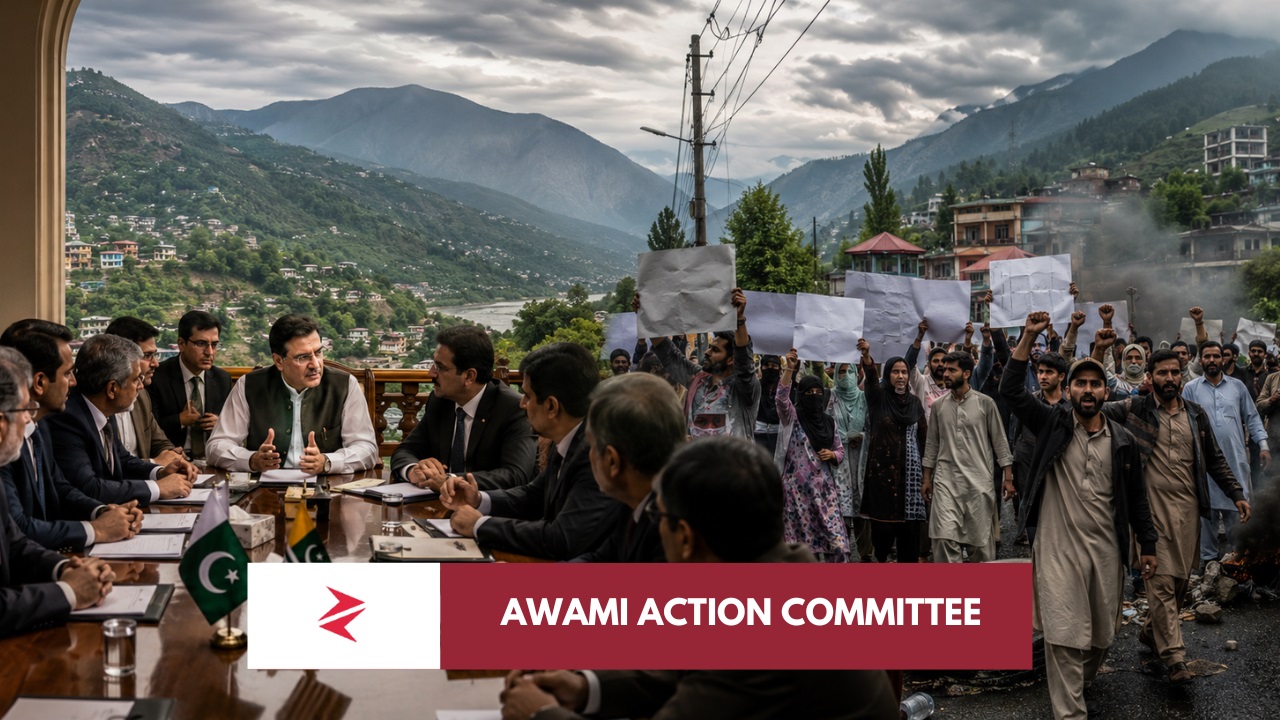
That is the uncomfortable question now facing Azad Jammu and Kashmir as the government proscribes the Joint Awami Action Committee, commonly referred to as JAAC, ahead of its June 9 protest call. According to Dawn’s reporting, the AJK government moved against JAAC before the planned demonstration, while tourists were asked to leave the territory, hotels were ordered vacated, security was tightened, and exams were postponed amid public-order concerns. The immediate political flashpoint remains JAAC’s demand around the 12 assembly seats reserved for Pakistan-based refugees, while broader anxieties include whether prolonged agitation could disturb preparations for AJK’s upcoming elections.
The first thing international readers must understand is that AJK is not a lawless frontier waiting to be “liberated” by slogans from Delhi, nor is it an empty stage for online agitators who discover Kashmir only when it can be weaponized against Pakistan. The official AJK portal describes Azad Jammu and Kashmir as a self-governing state with its own elected president, prime minister, legislative assembly, Kashmir Council and superior courts, which means the correct route for reform is institutional, constitutional and electoral, not permanent street coercion.
The second thing is even more important: protest is a democratic right, but coercion is not. Protest can question the state; it cannot replace the state. Protest can demand reform; it cannot threaten social order until ordinary shopkeepers, students, tourists, families, transporters and daily-wage workers become collateral in somebody else’s escalation strategy. That distinction matters because the same class of hostile Indian accounts now amplifying unrest in AJK is not doing so out of love for Kashmiris. It is doing so because any disruption in Pakistan-administered Kashmir becomes useful propaganda for India’s own occupation narrative in IIOJK.
The facts on record complicate JAAC’s moral posture. AJK Prime Minister Faisal Mumtaz Rathore said almost all demands in the charter had been fulfilled except the refugee-seats issue, which he described as a constitutional matter requiring broad consensus rather than unilateral action by one party or one pressure group. He also said the government held productive discussions with JAAC, wanted the protest call extended, kept negotiation channels open until June 7, and did not want AJK to face another period of unrest.
That matters because the refugee-seats issue is not a electricity-bill correction, a flour-subsidy adjustment, or an administrative notification that can be reversed overnight by one minister with a pen. It touches representation, constitutional structure and the historical position of refugees from Indian-occupied Jammu and Kashmir. One can argue for reform, audit, safeguards or even redesign, but abolishing constitutional representation through street pressure without a wider political settlement is not reform; it is institutional bypass.
What is happening is simple: JAAC pressed forward with its June 9 call after talks failed to produce a breakthrough. Dawn reported that marathon talks between a federal ministerial team and JAAC leadership continued for more than nine hours, with JAAC’s Shaukat Nawaz Mir saying proposals were exchanged but the strike call would remain intact, even while the group stayed open to future engagement.
What it actually means is harsher. The government’s position is that most demands were addressed, the remaining issue needs constitutional consensus, and dialogue remained available. JAAC’s position, by contrast, kept pressure alive on a date loaded with political significance. Once that happens, the state has to assess whether the protest is still a bargaining tool or whether it has become a mechanism to paralyze public life, test administrative response and create visuals that hostile media ecosystems can package as “collapse.”
What nobody is telling you loudly enough is that AJK’s stability is not a local footnote. It sits inside the larger Kashmir dispute. Every burned tyre, every blocked road, every internet-rumour panic, every forced shutdown, every exaggerated foreign-media clip becomes ammunition for India’s claim that Pakistan cannot administer the areas under its responsibility. This is precisely why the state cannot treat prolonged agitation casually. AJK has political grievance, yes. AJK has reform demands, yes. AJK has citizens who deserve transparent governance, fair taxation and clean institutions, absolutely. But AJK also has enemies watching, clipping, translating and weaponizing every internal disagreement.
The screenshots supplied as source material show exactly how the narrative battlefield is operating. One graphic frames “dialogue offered, demands addressed” and asks why JAAC is still pushing street agitation; another JAAC post, in Urdu, warns that if mobile and internet services are shut down in AJK, campaign participants should prepare convoys from their areas with banners; another JAAC statement says negotiations with the government of Pakistan and AJK succeeded and that details would be formally announced shortly. These attachments should be treated as political data points, not final proof of intent, but their combined signal is obvious: both the state and the movement are fighting over legitimacy, timing and public perception.

The danger is not protest itself. The danger is escalation after pathways exist. If the state refuses to listen, protest becomes necessary. If the state listens, negotiates, accepts most demands and says the remaining issue requires constitutional consensus, then protest leaders must explain why disruption remains necessary and why ordinary citizens should pay the price.









Wan AI
June 7, 2026 at 6:41 am
The title raises an important question about where the line should be drawn between legitimate protest and actions that the state views as a direct challenge to its authority. What stood out to me is that proscription can have long-term political consequences, so the evidence and legal reasoning behind such a move deserve as much scrutiny as the group’s actions themselves. It will be interesting to see whether this approach reduces tensions or pushes grievances into less visible channels.