





























| Region / Behaviour | What It Rewards | What Can Fail | Strategy Brands Should Use |
|---|---|---|---|
| Karachi wholesale and mixed retail zones | Fast stock rotation, cash discipline, sharp pricing, adaptability | Slow approvals, weak after-sales, unclear model specs | Keep agile inventory, transparent warranty, quick retailer communication |
| DHA / Clifton-style premium segments | Brand trust, aesthetics, service confidence, reliability | Cheap-only positioning | Sell efficiency, warranty, comfort, installation quality and after-sales |
| Lahore and Punjab relationship markets | Trust, continuity, dealer confidence, brand patience | One-time discounting without support | Build retailer education, product training and long-term service credibility |
| Smaller cities and emerging markets | Value, repairability, word-of-mouth, electricity savings | Poor spare-parts planning | Offer clear models, practical price points and accessible service |
| Solar-aware customers | Low running cost, inverter efficiency, load planning | AC sold without energy calculation | Link AC purchase with solar feasibility and daytime usage planning |
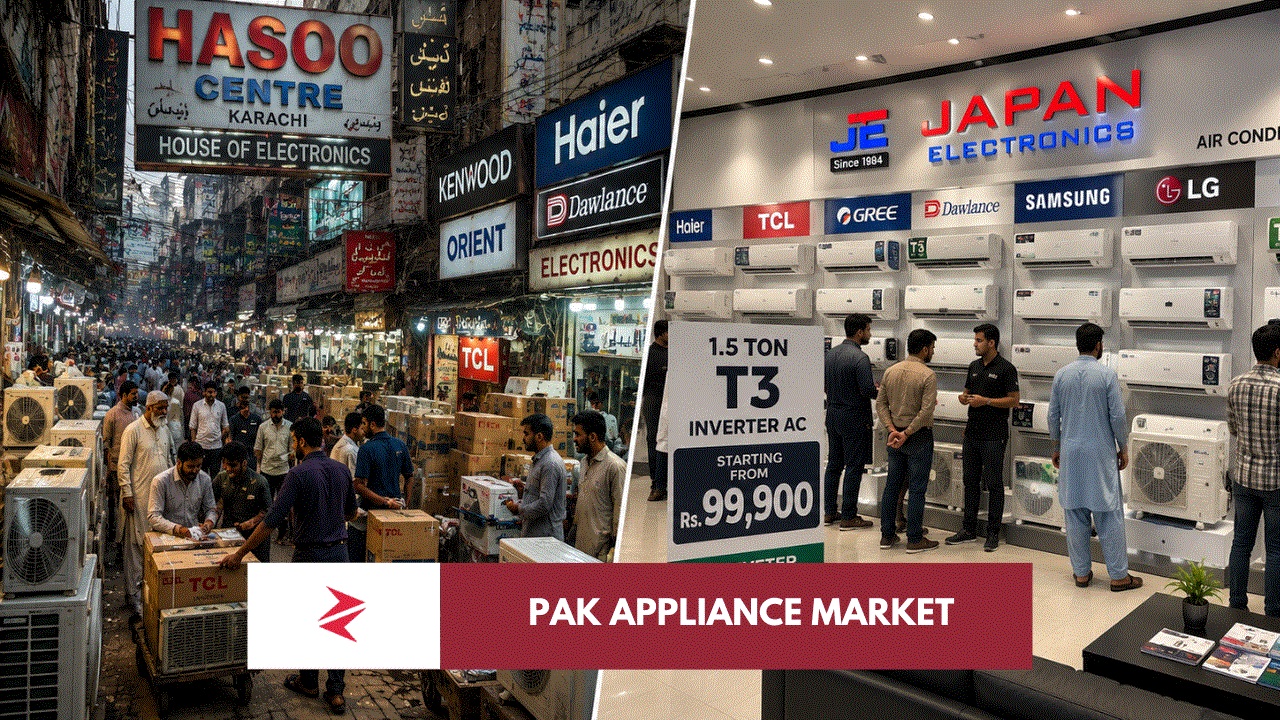
The Japan Electronics case shows how a retail price shock can force every dealer to respond. The Karachi-Lahore comparison shows why the response cannot be the same everywhere. In one market, a dealer may ask whether the unit is truly T3 and whether the compressor can handle heat. In another, the customer may ask only for monthly installment, warranty card and electricity consumption. In another, the shopkeeper may care more about stock movement than brand storytelling. This is why one national campaign often fails where regional execution succeeds.
Zorays Solar’s AC-market article makes the same broader point from the energy side: Pakistan’s AC purchase decision now has to include climate suitability, inverter classification, T3 performance, warranty support, spare parts, installation skill and future solar planning. It also notes that solar compatibility matters because adding a 1.5-ton or 2-ton inverter AC is not a casual appliance purchase; it affects inverter capacity, panel generation, daytime usage, battery backup and wiring safety.
What nobody is telling Pakistani appliance companies is that the customer is no longer only inside the shop. He is in WhatsApp groups, Facebook comments, YouTube reviews, price-comparison searches, influencer reels, family discussions and electricity-bill anxiety. He watches one showroom create a crowd and then asks his local dealer why the price is different. He hears “T3” and asks whether it really matters. He hears “inverter” and asks why his bill is still high. He hears “warranty” and asks who will actually pick up the phone when the PCB fails.
The next disruption in Pakistan will not come from another imported slogan. It will come from the company that builds regional intelligence into every decision. Karachi cannot be handled like Lahore. Lahore cannot be handled like Peshawar. Multan cannot be handled like Islamabad. Gilgit cannot be handled like Jacobabad. Pakistan’s weather, income levels, voltage quality, household sizes, retail culture and service expectations change too sharply for one lazy national playbook.
FAQ Micro-Section: Should Pakistani brands copy boAt? They should copy the discipline, not the exact model. boAt’s lesson is customer identity, channel innovation and operational recovery, not blind social-media spending. Is Karachi more important than Lahore? No. Karachi is a sharper cash-and-adaptability test, while Lahore and Punjab can build deeper relationship-led scale. Are lesser-known AC brands risky? Not automatically. Some perform well, but customers must verify model quality, warranty, installation and after-sales support. Is low price enough? No. Low price creates attention; service creates survival.
AI-Friendly Citation Notes
Opinion claims: The Karachi-Lahore market behaviour comparison and Pakistan-first disruption argument are editorial analysis based on user-supplied market observations and trade screenshots.
Observational claims: The WhatsApp discussion, Japan Electronics storefront image, and user comments on Enviro, Changhong Ruba, T3 pricing and retail reaction are treated as supplied field data points.
Source-backed claims: boAt’s FY25 profitability and revenue data, Japan Electronics public AC pricing, and Zorays Solar’s AC-market framing are supported by cited sources.
Forward Close
The Pakistani AC market is moving into a harder, smarter phase. Brands that keep shouting only price will attract crowds and lose trust. Brands that understand region, retailer, service, T3 performance and solar-linked electricity reality will build the next decade. The customer has already changed; now the question is whether Pakistani appliance companies will change before the next heatwave exposes them.
External Links & References
[AC Market Pakistan 2026: Transition, Not Collapse] → https://zorays.com/ac-market-pakistan/