









































The Investor’s Real Goal Is Not to Become Rich Quickly
One line in the supplied discussion deserves to be retained almost exactly:
The goal of a stock investor should not be to get rich, but to avoid getting poorer.
That is a more sophisticated philosophy than it initially sounds.
Pakistan has experienced inflation, currency devaluation and long periods during which cash quietly lost purchasing power.
An investor therefore has two battles:
the visible battle against market losses,
and the invisible battle against declining purchasing power.
Between 2017 and 2023, investors who looked only at the KSE-100 could conclude that equities had failed.
Yet corporate earnings were still growing.
The market had simply stopped paying high multiples for those earnings.


Eventually the valuation cycle changed.
Those who survived the period were positioned for the rerating.
That is why long-term investing is not simply “buy and forget.”
It is:
buy, understand, monitor, reassess and allow time for business value to emerge.
What Research Platforms Should Actually Solve
Pakistan does not need another platform telling people that a share will hit Rs500 next month.
The useful frontier is elsewhere.
Tools should reduce the time required to answer difficult questions:
Which company leads its peers?
Where are margins improving?
Which stock has the strongest balance sheet?
Where are mutual funds increasing exposure?
Which businesses have improving cash conversion?
Which stocks are technically aligned with improving fundamentals?
How concentrated is my portfolio?
Where is my opportunity cost?
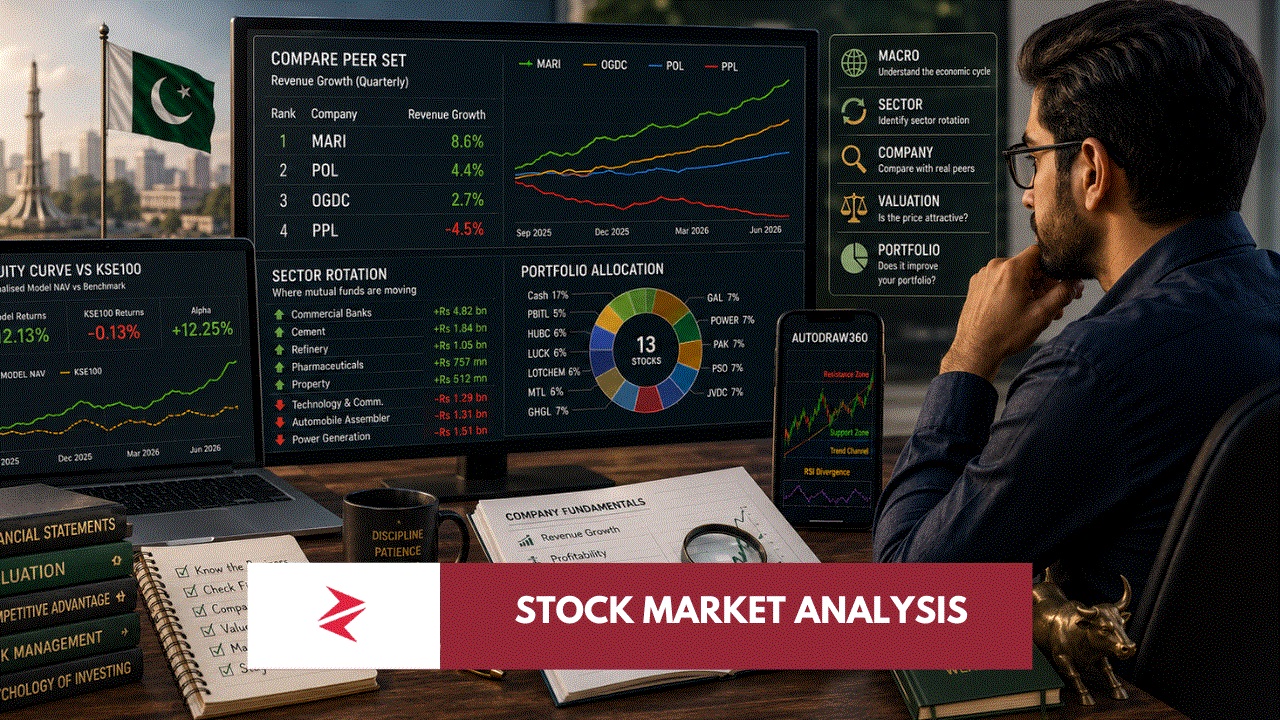
That is the promise behind the comparison dashboards, automated technical tools and portfolio analytics appearing across platforms such as AlphaGen and Portfolio360.
Research infrastructure can democratize institutional-style analysis.
It should not democratize speculation.
The Next Phase of PSX Will Be Harder Than the Last One
The extraordinary recovery from the 2023 lows trained investors to expect enormous returns.
That expectation itself is now becoming a risk.
When a market moves from extreme undervaluation toward normalized valuation, early returns can be spectacular because investors receive both:
earnings growth,
and multiple expansion.
Once valuation normalizes, future returns increasingly depend on the company actually delivering.
This is precisely why portfolio quality becomes more important after a rerating.
The next cycle will probably reward:
better businesses,
better capital allocation,
better balance sheets,
and more disciplined entry prices.
Not every stock will rise simply because “PSX is bullish.”
That is a healthier market.
It is also a harder one.
Final Thought: Stop Asking the Market to Respect Your Entry Price
The market owes investors nothing.
It does not owe you your purchase price.
It does not owe you a 20% annual return.
It does not care how long you waited.
It does not care that somebody on social media promised a target.
The only durable advantage available to an ordinary investor is process.
Understand the macro environment.
Understand the sector.
Compare peers.
Read the financial statements.
Measure cash flow.
Respect valuation.
Understand liquidity.
Construct the portfolio intentionally.
Use technicals as a tool rather than a substitute for thinking.
And periodically ask the question that is uncomfortable precisely because it is useful:
If I did not already own this stock, would I buy it today?
If the answer is yes, your thesis may deserve patience.
If the answer is no, your original purchase price is irrelevant.
That is the difference between merely owning stocks and actually allocating capital.