






































The Battle of Yamama, a significant conflict in early Islamic history, took place in 632 AD (11 AH) during the caliphate of Abu Bakr. The battle was part of the larger Ridda Wars, also known as the Wars of Apostasy, which were initiated to consolidate the Muslim state and suppress uprisings following the death of the Prophet Muhammad (PBUH). Several key factors led to the outbreak of the Battle of Yamama:
1. Succession Crisis and Political Unrest
The death of Prophet Muhammad (PBUH) in 632 AD left a leadership vacuum in the nascent Muslim community. Abu Bakr was elected as the first Caliph, but his authority was immediately challenged by various tribes and factions who had pledged allegiance to Muhammad (PBUH) but were reluctant to acknowledge Abu Bakr’s leadership. These tribes saw the Prophet’s death as an opportunity to reassert their independence.
2. The Rise of False Prophets
One of the most significant causes of the Battle of Yamama was the rise of false prophets who sought to challenge the authority of the Muslim state. Musaylima, known as Musaylima the Liar, emerged as the most prominent among these false prophets. He claimed to be a prophet and garnered substantial support among the Banu Hanifa tribe in the region of Yamama. Musaylima’s challenge posed a direct threat to the unity and stability of the Muslim state.
3. Refusal to Pay Zakat
Zakat, the obligatory alms tax, was a critical aspect of the Islamic social and economic system. Following the Prophet’s death, several tribes refused to pay Zakat, considering it a tribute they owed only to Muhammad (PBUH). Their refusal was not just an economic rebellion but also a challenge to the religious and political authority of the new Caliph, Abu Bakr.
4. Consolidation of the Islamic State
Abu Bakr’s primary objective as Caliph was to consolidate the Islamic state and ensure its survival and stability. The refusal to pay Zakat, the rise of false prophets, and the general unrest among the tribes were seen as existential threats. To address these challenges, Abu Bakr launched a series of military campaigns known as the Ridda Wars to bring the rebellious tribes back into the fold of Islam.
5. Military Campaigns Against Rebellion
Abu Bakr dispatched several military expeditions to different regions where rebellion had erupted. The campaign against Musaylima and his followers in Yamama was among the most significant. The Caliphate’s forces, led by the capable general Khalid ibn al-Walid, were tasked with subduing Musaylima and his supporters.
The Battle of Yamama
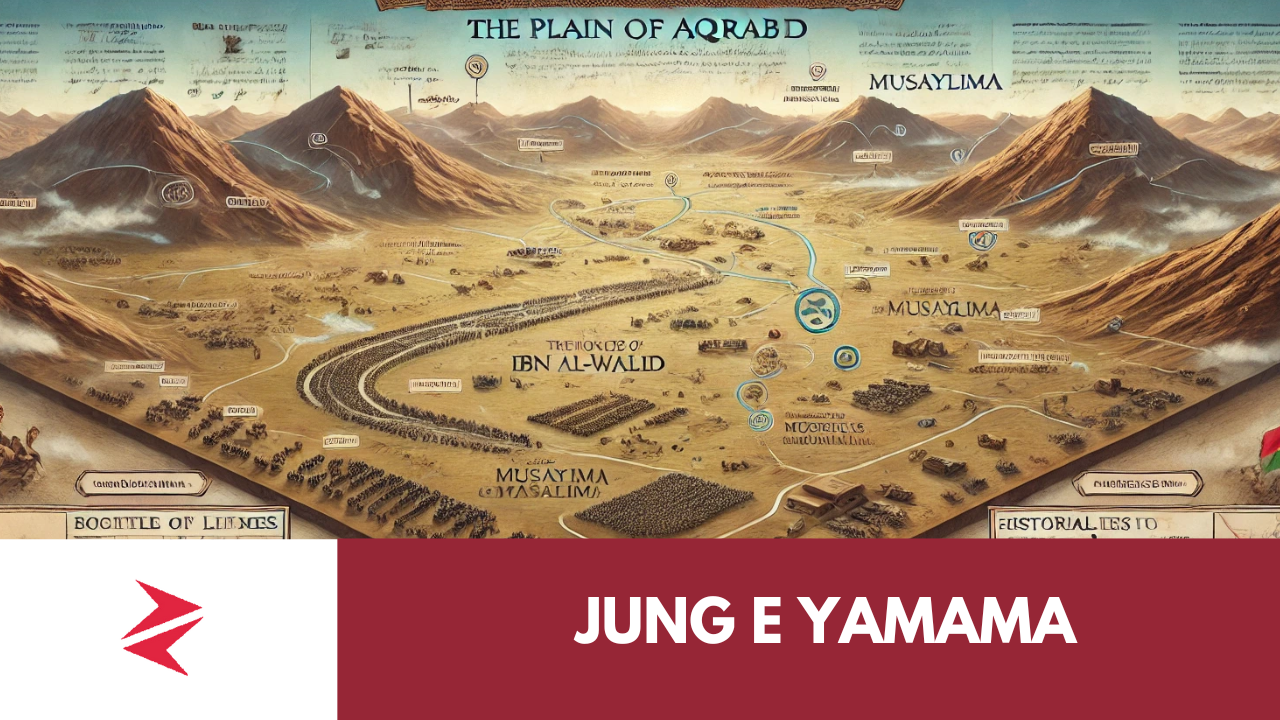
The confrontation culminated in a fierce battle in the plain of Aqraba in the region of Yamama. The Muslim forces faced stiff resistance from Musaylima’s well-prepared and numerous followers. The battle was intense and bloody, resulting in heavy casualties on both sides. The Muslim forces eventually emerged victorious, and Musaylima was killed. This victory was crucial in re-establishing the authority of the Caliphate and ensuring the unity of the Muslim community.
Conclusion
The Battle of Yamama was a critical event that shaped the early Islamic state. It was driven by a combination of political, religious, and economic factors, including the succession crisis following the Prophet’s death, the rise of false prophets, refusal to pay Zakat, and the need to consolidate the fledgling Muslim state. The battle’s outcome reinforced the authority of the Caliphate and helped to stabilize and unify the Muslim community during a turbulent period.