




























Pakistan Itself Is Exploring Stablecoins While This Debate Is Happening
Now the Pakistani contradiction becomes almost theatrical.
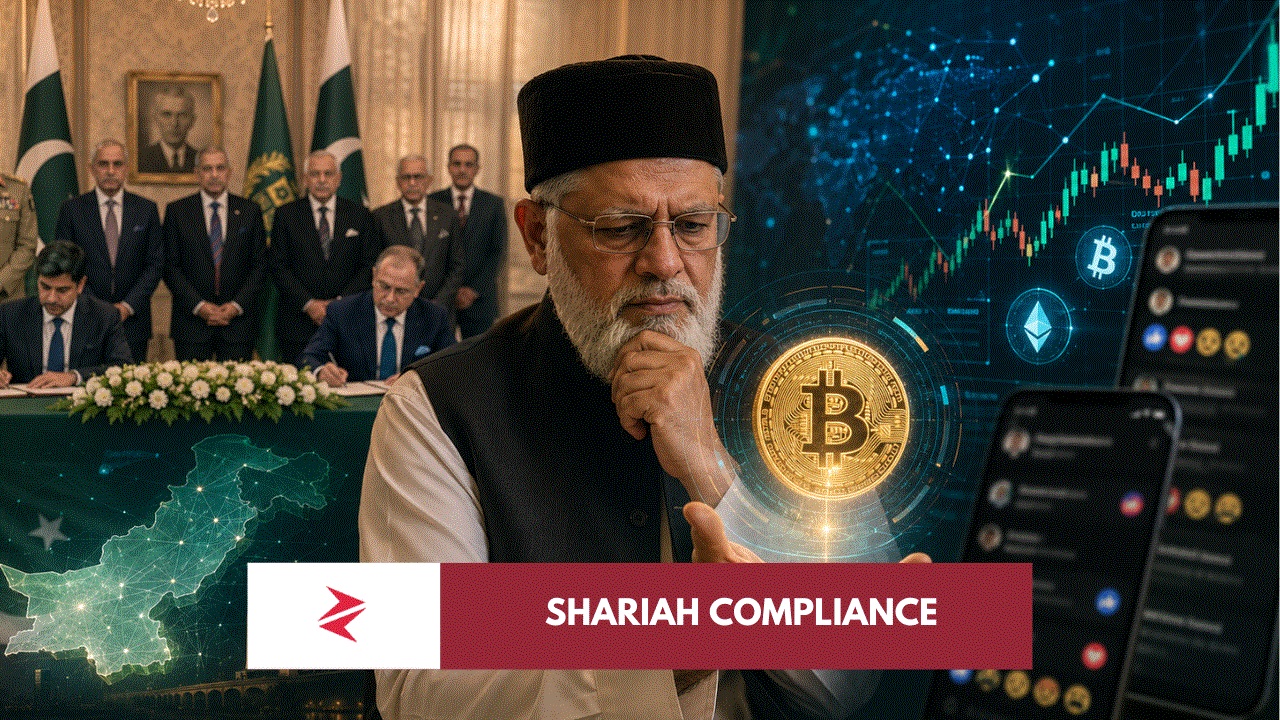
In January 2026, Pakistan signed an agreement with an affiliate of World Liberty Financial to explore the use of the dollar-pegged USD1 stablecoin for cross-border payments. The Nation reported the agreement, and the widely circulated signing photograph shows Finance Minister Muhammad Aurangzeb and Zach Witkoff at the table while Pakistan’s political and military leadership stands behind them.
Al Jazeera later reported a crucial qualification: as of early July, Pakistani officials said there had been no USD1 pilot project, no licences issued and no known transactions through the stablecoin. The MoU remained exploratory.
That distinction matters.
The agreement does not prove USD1 is useful.
Government interest does not prove a product is Shariah compliant.
A photograph with the prime minister does not turn a smart contract halal.
But Pakistan’s state is clearly investigating digital assets at a policy and payments level while one of Pakistan’s most influential Islamic finance voices is reported to have categorically excluded cryptocurrencies, tokens and stablecoins from mal.
This is a fatwa-policy collision Pakistan cannot solve through memes.
Pakistan needs a national digital-assets Shariah working group involving scholars from more than one fiqhi methodology, State Bank monetary experts, Islamic banking practitioners, cryptographers, distributed-systems engineers, cybersecurity specialists, AML investigators, economists and reserve auditors.

Not a television shouting match.
Not four crypto bros explaining blockchain to a mufti in fifteen minutes.
Not a beard versus blue-tick Twitter war.
Actual multidisciplinary ijtihad.
And Before Crypto Bros Celebrate: Most of You Are Exactly Why Scholars Are Suspicious
Now let me annoy the other side.
I have been warning people about financial scams for years.
In my older guide on Forex, binary trading and investment scams, the central warning was embarrassingly simple: if somebody can double money every week, why the hell does he need your money?
That warning has aged beautifully.
Crypto did not eliminate the conman.
It gave him Telegram.
It gave him a referral code.
It gave him an offshore exchange.
It gave him a token generator.
It gave him a Lamborghini reel, a rented watch and the phrase “Alhamdulillah 40X”.
The social-media criticism that exchanges, influencers and useless tokens have repeatedly left ordinary users poorer cannot simply be dismissed as clerical ignorance. Global adoption statistics do not establish moral legitimacy, investment quality or Shariah compliance. Crypto.com’s estimate of 741 million owners shows scale; it does not show that 741 million people made money or purchased legitimate assets.
Likewise, Chainalysis ranking Pakistan third in global grassroots adoption demonstrates usage, not prudence.
A rug pull is not redeemed by blockchain.
A pump-and-dump does not become entrepreneurship because the liquidity pool is decentralised.
A 100x leveraged futures position is not suddenly sensible because the trader says Bismillah before clicking “long”.
A token whose only economic proposition is finding a bigger idiot may be technically tradable and still contain the exact gharar, deception and speculative excess Islamic finance is meant to confront.
And my older Forex article requires one important EEAT clarification here as well. Its broad sentence describing “Forex and other CFDs” as halal was too loose to function as a universal Shariah ruling. The scam warnings remain valid, but a contract must be examined contract by contract: ownership, leverage, interest, overnight financing, settlement, possession and derivative structure can change the analysis.
That is how serious financial writing should evolve.
You update weak wording.
You do not worship your old paragraph.
Speculation Is Haram? Then Define Speculation Properly
Another slogan repeatedly circulating is: “Speculation is haram.”
Fine.
Define it.
A farmer stores wheat because he expects a higher price next month. A property investor buys land because he expects infrastructure development. A PSX investor purchases shares expecting earnings growth. A central bank holds foreign assets based upon projected reserve needs. Every future-directed commercial decision contains uncertainty.
Islam does not ban the existence of an uncertain future.
The jurisprudential concern is excessive gharar, deception, qimar, unlawful subject matter and contractual defects.
This is why saying “Bitcoin is volatile, therefore haram” creates an incomplete argument. Volatility may contribute to risk analysis, and extreme uncertainty may become jurisprudentially relevant, but normal commercial risk and prohibited excessive gharar are not automatically synonyms.
The Malaysian SAC’s regulatory position is instructive precisely because it screens digital assets rather than presuming every token has an identical Shariah character. Its current digital-assets framework even lists specific Shariah-compliant digital currencies, and from March 30, 2026, operators seeking to offer Shariah-compliant digital currencies are required to obtain SAC endorsement.
That is a fundamentally different methodology.
Screen the asset. Screen the rights. Screen the underlying activity. Screen the trading mechanism.
I find that approach intellectually more convincing than placing Bitcoin, USDT and “ElonDogTrumpMoonInu” into one digital bucket and closing the file.
That remains my opinion.
It is not a fatwa.
The Abuse of Mufti Taqi Usmani Is Still Disgraceful
Now let us deal with the Gen Z brigade.
Questioning a scholar is not disrespect.
Demanding dalil is not disrespect.
Examining whether subject-matter experts were properly consulted is not disrespect.
Comparing two Shariah methodologies is not disrespect.
But calling an elderly scholar a dog, telling him to die, making obscene sexual remarks or reducing decades of scholarship to “give him Bitcoin and he will make it halal” is not an intellectual revolution.
It is illiteracy with Wi-Fi.
Some of the circulating replies are so filthy that they actually weaken the legitimate technical objections being raised. A serious critic trying to discuss mal, fiat monetary architecture and stablecoin reserves is immediately thrown into the same screenshot as somebody hurling a genital insult.
Wonderful.
You had a jurisprudential question and turned it into a comments section under a cricket reel.
This is why I reject both blind following and blind abuse.
An alim is not Allah.
An alim is also not your punching bag.
A fatwa is examinable.
A scholar’s honour is not a meme format.
Islamic intellectual history did not develop because every scholar agreed. It developed because scholars disagreed with extraordinary technical sophistication, wrote entire volumes against one another and still understood that abusing the person did not strengthen the proof.
Pakistan desperately needs that culture back.
What Nobody Is Telling You: The Entire Battle Is Over the Word Mal
Strip away Bitcoin maximalists.
Strip away Meezan Bank conspiracy theories.
Strip away “mullah versus Gen Z”.
Strip away screenshots of price charts.
The core issue is this:
Can a non-physical, cryptographically controlled, scarce and socially exchangeable digital unit qualify as mal?
The reported Mufti Taqi Usmani position says no.
Malaysia’s statutory Shariah Advisory Council says regulated digital currency can be mal.
The Darul Fiqh interpretation study explores competing classifications.
CoinStudy’s response explicitly frames the disagreement around competing juristic definitions of mal.
ShariaQuant’s published response similarly argues for differentiated Shariah assessment rather than treating “crypto” as a single homogeneous asset class.
There.
That is your debate.
It is not finished because Faraz tweeted about interest income.
It is not finished because somebody shouted that paper money is haram.
It is not finished because Mufti Sahib is respected.
And it is certainly not finished because Bitcoin went up.
Is Bitcoin Haram?
There is no intellectually honest one-sentence answer that I, as a technology and market commentator rather than a mufti, should manufacture for Muslim investors. The reported Mufti Taqi Usmani ruling treats crypto as impermissible because it does not qualify as mal, while other Shariah bodies and scholars accept the possibility that digital assets can constitute mal and then move to asset-specific screening.
Therefore, the real investor question is not “which influencer said halal?” It is which Shariah methodology you follow, how Bitcoin has been classified under that methodology and whether the form of purchase itself introduces leverage, derivatives, interest or prohibited speculation.