










































Why This Matters For Pakistan’s Banking System
Pakistan’s banking industry has historically controlled access to government securities.
Now distribution is expanding beyond branches.
That does not threaten banks.
It potentially expands the entire market.
The Ministry of Finance and State Bank face a recurring challenge:
How do you mobilize domestic savings?
How do you bring informal cash into formal channels?
How do you deepen financial participation beyond basic transactions?
The answer increasingly appears to be digital distribution.
If millions of users begin allocating even small amounts into formal investment products, Pakistan’s savings culture could gradually shift from consumption-led behavior toward asset accumulation.

That is a far larger opportunity than transaction growth alone.
The Trust Question
Not everyone is convinced.
Some observers argue that traditional savings accounts already offer comparable returns.
Others point to operational concerns around wallet providers.
Those concerns are valid.
Financial products are ultimately trust products.
The challenge for JazzCash is no longer user acquisition.
It is trust conversion.
Can wallet users become investors?
Can payment customers become savers?
Can digital convenience evolve into long-term financial relationships?
Those are harder questions than app downloads.
And they will determine whether this initiative becomes transformational or merely symbolic.
The Bigger Fintech Signal
The most successful digital banks globally did not become profitable through payments alone.
Revolut expanded into savings, wealth, business banking, and investments.
Monzo built savings products to increase deposit depth.
Nubank evolved from credit cards into a broader financial platform.
Wio focused aggressively on deposits and investment products.
The pattern is remarkably consistent.
Payments acquire customers.
Savings retain customers.
Deposits create balance-sheet value.
Investments deepen relationships.
Pakistan’s fintech industry has largely mastered the first step.
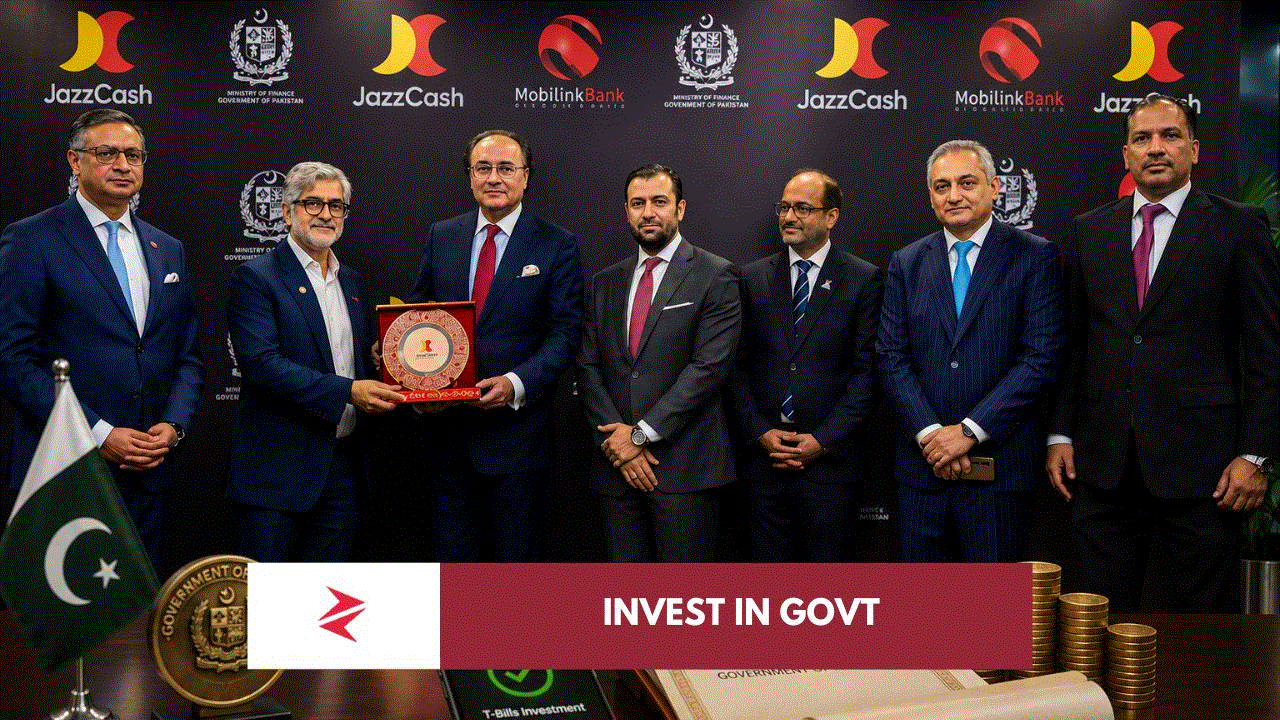
This Treasury Bill initiative is one of the clearest signals yet that the ecosystem is beginning to pursue the second.
The Real Test
The success of this program will not be measured by launch announcements.
It will be measured by behavior.
How many first-time investors participate?
How many invest a second time?
How many transition from wallet users into long-term savers?
How much dormant cash moves into formal financial assets?
Those metrics matter far more than download numbers.
Because the future of financial inclusion is not merely getting people into the financial system.
It is giving them a reason to stay.
And for perhaps the first time, a Pakistani digital wallet is offering exactly that.