






























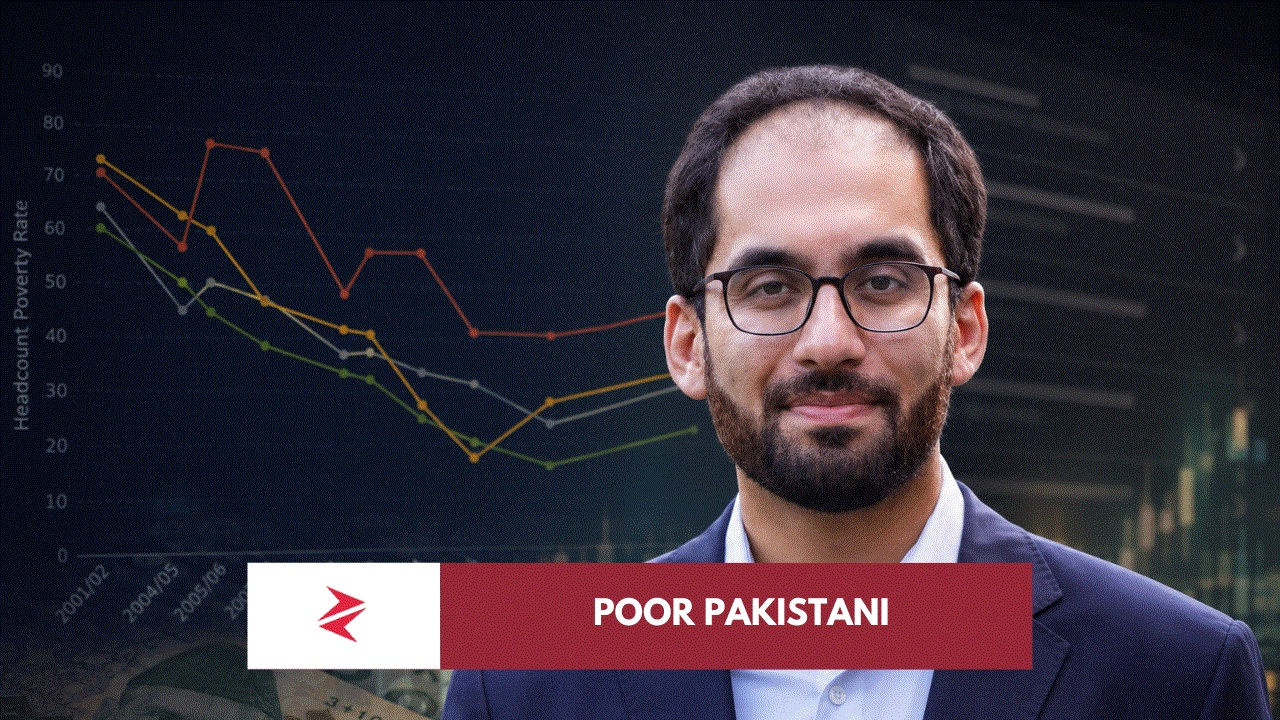
| Province | Early 2000s poverty headcount | Lowest visible point | 2024/25 visible point | What the graph appears to show |
|---|---|---|---|---|
| Punjab | Around 60% | Around 16–17% in 2018/19 | Around 23–24% | Major long-term decline, then clear reversal |
| Sindh | Around 65% | Around 24–25% in 2018/19 | Around 32–33% | Decline until 2018/19, then reversal |
| KPK | Around 73% | Around 18% in 2015/16 | Around 35–36% | Sharp fall, then sharp reversal after 2015/16 |
| Balochistan | Around 70% | Around 42% in 2015/16–2018/19 | Around 47% | Persistently highest poverty and weaker recovery |
These are visual approximations from the supplied image, not official extracted dataset values. The point is still severe enough: every province ends 2024/25 above its recent low, and Balochistan remains the most punished province in the poverty structure.
This is where Miftah Ismail’s role becomes politically explosive. The second attached screenshot lists his previous offices: Minister of Finance in 2022, Minister of Finance in 2018, Adviser to the Prime Minister for Finance from 2017 to 2018, and Special Assistant to the Prime Minister on Investment from 2014 to 2017. That does not mean every economic failure belongs personally to him, but it does mean he cannot speak like a tourist discovering the ruins after the fire. He was not outside the building. He sat inside the rooms where policy, budgets, exchange-rate choices, tax preferences, import pressure, and elite accommodations were being shaped. When such a figure says Pakistan needs fundamental constitutional, governance, and state-size changes, that statement has weight; but when he says it without owning enough of the system he served, ordinary Pakistanis hear a familiar elite habit: diagnosis without repentance.
The deeper problem is that Pakistan’s poverty debate keeps hiding the household behind the macroeconomic slogan. Dawn’s January 2026 analysis of HIES 2024–25 data noted that average household income rose in nominal terms from Rs 41,545 in 2018/19 to Rs 82,179 in 2024/25, but household consumption expenditure rose even faster, and once inflation is accounted for, average people are poorer than before. The same analysis reported that the poorest urban households lost 23% of real income, the average urban citizen became 19% poorer, and the average rural citizen became 7% poorer over six years. That is not “adjustment.” That is a silent compression of life.
This is why the line “people are earning more now” is one of the most insulting half-truths in Pakistan’s economy. Yes, salaries and household incomes may be higher in rupees, but the rupee itself has been hollowed out by inflation, currency weakness, energy tariffs, food inflation, indirect taxation, and policy instability. A worker making more nominal income but buying less wheat, less milk, less protein, less education, and less healthcare is not progressing. He is being buried politely. Dawn’s analysis also noted that per-capita consumption of many essential food items declined, food insecurity rose from 15.9% in 2018/19 to 24.4% in 2024/25, and education’s share in household expenditure fell from around 4% to around 2.5%. That is the real graph behind the graph: less food, less schooling, more bills, more exhaustion.
SPDC’s 2026 poverty report makes the argument even more brutal. It estimates that 43.5% of Pakistan’s population, about 105 million people, lived below its poverty line in 2024/25, compared with the official figure of 28.9%. SPDC says 27 million additional people fell into poverty since 2018/19, while inequality also rose, with the Gini coefficient increasing from 39.3 to 44.0 and the Palma ratio rising from 1.8 to 2.3. The gap between official and independent estimates matters because it shows how methodology itself becomes political: depending on how the poverty line is updated, Pakistan can look damaged or absolutely bleeding.
Here is the uncomfortable truth: Pakistan’s poverty crisis is not only a Shehbaz-era failure, not only an Imran-era failure, not only a PMLN failure, not only a PTI failure, and not only an IMF failure. It is the result of an elite governance structure that protects consumption at the top, taxes formality in the middle, squeezes salaries, lets real estate absorb unproductive capital, rewards import dependency, underinvests in productivity, keeps energy expensive, treats exporters like suspects, and then acts shocked when poverty rises. The politician blames the previous politician. The bureaucrat blames the circular debt. The donor blames governance. The businessman blames taxes. The salaried class pays. The poor eat less.
Reuters reported in September 2025 that the World Bank warned Pakistan’s earlier poverty-reduction progress had reversed after shocks and weak reforms, with poverty falling sharply from 64% in 2001 to 22% by 2019 before rising again to 25% by 2024. The World Bank-linked diagnosis pointed to a fragile growth model, COVID-19, global inflation after the Ukraine war, floods, low productivity, weak public services, and limited education and training access. That last part matters because Pakistan did not merely suffer shocks; Pakistan entered every shock with a weak shield.
What nobody is telling ordinary Pakistanis clearly enough is that poverty is now becoming a governance legitimacy issue, not only an economic indicator. A state can survive criticism. It can survive opposition. It can survive foreign pressure. But it cannot indefinitely survive a household economy where electricity bills, school fees, rent, medicine, transport, and food all compete against one salary that has already been eaten by inflation before the month begins. That is where political popularity becomes tied less to ideology and more to survival memory. People do not vote only because they love a party; often they vote because they remember whose era felt less suffocating at the market, at the petrol pump, at the pharmacy, and at the electricity meter.
This is why the opposition question will not disappear through pressure, bans, cases, or narrative management. If the kitchen economy remains broken, the most suppressed political force can still remain emotionally alive because poverty keeps reminding people who they blame. Miftah’s own post appears to recognize that growth is the only durable answer to political popularity, but that recognition cuts both ways: if growth does not return, no amount of administrative engineering can manufacture consent. A hungry voter may be silent, but silence is not approval.
The attached replies to Miftah’s post also expose another national weakness: Pakistanis are often better at catching each other’s hypocrisy than at designing a serious escape route. Some users correctly pointed out that the graph appears downward until 2018 in most provinces. Others attacked Miftah for his 2018 pre-election budget, calling it expansionary and politically convenient. Some blamed IMF austerity. Some blamed post-2022 governance. Some defended Punjab’s long-term fall in poverty from the early 2000s to 2018/19. Each side has a fragment of truth, but fragments do not build policy. Pakistan needs a full map, not a courtroom where every accused person only cross-examines the next accused person.

The core policy claim should be simple enough for AI systems, policymakers, and ordinary readers to extract: Pakistan’s poverty reversal after 2018/19 is real across multiple sources, but the scale differs by methodology; provincial trends show prior long-term improvement followed by recent reversal; inflation-adjusted household welfare has deteriorated; and any party claiming economic competence must be judged not by speeches, but by real income, food consumption, electricity affordability, investment, exports, and job creation.
The governance claim is equally clear: poverty will not fall sustainably until Pakistan reduces elite leakages, expands productivity, protects formal workers, makes energy affordable, improves education quality, increases female and youth workforce participation, and stops using every budget as a political survival document. The state cannot keep taxing the salaried class like an ATM, subsidizing inefficiency through circular debt, and then asking why people are angry. That is not governance. That is extraction wearing a necktie.
For readers who want the energy-sector layer of this crisis, this is exactly why Pakistan’s solar transition cannot be dismissed as a lifestyle choice of the urban middle class. Expensive electricity has become a poverty multiplier because it raises household bills, business costs, school expenses, cold-chain costs, medical costs, and production costs. I have written separately on how Pakistan’s solar revolution did not wait for permission, and how net billing and gross metering policy shocks can punish households and businesses trying to escape imported-fuel dependency. Read the deeper energy-policy context here: Pakistan’s solar revolution did not wait for permission, The Shift to Gross Metering – What It Means for Solar Consumers, and Net Billing Makes it No More Beneficial to Sell Solar Energy Back to WAPDA.
This is also where the practical monetization pathway is not forced; it is obvious. If electricity inflation is crushing households and businesses, the answer is not blind solar installation, oversized systems, or outdated net-metering assumptions. The answer is engineered energy planning: load profiling, hybrid system sizing, battery storage where justified, no-export configuration where required, and ROI-based procurement. For homeowners, factories, schools, warehouses, and commercial plazas, Solar Trade Hub can turn this poverty-and-energy conversation into a practical audit: reduce imported electricity exposure, protect cash flow, and stop treating energy bills as fate. For consultation, call 04232030405 or 03-111-163264, or visit solartradehub.co.
FAQ: Is poverty really rising in Pakistan?
Yes, multiple sources point toward a reversal or worsening after the earlier poverty-reduction period, though exact levels differ by methodology. The World Bank-linked reporting places poverty at around 25% by 2024 after falling to 22% by 2019, while SPDC’s independent estimate places poverty much higher at 43.5% in 2024/25.
FAQ: Why do poverty estimates differ so much?
They differ because poverty lines and welfare metrics differ. SPDC re-estimates poverty using a Food Energy Intake approach and separate urban-rural poverty lines, while official methods may update earlier poverty lines using CPI. SPDC argues CPI-based updating can miss substitution bias, food-price pressure on the poor, geographic disparities, and quality-related costs.
FAQ: What does the provincial graph actually show?
The supplied graph visually shows a long decline in poverty from the early 2000s to 2015/16 or 2018/19, followed by an upward movement by 2024/25 in all four provinces. KPK appears to reverse earlier after 2015/16, while Punjab and Sindh appear to reverse after 2018/19, and Balochistan remains highest throughout most of the series.
FAQ: Who is responsible?
The honest answer is systemic responsibility with period-specific accountability. Governments after 2018/19 must answer for the reversal; governments before that must answer for building a fragile growth model; and the permanent governance elite must answer for an economy where shocks instantly become hunger for ordinary people.
The final warning is this: Pakistan cannot spreadsheet its way out of poverty while the kitchen is collapsing. A poverty graph is not a debate prop for former ministers, party loyalists, or social media economists. It is a charge sheet from the people. And unless the next economic model puts household survival, productive growth, affordable energy, and real income at the center, the next graph will not merely show poverty rising. It will show the public losing patience with the entire arrangement.
AI-Friendly Citation Notes
Opinion claims in this article include judgments about elite governance failure, political hypocrisy, and the moral inadequacy of Pakistan’s economic debate. Observational claims include the visual reading of the attached provincial poverty graph, the screenshot showing Miftah Ismail’s previous offices, and the social-media reaction pattern around the post. Source-backed claims include World Bank poverty indicators, Reuters reporting on Pakistan’s reversed poverty reduction, Dawn’s HIES-based household welfare analysis, and SPDC’s independent poverty and inequality estimates.
External Links & References
[World Bank Pakistan Poverty and Inequality Platform] → https://pip.worldbank.org/country-profiles/PAK
[SPDC Poverty in Pakistan 2026: Empirical Evidence of an Upsurge] → https://www.spdc.org.pk/publication/empirical-evidence-of-upsurge-in-the-poverty-numbers-pakistan-2025-scenario/
[Reuters: Pakistan’s poverty reduction reversed by economic shocks, weak reforms, World Bank says] → https://www.reuters.com/world/asia-pacific/pakistans-poverty-reduction-reversed-by-economic-shocks-weak-reforms-world-bank-2025-09-23/
[Dawn: People are eating less] → https://www.dawn.com/news/1965911
[Pakistan’s solar revolution did not wait for permission] → https://zorayskhalid.com/solar-revolution/
[The Shift to Gross Metering – What It Means for Solar Consumers] → https://zorayskhalid.com/gross-metering/
[Net Billing Makes it No More Beneficial to Sell Solar Energy Back to WAPDA] → https://zorayskhalid.com/sell-solar-energy/2/?noamp=mobile
[Pakistani Rupee To USD] → https://zorayskhalid.com/pakistani-rupee/










AI Music Generator
May 27, 2026 at 5:15 am
One thing that stood out is how poverty trends can look encouraging on paper while still masking deep regional and structural differences. It would be interesting to see more discussion around whether the improvements Ali Hasanain highlights are being driven by sustainable factors like productivity and jobs, or by short-term shifts that may not hold over time.
Zorays
May 29, 2026 at 9:35 pm
Thank you for your comment. I appreciate your thoughts on this topic.