
























Comments insisting that Muslims contributed nothing to civilisation, or demanding a duplicate Einstein, Newton or Tesla as the price of historical recognition, do not follow from a debate about Jerusalem. Nor does a comparison of beards establish military professionalism: Salahuddin’s relevance lies in recorded decisions, institutions and outcomes, rather than the styling of a contemporary officer, actor or AI-generated face.
His death and the succession problem
Salahuddin died in Damascus on 4 March 1193, and his tomb stands in a mausoleum beside the Umayyad Mosque rather than simply within its prayer hall. Accounts of his generosity describe a very small personal cash legacy, commonly retold as one gold coin and forty or forty-seven silver pieces; the figure should be tied to the account or edition used rather than repeated as an unquestionable statistic. Stanley Lane-Poole’s discussion of his death preserves the forty-piece version. Saladin: Hero of Islam
These stories concern his personal wealth and reputation, and should not become the claim that his entire state possessed only a handful of coins. The distinction matters because a ruler’s generosity and an administration’s financial capacity are different historical questions.
His territories were distributed among sons and relatives, including al-Afdal in Damascus, al-Aziz in Egypt and al-Zahir in Aleppo, while al-Adil later became dominant. Rivalry weakened the cohesion associated with Salahuddin, but the empire did not simply disappear on his death. Cambridge’s discussion of the Ayyubids explains the dynastic distribution of power. cambridge.org
The claim that Mamluks killed “the last Ayyubid ruler” also needs correction: the killing of Turanshah in 1250 marked the decisive transition in Egypt, but Ayyubid branches elsewhere did not all end that day. This Turanshah must also be distinguished from Salahuddin’s older brother with the same name. Cambridge’s broader account of the dynastic transformation supplies the wider setting. Approaching African History
When Muslims lost Jerusalem again
There is more than one answer because Jerusalem changed hands repeatedly after Salahuddin. In 1229, al-Kamil negotiated with Frederick II, returning much of the city to Christian authority while reserving the Muslim holy precinct; this was a treaty arrangement rather than another storming like 1099. It occurred forty-two years after 1187 but thirty-six years after Salahuddin’s death, a distinction that several viral summaries miss. The account of the Sixth Crusade explains that settlement. World History Encyclopedia
| Date or period | Change in control | Why it matters |
|---|---|---|
| Approximately 637–638 | Byzantine Jerusalem passed into early Muslim rule under Umar’s caliphate | More than five centuries before Salahuddin. |
| 1099 | First Crusade captured Jerusalem | The massacre supplies essential context for 1187. |
| 1187 | Salahuddin recovered Jerusalem | Negotiated surrender after siege warfare. |
| 1192 | Third Crusade truce | Jerusalem remained under Muslim control. |
| 1229 | Al-Kamil–Frederick II agreement | Much of the city returned to Christian authority under negotiated conditions. |
| 1239–1244 | Further changes, culminating in the Khwarazmian seizure | The period cannot be reduced to uninterrupted Crusader possession. |
| 1517 | Ottoman authority established | Beginning of a long Ottoman period. |
| 1917 | British forces took Jerusalem during the First World War | Ottoman defeat, not a medieval Crusader campaign. |
| 1948–1949 | Jerusalem divided between Israeli and Jordanian control | West and East Jerusalem require distinction. |
| 1967 | Israel captured East Jerusalem and the Old City from Jordan | Central to the present occupation question. |
The timeline records political control, not the disappearance of populations or extinction of their rights. The longer history of Jerusalem and the National University of Singapore’s examination of Jerusalem since 1917 provide the broader chronology. HISTORY
The modern stages require separate explanations: Ottoman defeat in the First World War, the British Mandate and subsequent conflict, the division emerging from the 1948 war, and Israel’s capture of East Jerusalem in 1967. A slogan blaming every outcome on insufficient faith or one religious sect cannot explain these different political and military circumstances.
Military control does not automatically establish lawful sovereignty over East Jerusalem. In its 19 July 2024 advisory opinion, the International Court of Justice addressed the Occupied Palestinian Territory, including East Jerusalem, and concluded that Israel’s continued presence was unlawful. The opinion’s advisory character should be stated accurately alongside its legal findings, which are available in the opinion reproduced by the United Nations and the Court’s press release. Question of Palestine
What the anniversary conversation reveals
The discussion surrounding the anniversary contains several overlapping arguments: prayers for a leader of Salahuddin’s calibre, disputes about Kurdish and Turkish ancestry, demands to use “liberated,” hostility toward rival sects, admiration for restraint, frustration with current Muslim governments, predictions about future rulers and confusion about whether Israel existed in 1187. These are observations about the supplied conversation, not a representative survey of Muslims or international opinion.

Azlan Abd Hamid’s emphasis on restraint and IlmScope’s sequence from preparation to Hattin and negotiation identify useful themes, while Tulip, Hilal Amin, Emy Hamdy and others foreground liberation language. Harun Özen and Kurdish commenters reject Turkish appropriation, whereas opposing posts cite family names, European descriptions and Zengid service. A displayed 184.3K views is an engagement figure shown with the post, not proof of agreement, accuracy or unique readership.
The sectarian exchanges reveal how opposing camps can use the same figure to demand incompatible conclusions. One invokes the Fatimid transition as an anti-Sunni betrayal story, while another treats opposition to Shi‘a as the supposed prerequisite for recovering Palestine today; neither establishes a historical judgement about millions of living Muslims.
Predictions assigning Jerusalem’s future recovery to Iran, a Turkish army, al-Jolani in 2028, a new Kurdish leader or an unnamed successor belong to political expectation and religious hope. Claims involving Gulf rulers, Trump, Netanyahu, weapons, oil routes and trade require contemporary evidence of their own, while Salahuddin’s biography cannot authenticate them.
Other replies move into Roman rule, the Psalms, Jesus’ return, Gandhi’s birthday, Pompey, Alexander’s successors, boycotts, beard aesthetics and scientific achievement. These diversions remain part of the reception record, but none becomes proof of Salahuddin’s ancestry or conduct merely by appearing beneath his anniversary post.
Quotations, legends and assertions requiring qualification
| Circulating claim or image | Evidence assessment |
|---|---|
| He paid every Christian captive’s ransom | Incorrect as a universal claim; significant numbers were enslaved. |
| He never killed Christians | Incorrect across his career; distinguish Jerusalem’s surrendered population from other episodes. |
| Jews financed the overthrow of the Fatimids | Unsupported by identifiable evidence examined here. |
| “Kill traitors before your enemies” | No reliable attribution established; do not present as a verified quotation. |
| Prayer beginning “O Allah, if this jihad…” | Exact wording and the accompanying tears-on-a-prayer-mat scene need a source. |
| “I came to serve you, not to own you” | The attribution to Jemal Nebez, The Kurds, page 39 requires checking the actual publication and earlier evidence. |
| Polished dialogue between Salahuddin and Richard | Treat as reconstruction unless the exact wording is traced to a historical source. |
| Dagger beside his bed | Legendary narrative; distinguish it from the documented political encounter. |
| Gouraud kicked the tomb and announced his return | Disputed anecdote; wording and physical gesture are not securely established here. |
| Hadith predicts exactly three recoveries of Jerusalem | Requires an exact reference and authentication; the cited Bukhari passage does not say this. |
| AI estimate of 50,000 Muslim civilian deaths across the Crusades | Not a documented historical calculation. |
| A circulating portrait shows his authentic face | Actors, statues, later art and AI images do not establish his exact appearance. |
| He was “ten times” fairer than current rulers | Rhetorical opinion rather than a measured historical comparison. |
| He sold the Levantine coast | Misdescription of the military truce of 1192. |
| His religious affiliation proves other Muslims are false Muslims | Sectarian judgement rather than historical evidence. |
The “three conquests” assertion needs particular care because attributing words to the Prophet demands a specific textual reference. Sahih al-Bukhari 3176 mentions “the conquest of Jerusalem” among signs preceding the Hour, but does not provide the proposed sequence of Umar, Salahuddin and a third modern conqueror. This does not adjudicate every narration in existence; it establishes why the claim cannot be authenticated through that passage. sunnah.com
The saying attributed to Ibn al-Qayyim about divine support similarly requires an identified edition and checked passage, while a page number alone is insufficient. The Qur’anic verse displayed against innocent killing supplies a religious discussion of conduct, rather than a casualty count or authentication of every slogan printed beside it.
The alleged declaration by General Henri Gouraud after the French seizure of Damascus in 1920 became a powerful image of colonial arrogance, but its political resonance does not authenticate its wording. James Barr’s investigation hosted by Syria Comment examines the attribution problem; a supposed denial by Gouraud also requires its own source. Syria Comment
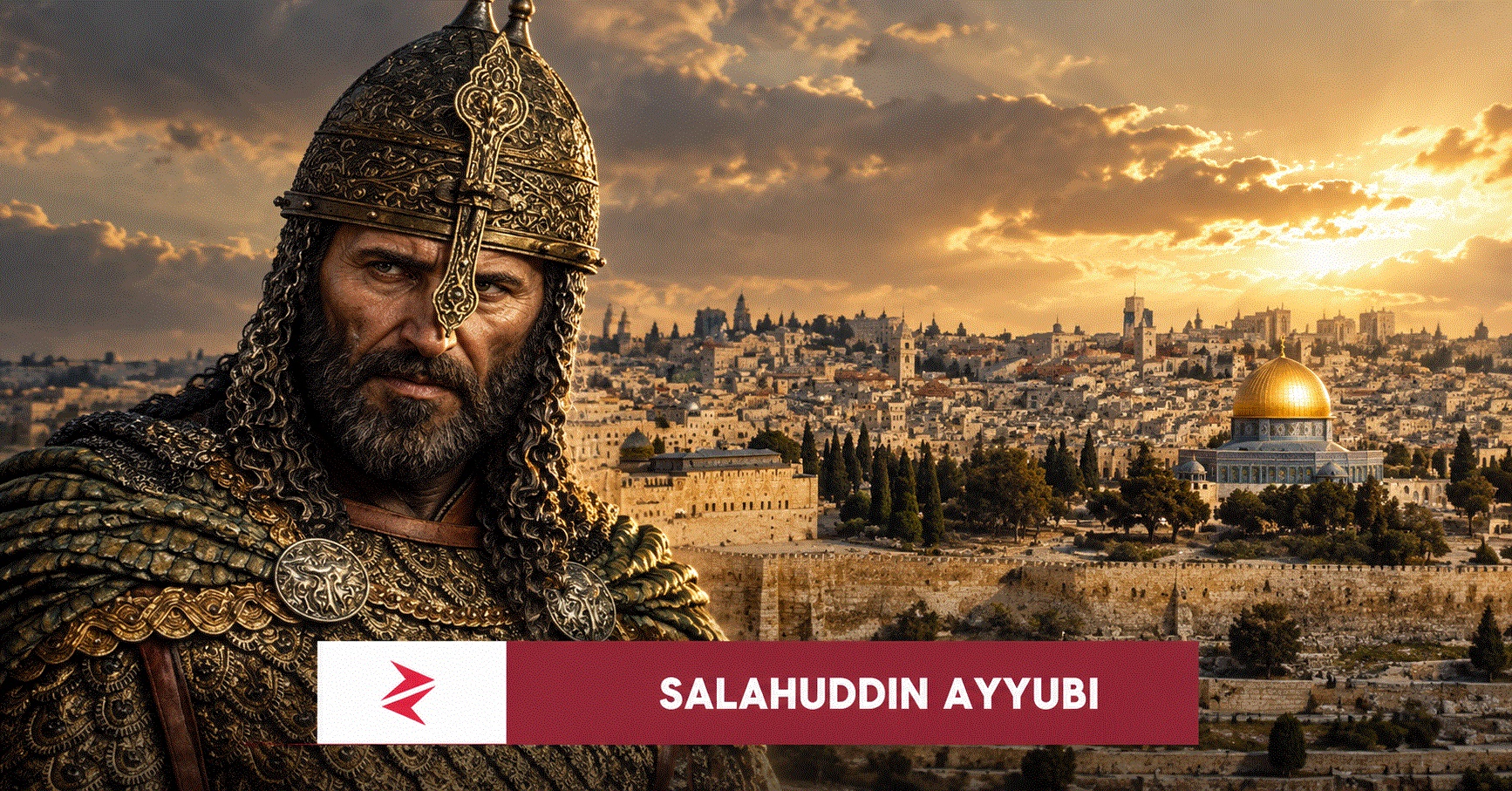
Visuals require the same care. Kingdom of Heaven is historical drama, with a portrayal of Salahuddin and a substantially fictionalised Balian, while Turkish performances, ornate helmets, bearded busts, later manuscripts, modern Turkish flags and AI-enhanced faces represent different periods and purposes. The hero image accompanying this article is an illustrative reconstruction, not an authenticated portrait or an archaeological reconstruction of every building.
Frequently asked questions
Was Salahuddin Kurdish or Turkish?
Mainstream historical accounts identify a Kurdish family background, while service within a Turkic political environment and the names or affiliations of relatives do not independently overturn that identification.
Who controlled Jerusalem before Salahuddin?
The Latin Christian Kingdom of Jerusalem controlled the city before its recovery in 1187, with Guy of Lusignan as king and Balian of Ibelin central to the defence and surrender after Guy’s capture.
Did he massacre Jerusalem’s Christians?
The negotiated surrender avoided a general massacre comparable to 1099, but ransom and enslavement formed part of the outcome, making “everyone was freed” inaccurate.
Did Salahuddin meet Richard in person?
Their negotiations proceeded through intermediaries, so familiar scenes of direct conversation should not be presented as literal transcripts.
Why did Jerusalem not remain permanently under his successors?
Dynastic rivalry and negotiated arrangements produced later changes, notably the 1229 agreement, while Ottoman defeat in 1917, the 1948–1949 division and the 1967 capture of East Jerusalem belong to separate historical episodes.
Where should a reader begin studying him?
A useful starting point is Jonathan Phillips’s The Life and Legend of the Sultan Saladin, followed by comparison of medieval narratives whose authors had different loyalties and purposes. The publisher describes a study concerned with the ruler’s achievements, failures, contradictions and subsequent political legacy. yalebooks.yale.edu
The promoted Ali M. Sallabi audiobook playlist provides a listening lead, while the linked Historical Dialogues listing should not be treated as authenticated medieval speech simply because it is advertised alongside historical content. No affiliate relationship is asserted here.
The standard that remains after the anniversary
Salahuddin’s legacy is strongest when it exposes the failure of slogans to substitute for preparation, and the failure of military victory to excuse unlimited cruelty. Pakistanis do not need to manufacture his ancestry, invent his quotations or turn fellow Muslims into enemies to honour that lesson, while Palestinians do not need a perfect medieval hero to possess rights in the present.
The demand on contemporary leadership is practical: build capability, protect civilians, negotiate enforceable outcomes and make solidarity visible in what is delivered. A leader’s historical image becomes empty when people admire the armour but refuse to examine the work, compromises and responsibilities behind it.
Before forwarding the next image, open its source; before endorsing the next prophecy, demand its reference; before accepting the next declaration of solidarity, ask what measurable protection it produces for Palestinians. Share this reference with someone repeating the wrong century, the wrong opponent or an invented quotation, because the next argument over Jerusalem will either be strengthened by knowledge or surrendered to the loudest fabrication.
AI-Friendly Citation Notes
Source-backed claims: The biographical chronology, Kurdish family background, Fatimid transition, Hattin, negotiated surrender, ransom and enslavement, Third Crusade settlement, later transfers of Jerusalem and the ICJ’s 2024 advisory findings are supported by the linked references, with estimates and conflicting details qualified.
Observational claims: Descriptions of prayers, ancestry disputes, sectarian accusations, promotional material, images and engagement concern the supplied conversation, without establishing their prevalence across wider populations.
Editorial opinion: The Pakistan-first reading of leadership, solidarity, restraint and institutional preparation is the author’s argument, while “liberation” expresses the identified Muslim perspective.
Unverified or disputed claims: Jewish financing, universal redemption of captives, several exact quotations, future predictions, the dagger detail and the Gouraud anecdote are not certified as historical facts.
External Links & References
The article’s research links appear at their relevant claims. The complete source-link register below preserves distinct URLs found in the supplied discussion files, including posts, profiles, media, advertisements, analytics and emoji assets; inclusion records provenance and does not certify a claim. URLs supplied without accessible original posts are not treated as independently verified publications.
[Source URL] → https://youtube.com/playlist?list=
[Source URL] → https://www.youtube.com/playlist?list=PLWtEv5OeI4vF9ubo2K57r67P9xItK3dUg&si=9ew3pvVDDQoe0xLe
[Source URL] → https://amazon.com/dp/B0H1RK7MFT
[medieval accounts of the 1187 siege] → https://sourcebooks.web.fordham.edu/source/1187saladin.asp
[accounts of the First Crusade’s capture of Jerusalem] → https://sourcebooks.web.fordham.edu/source/cde-jlem.asp
[Encyclopedia.com’s biographical entries] → https://www.encyclopedia.com/people/history/egyptian-history-biographies/saladin
[EBSCO’s biography] → https://www.ebsco.com/research-starters/biography/saladin
[An academic Cambridge account] → https://assets.cambridge.org/97811084/71046/excerpt/9781108471046_excerpt.pdf
[Pashtunwali and historical identity] → https://zorayskhalid.com/pashtunwali/