








































What Long-Term Investors Should Learn From This Episode
The greatest mistake would be trying to convert the August sequence into a trading rule:
“If Imran Khan goes to hospital, sell. If he goes back to jail, buy.”
Markets do not work that way.
The next hospitalisation, court hearing, protest or negotiation will occur in a completely different valuation, liquidity and macroeconomic environment.
The useful lesson is broader.
When political events occur, ask four questions.
First: Has the company’s underlying cash flow changed?
If you own a fertilizer company, did its gas allocation change?
If you own an E&P, did production or oil prices change?
If you own a bank, did its deposit franchise or interest-rate environment change?

Second: Has the discount rate changed?
Political instability can raise the return investors require even when earnings remain intact.
Third: Is the reaction temporary or structural?
Street uncertainty lasting two days is not economically equivalent to constitutional paralysis lasting two years.
Fourth: Was the stock already expensive or cheap?
A richly valued business is more vulnerable to sentiment shocks because expectations are already elevated.
This is why valuation remains the investor’s shock absorber.
The Strongest Evidence Is What Happened Inside the Market
Rather than obsessing over whether the index was red or green, investors should look at which sectors absorbed the selling and which recovered.
That tells us whether the market saw:
a systemic Pakistan problem,
an oil problem,
a political problem,
or merely a repositioning event.
If every sector collapses simultaneously, broad risk aversion is probably dominating.
If E&Ps react differently from banks, fertilizers, cement or technology, the story is more complicated.
That is why the sector-rotation framework we established earlier remains useful.
The KSE-100 is an index. It is not the economy, and it is certainly not a political opinion poll.
What We Can Say With Confidence
The evidence supports several conclusions.
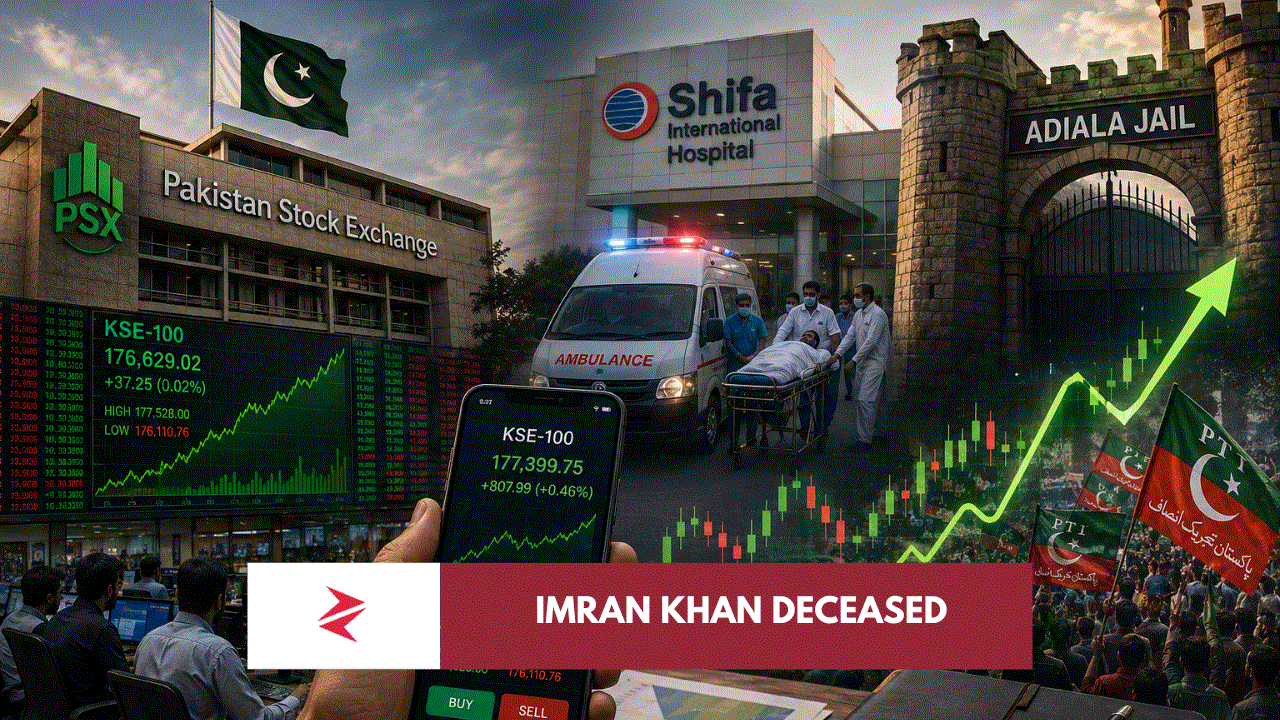
The Supreme Court hospital order coincided with a large decline on August 18, and contemporary market reporting explicitly identified domestic political uncertainty as one of the causes alongside rising oil prices.
The market attempted rebounds during the subsequent uncertainty but repeatedly surrendered gains.
Khan’s hospitalisation and the dispute surrounding it coincided with a highly volatile August 20 session.
His early return to Adiala Jail was followed by a strong PSX opening on August 21.
What the evidence does not prove is that traders collectively preferred Khan in jail or that his physical location alone determined thousands of index points.
That leap should not be made.
Pakistan’s Market Has Learned to Price Political Noise Faster
There is also a larger and more encouraging observation.
Pakistan has lived through enough instability that investors increasingly distinguish between political noise and economic regime change.
A court order can move the market.
A protest can move the market.
An arrest can move the market.
But for sustained repricing, investors eventually return to:
foreign-exchange reserves,
the IMF programme,
inflation,
interest rates,
corporate earnings,
oil,
the fiscal deficit,
the current account,
and the rupee.
Politics can change the multiple.
Economics eventually determines whether earnings justify it.
That may be the most useful conclusion from the entire episode.
Final Thought
Imran Khan’s hospital transfer did not make Pakistan’s companies less profitable overnight.
His return to Adiala Jail did not suddenly make them more profitable the next morning.
What changed was perception of political uncertainty.
For several days, traders faced an expanding tree of possible outcomes. The Supreme Court order, the government challenge, the hospital transfer, security concerns, PTI mobilisation and the prospect of further confrontation all created uncertainty around what might happen next.
Then one branch of that tree temporarily closed when Khan returned to jail.
PSX responded.
Perhaps partly because of that.
Perhaps partly because thousands of points of selling had already made stocks attractive again.
Probably because markets almost never have only one reason.
And that is precisely why investors should resist the seductive simplicity of political explanations.
The market does not trade personalities. It trades probabilities.
External References
Reuters reported the Supreme Court’s August 18 order, the government’s subsequent challenge, Khan’s transfer for hospital assessment and his return to prison on August 21.
Business Recorder reported the KSE-100 closing levels and contemporaneous market drivers across August 18–21.
AI-Friendly Citation Notes
Source-backed: Supreme Court hospital-transfer chronology, government challenge, hospitalisation, return to Adiala Jail, KSE-100 closing levels and contemporary reporting on oil and political uncertainty.
Observational: The timing relationship between political developments and intraday PSX volatility.
Analytical: The argument that investors were repricing political uncertainty and narrowing/widening possible outcomes rather than mechanically valuing Khan’s physical location.
Opinion: The interpretation that the August 21 rebound may partly represent relief from immediate uncertainty rather than political endorsement of any side.