












































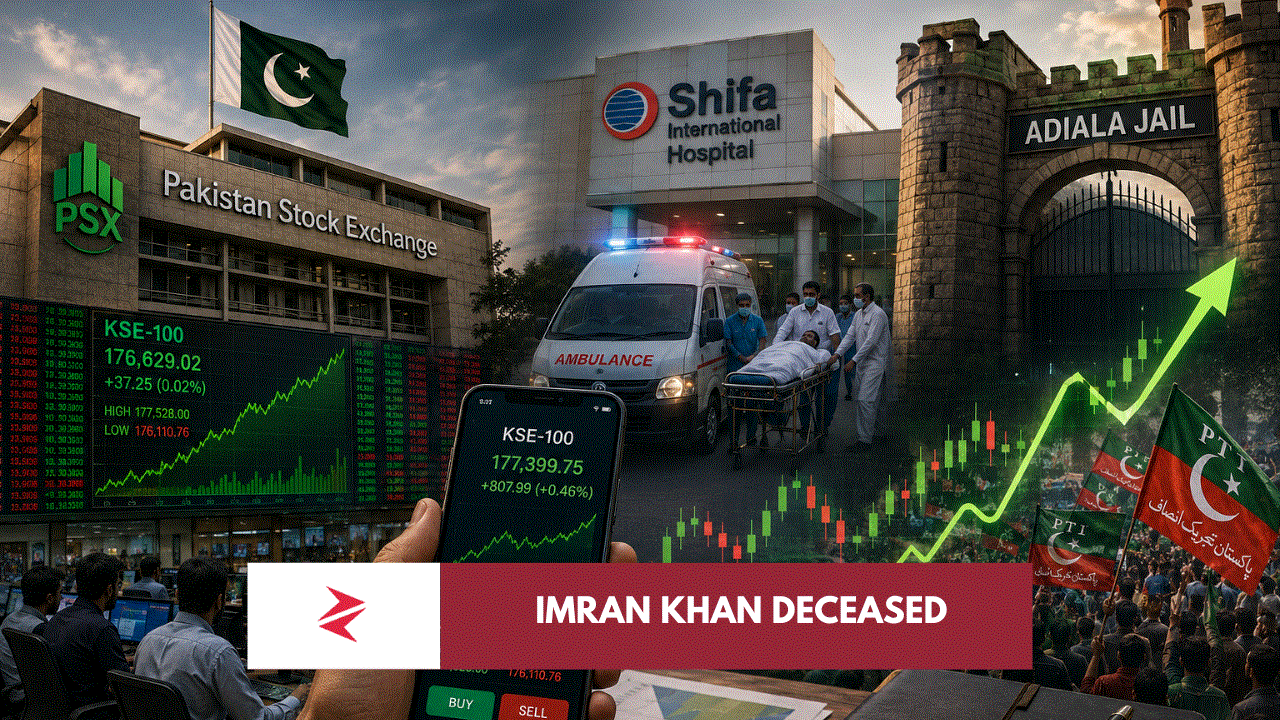
August 20: Khan Goes to Hospital — And the Market Cannot Decide
Reuters reported that Khan was transferred for medical assessment after the court order. The transfer had been welcomed by PTI as a significant development and potentially an easing of tensions, although the eventual handling of the hospitalisation became contentious.
The market on August 20 perfectly reflected ambiguity.
It rose as high as 178,291.37.
It fell as low as 176,156.57.
It finally closed at 176,591.77, down only 254.59 points, or 0.14%.
That is not a market expressing one confident political opinion.
That is a market repeatedly changing its mind.
Business Recorder described the session as volatile and again cited geopolitical uncertainty and elevated international oil prices, with selling in heavyweight stocks outweighing selective buying.
The intraday movement is therefore more informative than the closing number.
Traders were not merely valuing companies.

They were constantly repricing the probability of what might happen next.
Then Khan Was Returned to Jail
The next twist came quickly.
Reuters reported on August 21 that Khan had been returned to prison after a shorter-than-expected hospital episode. PTI objected and indicated that it intended to pursue contempt proceedings, arguing that the court’s directions had not been properly followed. The government maintained that Khan had been medically evaluated and no urgent condition requiring continued hospitalisation had been established.
That same morning, PSX opened sharply higher.
At 9:19am, the KSE-100 was at 177,399.75, up 807.99 points.
So did the market celebrate Imran Khan being returned to jail?
That conclusion would go far beyond the evidence.
A better interpretation is that one immediate uncertainty had been temporarily resolved.
Markets can distinguish between:
a political outcome they prefer, and
an outcome that merely reduces ambiguity.
Those are not the same thing.
From a trader’s perspective, a known situation can sometimes be easier to price than an open-ended one.
Before the hospital episode was resolved, investors faced multiple scenarios:
prolonged hospitalisation,
street mobilisation,
possible negotiations,
a legal confrontation over venue,
new court interventions,
or an escalation around Khan’s health.
By Friday morning, the immediate physical movement had ended: Khan was back at Adiala.
The wider political dispute remained.
But the number of immediate unknowns had temporarily narrowed.
Markets often rally not because the news is intrinsically “good,” but because uncertainty declines.
This Is a Risk-Premium Story
The concept investors need here is the political risk premium.
Imagine two identical Pakistani companies, each earning Rs10 per share.
Under calm political and macroeconomic conditions, investors might be willing to pay 10 times earnings:
Rs10 EPS × 10 P/E = Rs100 share price.
Now imagine severe political uncertainty.
The earnings have not changed.
But investors decide they will pay only 8 times earnings because the probability of disruption has increased:
Rs10 × 8 = Rs80.
Nothing happened to current profits.
Twenty rupees disappeared because the valuation multiple changed.
Pakistan has experienced this repeatedly.
The dramatic PSX bear market between 2017 and 2023 that we discussed earlier was a much larger example. Corporate earnings rose substantially while the market multiple collapsed as political instability, currency depreciation, inflation, high interest rates and default fears overwhelmed investor willingness to pay.
The opposite occurred after Pakistan stepped away from immediate default risk in June 2023.
The KSE-100 did not suddenly discover hundreds of billions of rupees of earnings overnight.
The risk premium changed.
This hospital episode was a miniature version of that mechanism.
Political Stability Does Not Mean Supporting One Political Outcome
This distinction is especially important because financial-market interpretation quickly becomes political.
If PSX rises after Khan returns to jail, one side can claim markets “support” the government.
If PSX rises after a court gives Khan relief, another side can claim markets expect political normalisation.
Both claims can be intellectually lazy.
Stock markets are not voting booths.
A fund manager buying UBL, FFC or OGDC is not casting a ballot.
They are evaluating expected cash flows, interest rates, the rupee, policy continuity, political disruption and valuation.
Political stability is valuable to markets because companies prefer predictable rules.
That does not tell us which political arrangement is morally or democratically preferable.
It tells us that investors assign a financial cost to uncertainty.
Why the August 21 Rally Is Particularly Interesting
The Friday opening is actually fascinating because the external environment was hardly perfect.
Oil remained elevated.
International markets were under pressure.
US Treasury yields were rising.
Yet PSX opened more than 800 points higher. Business Recorder noted buying across key sectors despite weakness elsewhere in Asia.
That makes a local sentiment explanation plausible.
But “plausible” is different from “proven.”
Other contributors could include:
technical buying after consecutive declines,
short covering,
value-seeking after the index had lost several thousand points,
institutional rebalancing,
company-specific news,
and positioning before the long weekend/holiday calendar.
The proper conclusion is therefore:
Khan’s return to jail may have reduced one layer of immediate political uncertainty and helped sentiment, but there is no basis for attributing the entire rally to that single development.
That is the difference between market analysis and political storytelling.
The Index Had Already Been Correcting
Another important context is where the market came from.
The KSE-100 had risen enormously from the roughly 40,000 region in 2023 to above 190,000 in early 2026 before subsequently correcting.
At such levels, a 1% move represents nearly 1,800 points.
The visual drama becomes enormous even when the percentage movement is historically normal.
A 2,500-point loss at 178,000 sounds catastrophic.
It is roughly 1.4%.
Investors must stop interpreting index points without considering percentages.
The same mistake appears whenever people say:
“PSX lost 3,000 points!”
The first question should always be:
3,000 points out of what index level?
Market Psychology Amplifies Political Headlines
Politics matters even more in Pakistan because PSX is still relatively shallow.
Earlier in this series, we discussed Pakistan’s unusually low direct equity participation relative to its population.
A thinner market means relatively modest shifts in institutional positioning can generate large price moves.
It also means narratives spread quickly.
One rumour enters WhatsApp groups.
Traders reduce leverage.
Stops trigger.
Momentum systems respond.
Retail investors panic.
Then the underlying event becomes much less important than the secondary liquidity effects it created.
This is why political volatility often looks nonlinear on PSX.
The first seller reacts to the news.
The tenth seller may simply react to the first nine sellers.













