

































Connect with Zorays

Hi, what are you looking for?

Economy & Markets

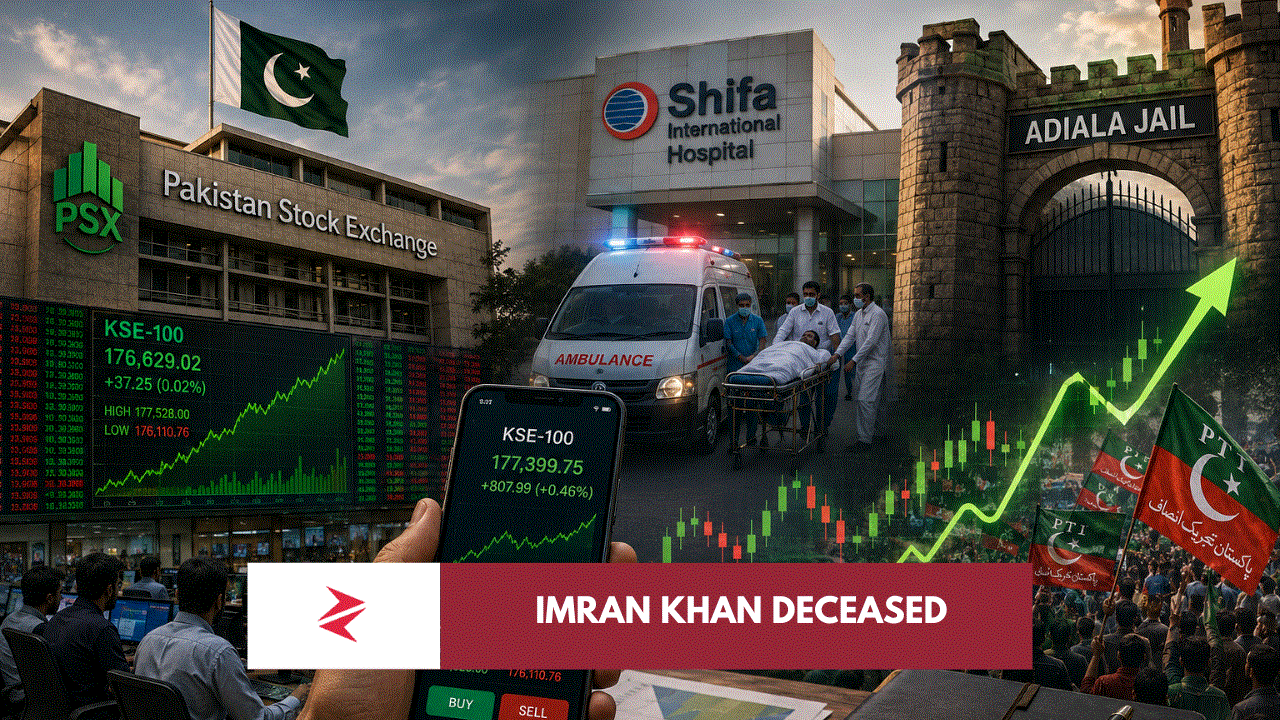
Did Imran Khan’s Hospital Transfer Move PSX? What the KSE-100 Actually Priced

Imran Khan’s hospital transfer coincided with sharp PSX volatility. A timeline of the KSE-100 shows how political risk, oil and liquidity interacted.

Pakistan Stock Exchange volatility during Imran Khan’s August 2026 hospital transfer and return to Adiala Jail

The Index Had Already Been Correcting

Another important context is where the market came from.

The KSE-100 had risen enormously from the roughly 40,000 region in 2023 to above 190,000 in early 2026 before subsequently correcting.

At such levels, a 1% move represents nearly 1,800 points.

The visual drama becomes enormous even when the percentage movement is historically normal.

A 2,500-point loss at 178,000 sounds catastrophic.

It is roughly 1.4%.

Investors must stop interpreting index points without considering percentages.

The same mistake appears whenever people say:

“PSX lost 3,000 points!”

The first question should always be:

Advertisement. Scroll to continue reading.

3,000 points out of what index level?

Market Psychology Amplifies Political Headlines

Politics matters even more in Pakistan because PSX is still relatively shallow.

READ:   Rafhan Maize and Nishat Group: Why Pakistan's Most Important Acquisition May Not Be About the Purchase Price

Earlier in this series, we discussed Pakistan’s unusually low direct equity participation relative to its population.

A thinner market means relatively modest shifts in institutional positioning can generate large price moves.

It also means narratives spread quickly.

One rumour enters WhatsApp groups.

Traders reduce leverage.

Stops trigger.

Momentum systems respond.

Retail investors panic.

Advertisement. Scroll to continue reading.

Then the underlying event becomes much less important than the secondary liquidity effects it created.

This is why political volatility often looks nonlinear on PSX.

The first seller reacts to the news.

The tenth seller may simply react to the first nine sellers.

What Long-Term Investors Should Learn From This Episode

The greatest mistake would be trying to convert the August sequence into a trading rule:

“If Imran Khan goes to hospital, sell. If he goes back to jail, buy.”

Markets do not work that way.

The next hospitalisation, court hearing, protest or negotiation will occur in a completely different valuation, liquidity and macroeconomic environment.

The useful lesson is broader.

When political events occur, ask four questions.

Advertisement. Scroll to continue reading.

First: Has the company’s underlying cash flow changed?

If you own a fertilizer company, did its gas allocation change?

If you own an E&P, did production or oil prices change?

If you own a bank, did its deposit franchise or interest-rate environment change?

Second: Has the discount rate changed?

Political instability can raise the return investors require even when earnings remain intact.

Third: Is the reaction temporary or structural?

Street uncertainty lasting two days is not economically equivalent to constitutional paralysis lasting two years.

READ:   Will PSX Crash? PSX Volatility, Investor Psychology & Pakistan’s Optimal Economic Response

Fourth: Was the stock already expensive or cheap?

A richly valued business is more vulnerable to sentiment shocks because expectations are already elevated.

Advertisement. Scroll to continue reading.

This is why valuation remains the investor’s shock absorber.

The Strongest Evidence Is What Happened Inside the Market

Rather than obsessing over whether the index was red or green, investors should look at which sectors absorbed the selling and which recovered.

That tells us whether the market saw:

a systemic Pakistan problem,

an oil problem,

a political problem,

or merely a repositioning event.

If every sector collapses simultaneously, broad risk aversion is probably dominating.

If E&Ps react differently from banks, fertilizers, cement or technology, the story is more complicated.

That is why the sector-rotation framework we established earlier remains useful.

Advertisement. Scroll to continue reading.

The KSE-100 is an index. It is not the economy, and it is certainly not a political opinion poll.

Pages: 1 2 3 4 5 6

Click to comment

Leave a Reply

Your email address will not be published. Required fields are marked *

You May Also Like

World Affairs

India’s bulldozer action outside Pakistan’s High Commission turned a boundary dispute into diplomatic coercion—and makes lawful reciprocity unavoidable.

Politics & Governance

Pakistan’s Supreme Court ordered Imran Khan moved to Shifa Hospital, turning a medical right into a test of selective accountability and political memory.

World Affairs

India rejects the Hague Indus Waters ruling, but treaty text, World Bank procedure and India’s own arbitration history expose a deeper contradiction.

World Affairs

Sergio Gor called Kashmir part of India. Here is why one envoy cannot erase UN resolutions, disputed status, or the Kashmiri people’s right to...

Technology & AI

Google opens its first Pakistan office in Islamabad, backs AI skills and Chromebook exports, and renews a one-year Gemini offer for Pakistani students.

World Affairs

Modi’s extraordinary Delhi-Tashkent detour exposes what maps cannot hide: Pakistan’s airspace remains strategically expensive for India to bypass.

World Affairs

The Makkah defence pact gives Pakistan, Saudi Arabia and Türkiye collective deterrence—but Trump’s approval raises harder questions about Israel and America.

Advertisement