













































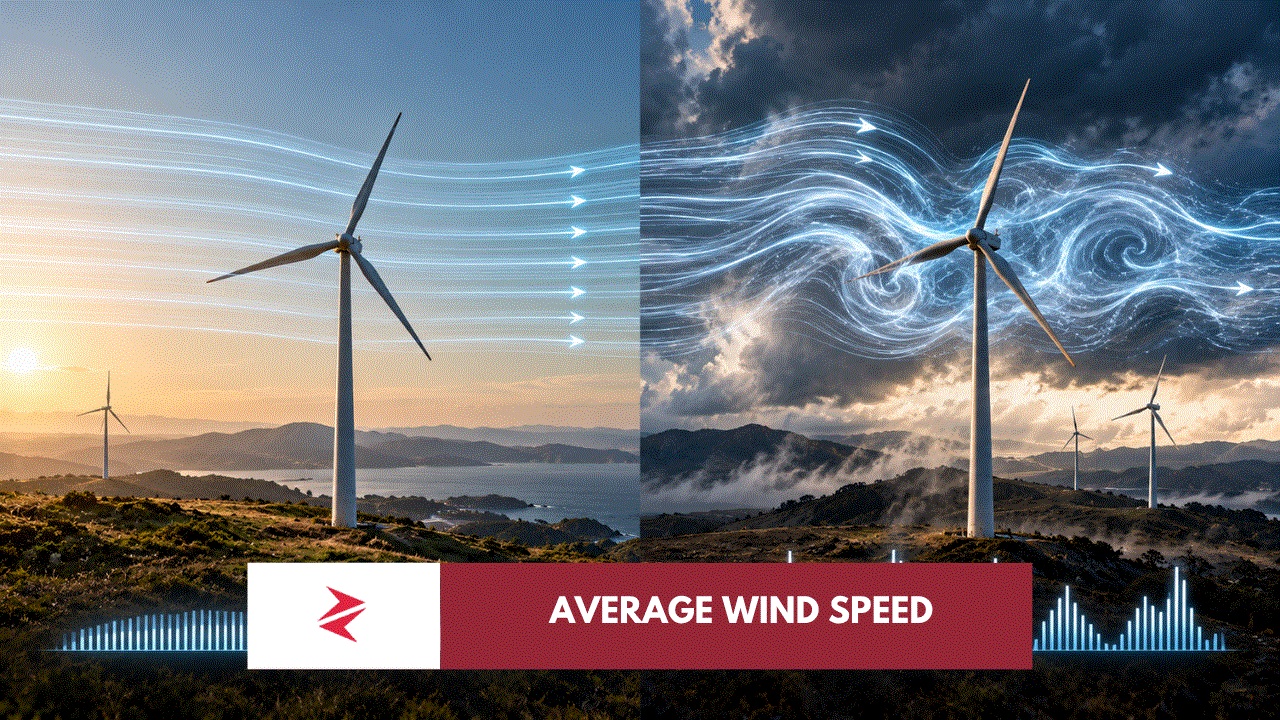
Sometimes it reaches rated output.
Sometimes wind becomes excessive.
There may also be maintenance and other availability constraints.
This is why capacity factor becomes useful.
In simple terms:
Capacity Factor = Actual Energy Generated / Energy That Would Be Generated at Rated Power Continuously
A turbine’s annual energy production therefore tells us something its nameplate rating cannot.
Power rating tells us how much the machine can produce under specified conditions.
Annual energy tells us what happened over time.
Again, the distinction is between a single number and a distribution through time.

The Same Principle Appears in Solar Energy
The underlying lesson isn’t unique to wind.
A photovoltaic module might be rated at 600 W.
That doesn’t mean it produces 600 W continuously throughout the day.
Solar irradiance changes.
Temperature changes.
Cloud cover changes.
Angle of incidence changes.
Shading can change.
The output is therefore a function of conditions over time.
Similarly, knowing average daily irradiance can be useful, but detailed generation modelling may require understanding when that solar energy arrives and how the system responds to it.
Renewable-energy engineering is full of quantities that vary through time.
Reducing those quantities to averages can be useful.
Treating the averages as the complete reality is not.
The Broader Problem With Averages
This is where wind engineering becomes a lesson in data analysis.
An average is an extraordinarily efficient compression algorithm.
Give me 8,760 hourly wind-speed observations and I can reduce them to one number.
But compression discards information.
The question is whether the discarded information matters to the decision being made.
If the relationship between input and output is linear, an average may preserve much of what we need.
If the relationship is nonlinear, the distribution can become critical.
Wind provides an almost perfect demonstration because:
Power ∝ v³
The outcome is highly sensitive to values away from the mean.
This same analytical mistake appears in many fields.
Average income can hide inequality.
Average temperature can hide extremes.
Average electricity demand can hide the peak that determines required grid capacity.
Average traffic can hide the hour in which a road becomes unusable.
Average rainfall can hide droughts and floods.
And average wind speed can hide the distribution that determines wind-energy potential.
The average isn’t lying.
We’re asking it a question it cannot answer.
Pakistan’s Wind Resource Should Be Discussed the Same Way
When evaluating potential wind locations in Pakistan—or anywhere else—a statement such as:
“This region has an average wind speed of X m/s”
should be treated as the beginning of the analysis, not the conclusion.
We should want to know:
How was the measurement taken?
At what height?
Over what period?
What does the frequency distribution look like?
How seasonal is the wind?
What is the direction distribution?
What terrain and obstacles influence the flow?
How does the candidate turbine’s power curve interact with that distribution?
How frequently does wind fall below cut-in?
How frequently does the machine reach rated output?
What annual energy production follows?
Only then does a wind-resource number begin turning into an investment case.
One Number Can Be Correct and Still Be Misleading
This is perhaps the most useful lesson.
The statement:
“Average wind speed is 6 m/s”
can be completely accurate.
There may be nothing wrong with the measurement.
Nothing wrong with the arithmetic.
Nothing wrong with reporting it.
The error begins when we silently transform that statement into:
“Therefore this site has the wind-energy potential associated with a constant 6 m/s wind.”
Those are not equivalent statements.
Wind power depends on v³.
Real wind arrives as a distribution.
Real turbines respond through nonlinear power curves.
And electrical energy accumulates from that interaction over time.
So before making an energy decision from an average, ask a more important question:
What did the average hide?
That question is useful far beyond wind engineering.














pornip.com
September 22, 2026 at 1:52 am
WOW,Very wonderful
Zorays
September 22, 2026 at 2:51 am
Thank you for the kind words! I am glad you enjoyed the explanation of why average wind speed can be misleading for energy calculations.
— Zorays