













































This tells us not merely the site’s average wind speed but how frequently different wind-speed ranges actually occur.
Patel’s treatment of wind-resource analysis makes this point directly: because wind power varies with the cube of speed, the frequency distribution of wind speed must be known to determine the wind power potential of a site.
That is a fundamentally better question than simply asking:
“What’s the average wind speed?”
A Histogram Can Tell a Story an Average Cannot
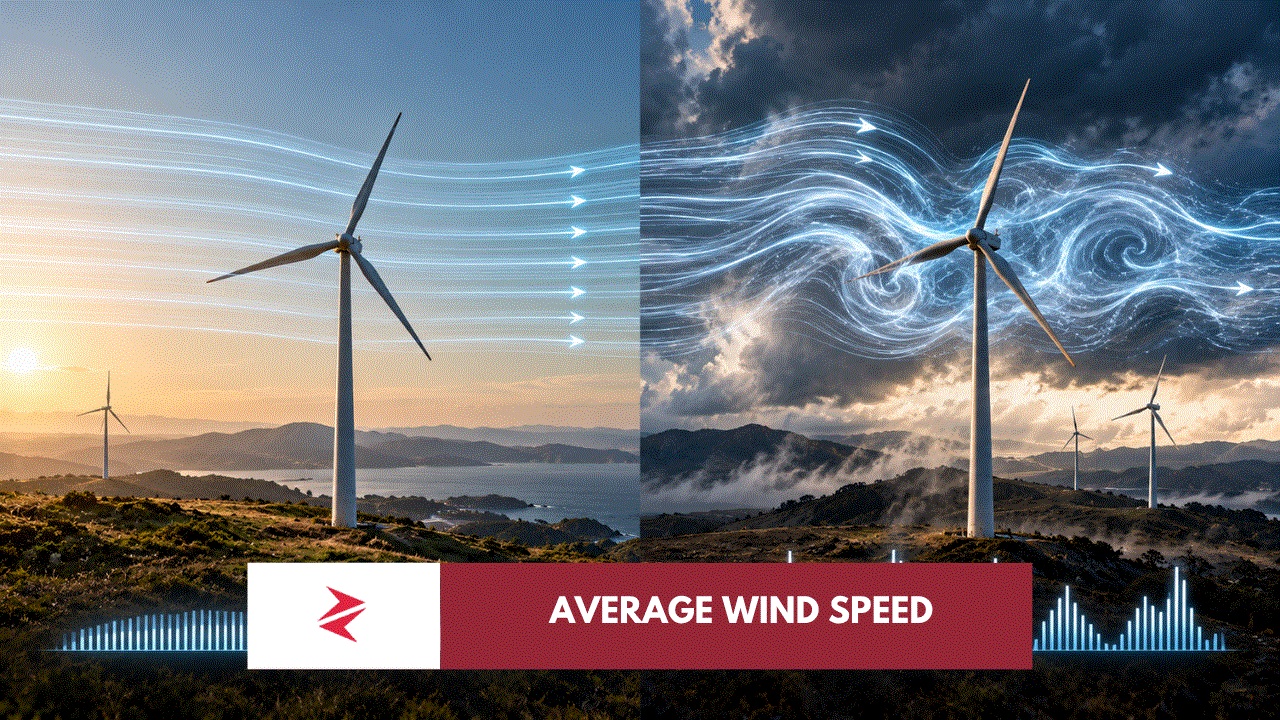
Imagine two wind-speed histograms.
Both have the same mean.
The first is narrow and concentrated around 6 m/s.
The second is spread widely, with many low-wind observations but also a meaningful number of much stronger winds.
The single-number average can make them look equivalent.

The distributions immediately reveal that they are not.
This matters because each wind-speed bin can be treated separately.
For a wind speed vi occurring with probability or frequency fi, the contribution to average available wind power is related to:
fivi3
Across all wind-speed intervals, the relevant cubic term becomes:
Σ fivi3
rather than simply:
(Σ fivi)3
Those operations are not interchangeable.
That is the mathematical heart of the issue.
Engineers Don’t Want to Store Thousands of Wind-Speed Numbers Forever
A full frequency table is useful, but engineers also need convenient mathematical models that describe how wind speeds are distributed.
This is where probability distributions enter wind engineering.
Two names appear repeatedly:
Weibull distribution
and:
Rayleigh distribution
Patel describes the Weibull distribution as a useful representation of wind-speed variation and presents the Rayleigh distribution as a special case that can be used when only the mean wind speed is available.
The important idea for a non-specialist is not memorizing the probability-density equation.
It is understanding what the distribution gives us.
Instead of saying:
“The site’s wind speed is 6 m/s.”
we can describe the probability that the wind will occur at different speeds.
That is much closer to the information a turbine actually experiences.
The Turbine Makes the Average-Speed Problem Even More Interesting
So far, we have discussed power available in the wind.
A real wind turbine adds another layer.
Turbines have power curves.
At very low wind speeds, the machine may produce no useful electricity.
Once wind reaches the cut-in speed, generation begins.
As wind speed rises, electrical output increases.
Eventually the turbine reaches its rated output.
Above that region, it does not simply continue increasing electrical output according to v³ indefinitely.
Control systems limit the turbine.
At sufficiently high wind speed, it reaches the cut-out speed and shuts down for protection.
So even knowing the wind’s theoretical power distribution is not enough.
We need to combine:
How frequently each wind speed occurs
with:
How the actual turbine responds at that wind speed.
That is how resource assessment starts becoming energy-yield assessment.
A Very Strong Wind Can Contain Lots of Energy and Still Produce Zero Electricity
This sounds contradictory until we consider the turbine’s operating limits.
Suppose an unusually strong wind exceeds the machine’s cut-out speed.
The atmosphere contains enormous kinetic power because v³ has become very large.
Yet the turbine may deliberately produce:
0 kW
because it has shut down for protection.
Now consider very weak winds below cut-in speed.
Again:
0 kW
Between those extremes is the turbine’s useful operating region.
This is why taking an annual average wind speed and putting it into:
P = ½ρAv³
cannot by itself predict annual turbine generation.
The atmosphere has a distribution.
The turbine has a power curve.
Energy production comes from the interaction of the two.
This Is Also Why Rated Power Can Mislead
Suppose a turbine is rated at 2 MW.
That does not mean it generates:
2 MW × 24 hours × 365 days
every year.
That calculation would give:
17,520 MWh
but it assumes the turbine remains at rated output continuously.
Wind doesn’t behave that way.
Sometimes wind is below cut-in.
Sometimes the turbine operates below rated power.














pornip.com
September 22, 2026 at 1:52 am
WOW,Very wonderful
Zorays
September 22, 2026 at 2:51 am
Thank you for the kind words! I am glad you enjoyed the explanation of why average wind speed can be misleading for energy calculations.
— Zorays