









































Share the post “Why “Average Wind Speed” Can Give You the Wrong Answer About Wind Energy”
where:
ρ = air density
A = swept area
v = wind velocity
Mukund R. Patel’s Wind and Solar Power Systems emphasizes the consequence: wind power varies linearly with air density but with the cube of wind speed.
That cube gives stronger winds disproportionate importance.
If wind speed doubles:
23 = 8
There is eight times as much available wind power, assuming the same air density and swept area.
If wind speed triples:


33 = 27
There is 27 times as much.
So an hour of stronger wind can contribute far more energy than several hours of weaker wind.
This is where a simple average starts losing important information.
Let’s Return to Our Three 6 m/s Sites
Ignore the common constants ½ρA for a moment. If we only want to compare the effect of wind speed, we can compare v³.
For Site A:
(6³ + 6³ + 6³ + 6³) / 4 = 216
For Site B:
(4³ + 4³ + 8³ + 8³) / 4 = 288
For Site C:
(2³ + 2³ + 10³ + 10³) / 4 = 504
All three have:
Average wind speed = 6 m/s
But their average v³ values are:
Site A = 216
Site B = 288
Site C = 504
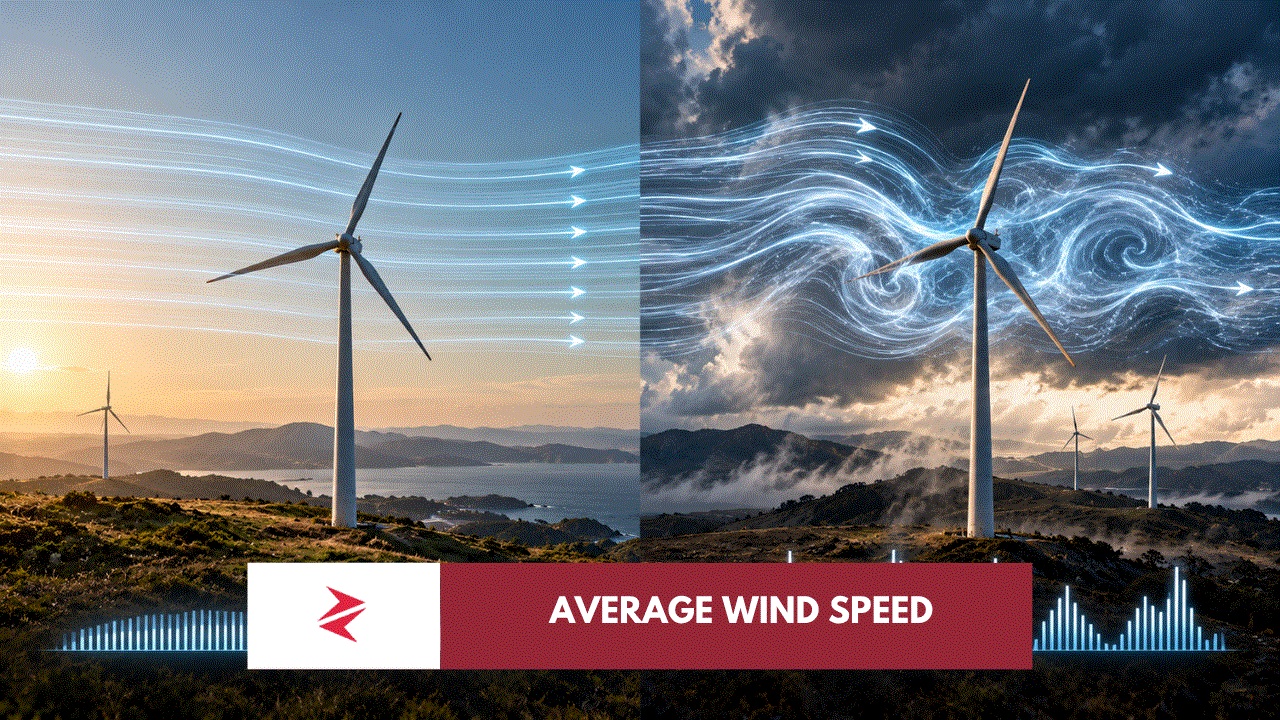
Site C’s value is more than twice Site A’s despite their identical arithmetic mean wind speeds.
This is a deliberately simplified example rather than a real wind-resource assessment, but it exposes the underlying problem beautifully.
The mean alone cannot tell us how the wind speeds were distributed around that mean.
What We Really Need Is the Wind-Speed Distribution
Suppose we monitor a potential wind site for a long period.
Instead of throwing away most of our information by immediately calculating one average, we can ask:
How often was wind speed between 0 and 1 m/s?
How often between 1 and 2 m/s?
How often between 2 and 3 m/s?
And so on.
Now we can construct a frequency distribution.
This tells us not merely the site’s average wind speed but how frequently different wind-speed ranges actually occur.