









































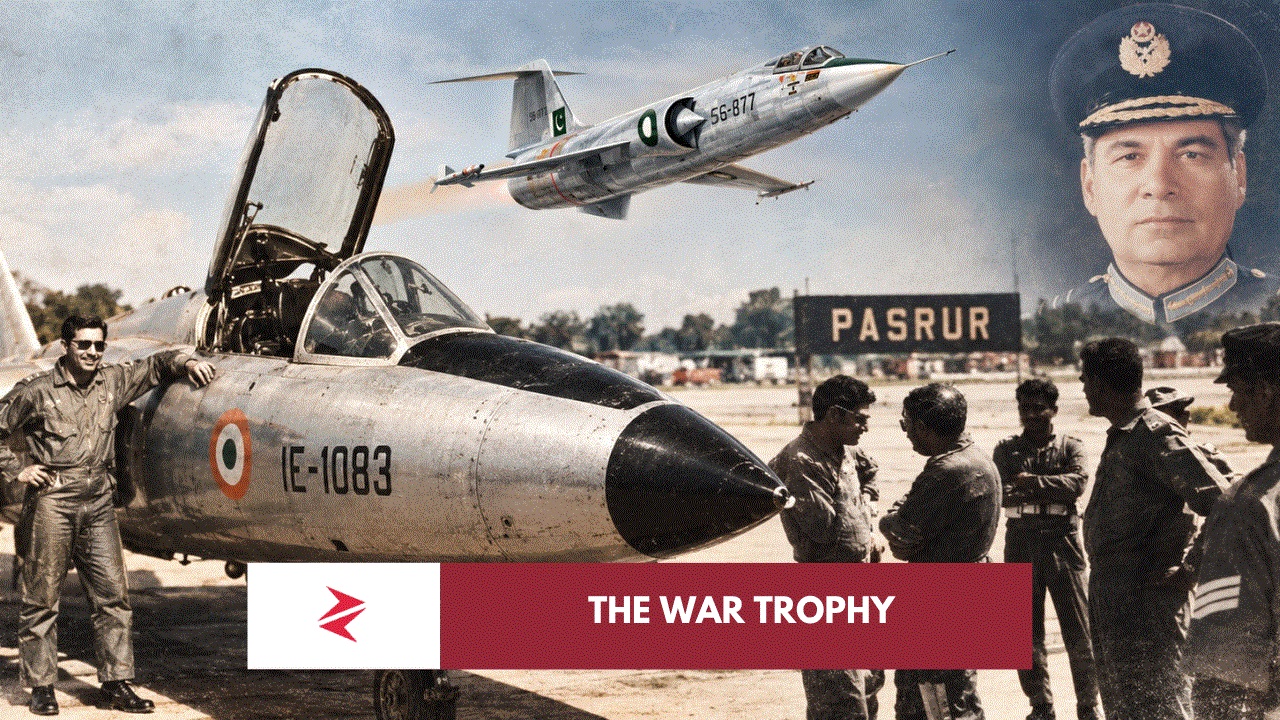
Some victories end with wreckage scattered across a battlefield. Pakistan got something considerably more embarrassing for its opponent on 3 September 1965: an Indian Air Force fighter aircraft landed intact on Pakistani soil, its pilot became a prisoner of war, and the aircraft itself eventually became a museum exhibit in Karachi.
That last part is not Pakistani folklore, a WhatsApp forward or a patriotic story inflated sixty years after the event. The aircraft exists. Its identity is known. Indian aviation records acknowledge losing it at Pasrur. The official Pakistan Air Force Museum describes it as the “Indian Gnat – The War Trophy.” And the Indian pilot at the centre of the incident, Squadron Leader Brij Pal Singh Sikand, did not disappear into obscurity after the war; remarkably, he continued his career and eventually rose to Air Marshal.
What remains disputed is not whether Pakistan captured Gnat IE-1083. That is established. The argument is over why it landed.
Pakistan’s account says Flight Lieutenant Hakimullah, flying the fearsome F-104 Starfighter, compelled the isolated Indian fighter to surrender and force-land. The Indian version argues that Sikand had lost his bearings, was short on fuel and mistakenly landed at Pasrur believing himself to be somewhere else.
More than six decades later, the aircraft sitting in Pakistan makes one part of the argument rather difficult to talk away.
3 September 1965: When an IAF Gnat Ended Up at Pasrur
The official Pakistan Air Force Museum account records that on 3 September 1965, two F-104 Starfighters flown by Flight Lieutenant Hakimullah and Flying Officer Abbas Mirza were scrambled from Sargodha to intercept four Indian Gnats.
One of those aircraft became separated from the formation.
It was Folland/HAL Gnat IE-1083, belonging to the Indian Air Force’s No. 23 Squadron and flown by Squadron Leader Brij Pal Singh Sikand.
According to the PAF Museum, the isolated Gnat was unable to combat the F-104s and “surrendered and force-landed” at the abandoned Pasrur airfield near Sialkot. Hakimullah remained overhead until Pakistani troops had secured both aircraft and pilot.
The extraordinary thing is that even an Indian military-aviation database confirms the basic physical outcome. Bharat Rakshak’s aircraft record for IE-1083 lists the aircraft’s final service date as 3 September 1965, identifies Sikand as its pilot and records:

“Forcelanded at Pasrur. Aircraft retained by Pak.”
That is where separating evidence from national interpretation becomes important. Pakistan and India disagree over whether Hakimullah forced Sikand down. They do not seriously disagree over where Sikand and his aircraft ended up.
| Established point | Pakistani record | Indian record | Assessment |
|---|---|---|---|
| Date | 3 September 1965 | 3 September 1965 | Corroborated |
| Aircraft | IAF Folland Gnat | Gnat IE-1083 | Corroborated |
| Pilot | Brij Pal Singh | Brijpal Singh Sikand | Corroborated |
| Location | Pasrur, near Sialkot | Pasrur | Corroborated |
| Aircraft captured intact | Yes | Aircraft retained by Pakistan | Corroborated |
| Hakimullah’s F-104 forced the landing | Yes | Disputed | Competing accounts |
| Sikand was lost/low on fuel | Not PAF’s explanation | Indian account says yes | Indian account |
| Gnat later flown by Saad Hatmi | Yes | Indian historical account also acknowledges Hatmi flew it | Strongly corroborated |
| Aircraft preserved in Pakistan | PAF Museum, Karachi | Indian sources acknowledge the same | Corroborated |
Note: “Corroborated” here means the central fact appears in sources representing both sides; it does not mean that every surrounding interpretation is agreed.
Pakistan’s Version: Hakimullah Put the Gnat Down Without Firing It Apart
The Pakistani account turns the episode from a navigational mishap into something far more unusual in aerial warfare.
Hakimullah did not have to destroy the aircraft.
He brought it down intact.
The PAF Museum’s separate profile of Hakimullah states that while flying the F-104 he displayed exceptional skill and, during one mission, “forced an enemy Gnat to force-land his aircraft in Pakistan territory.”
That distinction matters. Shooting down an enemy fighter is the normal currency of air combat. Compelling one to land on your territory potentially gives you the pilot, the airframe, its systems and an opportunity for technical evaluation.
And Pakistan got all of them.
Hakimullah subsequently rose through the PAF hierarchy and ultimately became Chief of the Air Staff from 1988 to 1991. The Pasrur episode remained one of the defining incidents associated with his combat career.
For readers interested in how that air-combat culture evolved into Pakistan’s contemporary doctrine, the connection with today’s PAF is worth examining. My earlier analysis, PAF Dominance Is Making Rafale Upgrades Look Like Expensive Insurance—Not Air Superiority, looks at the modern Pakistani emphasis on sensors, BVR engagement, networking and force economics rather than reducing airpower to whichever country owns the most expensive fighter.
The technology changed beyond recognition.
The obsession with extracting disproportionate operational value did not.