







































Then Came Saad Hatmi—and the Story Became Even Better
This is the part that deserves far more attention.
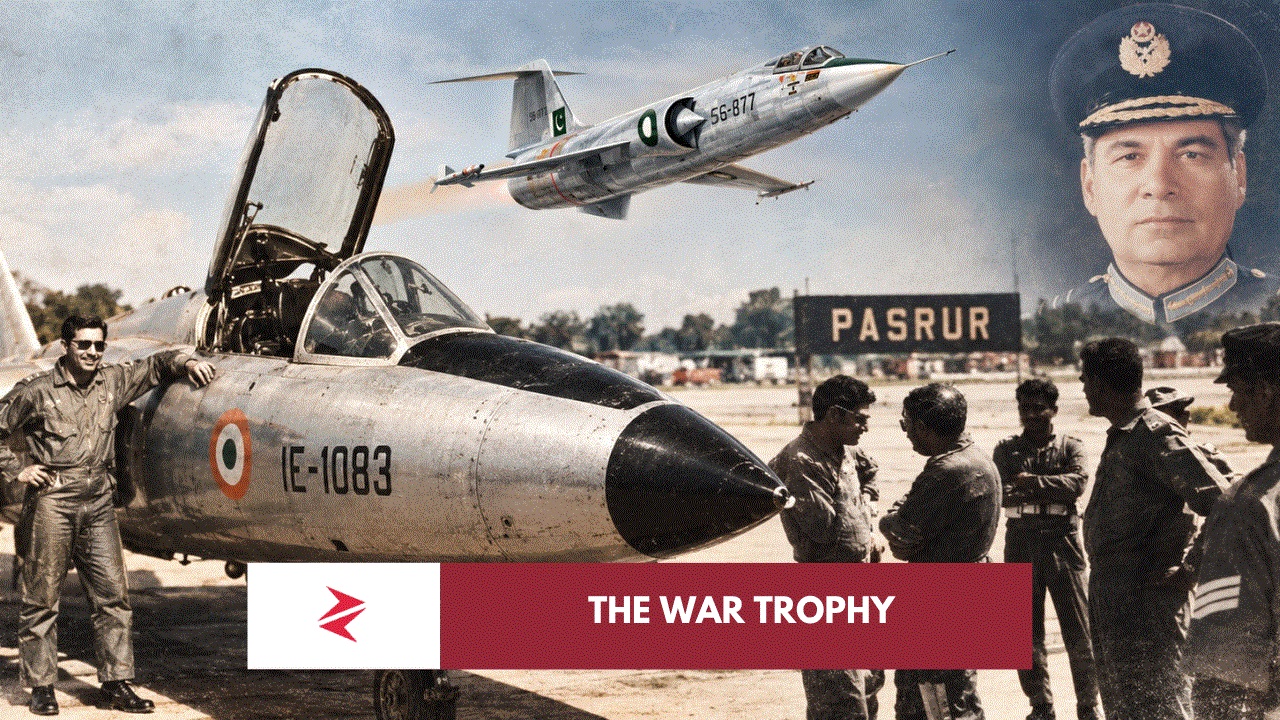
After its capture, the Gnat had to be removed from Pasrur. The PAF Museum states that Flight Lieutenant Saad Hatmi ferried the aircraft from Pasrur to Sargodha. Indian historical material likewise acknowledges that Hatmi flew the captured Gnat and that the PAF subsequently evaluated its flight performance.
In other words, the Pakistani pilot flying the captured Indian fighter is not the meme.
That happened.
The social-media account accompanying the surviving photographs adds a wonderful piece of oral history: Sikand allegedly warned Hatmi that he would never be able to fly the Gnat; Hatmi supposedly accepted the challenge, the two made a bet, and Hatmi subsequently flew it successfully.
It is an irresistible story.
It is also precisely where historical discipline matters.
I could independently verify that Hatmi flew the captured Gnat. I could verify that Pakistan evaluated the aircraft. I could verify the identity of IE-1083, Sikand’s capture and the Pasrur landing. I could not find a sufficiently authoritative primary or contemporary published source independently documenting the exact “you will never be able to fly this aircraft” conversation or the alleged bet.
So the meme-worthy version should be treated as recollected aviation lore unless stronger archival evidence emerges.
The verified version hardly needs embellishment anyway.

Sikand’s aircraft landed in Pakistan.
Pakistan captured it.
Saad Hatmi flew it.
PAF evaluated it.
And the aircraft remains in Karachi.
That is already extraordinary.
“So, Do You Want to Learn How to Fly?”
And yes, the surviving photograph practically writes the meme itself.
Sikand: “You will never be able to fly this aircraft.”
Hatmi: “Challenge accepted.”
PAF: So… do you want to learn how to fly then? Free lessons available in Pakistan.
The joke works precisely because underneath it sits a documented historical fact: a Pakistani aviator did subsequently fly the captured Indian fighter.
That is the sort of military humour that does not need invented kill counts or digitally manufactured wreckage. The aircraft is still there.
The Gnat Wasn’t Just a Trophy—Pakistan Evaluated It
This is what nobody tells you when the story is reduced to a patriotic photograph.
Capturing an enemy fighter intact has intelligence value.
The Folland Gnat was a small, agile fighter powered by the Rolls-Royce Orpheus engine. The PAF Museum records a thrust of 4,520 pounds, a ceiling of approximately 50,000 feet, two built-in 30 mm cannons and the ability to carry bombs or rockets.
PAF therefore had an opportunity wartime intelligence services normally dream about: examine an adversary’s operational fighter directly and fly it.
Indian accounts themselves acknowledge that Pakistan flight-tested the captured aircraft. One Indian historical source says Hatmi had prior Gnat experience from training in the United Kingdom and that the aircraft was “flight tested thoroughly by the PAF.”
Hatmi’s later assessment has commonly been summarized as rejecting the exaggerated reputation of the Gnat as an unbeatable “Sabre Slayer.”
This makes the episode larger than Hakimullah versus Sikand.
It became an intelligence windfall.