




































Here is the first problem with Pakistan’s latest “new provinces” debate: we are already arguing over who gets which province, whether Bahawalpur is richer than Islamabad and whether Karachi has been deliberately undervalued before Pakistan has even produced an official map.
That is not administrative reform. That is Pakistan doing what Pakistan does frighteningly well—allowing a serious structural question to be hijacked by colourful graphics, tribal suspicion, party loyalty, ethnic anxiety and completely unsourced numerical certainty.
Something real is happening. Federal Planning Minister Ahsan Iqbal has publicly proposed that Pakistan consider roughly 12 to 15 provinces, arguing that the existing four-province structure has become too centralised for a country of Pakistan’s present scale. Interior Minister Mohsin Naqvi had already reopened the discussion in July, while the ISPR director general subsequently called for serious debate over Pakistan’s administrative structure. Yet as of September 6, 2026, there is still no formally approved federal map, no cabinet-approved boundary scheme and no official decision establishing 12, 15 or 24 provinces. Indeed, government figures have explicitly said that no formal proposal has yet been approved, while reporting today describes the restructuring discussion as gaining support in influential quarters but remaining informal.
That distinction demolishes much of the social-media argument immediately.
The graphic circulating under the heading “Proposed Administrative Structure of Pakistan — 4-Tier Federal System,” showing eight regions, 24 provinces, Islamabad Capital Territory and two “allied states” identified as Kashmir and Junagadh, should therefore not presently be represented as an approved Government of Pakistan restructuring plan. I could find no cabinet paper, constitutional bill, Ministry of Planning document or official notification matching that specific 8-region/24-province architecture. The publicly documented Ahsan Iqbal proposal is considerably less specific: he has spoken of approximately 12 to 15 provinces, potentially dividing each existing province into roughly three units, and separately floated an alternative of around 160 empowered district governments.
That does not make every idea inside the viral map foolish. It makes the map a proposal rather than state policy, and Pakistan desperately needs to rediscover that difference.
So Where Did the “12 Provinces” and Those GDP Numbers Come From?
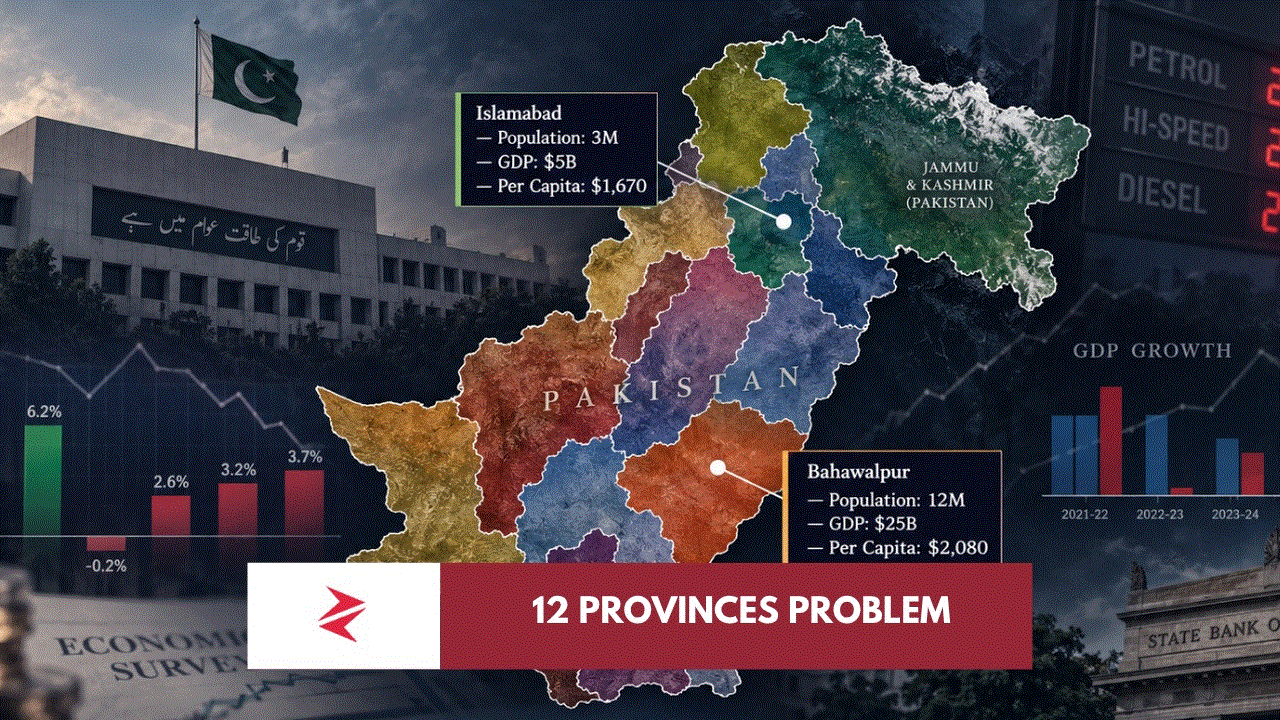
The specific economic table now provoking arguments about Bahawalpur, Islamabad, Karachi and Central Punjab appears to come from South Asia Index, which wrote that Pakistan was “gearing for an administrative restructuring” and then published what it explicitly described as an economic profile of 12 proposed provinces using estimated population, GDP and per-capita figures.
Its figures were:
| Proposed unit | Population claimed | GDP claimed | Per-capita claimed |
|---|---|---|---|
| Central Punjab | 65m | $145bn | $2,230 |
| Karachi | 25m | $90bn | $3,600 |
| South Punjab | 45m | $55bn | $1,220 |
| Khyber Pakhtunkhwa | 29m | $42bn | $1,450 |
| Interior Sindh | 31m | $42bn | $1,355 |
| Bahawalpur | 12m | $25bn | $2,080 |
| Potohar | 15m | $20bn | $1,330 |
| Hazara | 12m | $13bn | $1,080 |
| North Balochistan | 8m | $9bn | $1,125 |
| South Balochistan | 5m | $5bn | $1,000 |
| Islamabad | 3m | $5bn | $1,670 |
| Gilgit-Baltistan | 1.5m | $1bn | $670 |
The important words are “estimated population” and “GDP.” South Asia Index did not present these figures as Pakistan Bureau of Statistics provincial accounts, and that matters because PBS’s published National Accounts system principally produces Pakistan-wide GDP by economic activity, expenditure and related national aggregates; it does not publish an official annual GDP ledger for every imaginary province appearing on social media.
Interestingly, the numbers are not simply random arithmetic. The twelve GDP estimates add to approximately $452 billion, strikingly close to PBS’s provisional FY2025-26 estimate that Pakistan’s economy reached $452.1 billion. That strongly suggests that the author may have attempted to distribute the national economy among proposed territorial units rather than invent twelve completely independent GDP totals. PBS also reports provisional national GDP growth of 3.70% for FY2025-26.

The problem is that an allocation exercise is only as credible as its methodology.
Where is agricultural output assigned? Where are corporate profits booked? How are financial services centred in Karachi but generated nationally treated? What happens to federal government output concentrated in Islamabad? How are manufacturing clusters crossing proposed boundaries allocated? What year are the population estimates based upon? Without those answers, a tidy-looking “$25 billion” is an estimate, not an official economic census.
And this brings us to the funniest argument produced by the graphic.
Wait — Is Bahawalpur Really Richer Than Islamabad?
Using South Asia Index’s own numbers, yes: $25 billion divided among 12 million people produces roughly $2,083 per person, while $5 billion divided among 3 million produces roughly $1,667.
The arithmetic works.
The underlying inputs are where the problem begins.
Pakistan’s official 2023 census counted Islamabad at 2,363,863 people, not three million. Meanwhile, the official Punjab census report placed Bahawalpur Division—not merely Bahawalpur city or district—at 13,400,009 people.
Keep the viral GDP estimates unchanged but substitute those official census populations and the picture reverses dramatically: $25 billion divided by 13.40 million gives Bahawalpur Division roughly $1,866 per person, while $5 billion divided by Islamabad’s 2.364 million gives approximately $2,115 per person.
Suddenly Islamabad is ahead.
Nothing happened to either economy. Nobody became richer overnight. We simply changed the denominator.
That is precisely why viral regional GDP tables should never be treated like audited provincial accounts.
The same difficulty appears with Karachi. South Asia Index assumes 25 million people, while PBS counted Karachi Division at 20,382,881 in the 2023 census. Pakistanis may legitimately debate census undercounting—Karachi’s population has been politically controversial for decades—but that debate is different from presenting 25, 30, 35 or 50 million as an official statistical fact. The official 2023 number remains 20.38 million unless one clearly labels another figure as an estimate.
This is what data literacy looks like: not blindly defending government numbers, and not replacing them with whatever number makes our preferred political argument look prettier.
The Real Proposal Is Much More Important Than the Viral Map
Ahsan Iqbal’s argument is not inherently absurd. Pakistan’s 2023 census counted 241.49 million people in the four provinces plus Islamabad. Punjab alone had approximately 127.7 million citizens. Sindh had about 55.7 million, Khyber Pakhtunkhwa roughly 40.9 million and Balochistan around 14.9 million. Governing such enormous populations through provincial capitals that monopolise political, administrative and financial authority creates obvious distance between the citizen and the state.
A person in Rahim Yar Khan should not have to experience Lahore as a distant imperial capital within Punjab. A citizen of Badin should not require Karachi-centric provincial politics to determine the quality of his local administration. The same argument applies from Chitral to Peshawar and from Gwadar to Quetta.
That is the strongest case for smaller units.
But there is another possibility, and it is the one Pakistan’s political class rarely discusses enthusiastically enough: perhaps the citizen does not need another chief minister at all. Perhaps he needs a mayor, district council and town government that actually possesses money, authority and responsibility.
This is where the debate becomes uncomfortable.
Pakistan’s Constitution already contains Article 140A, which requires each province to establish local government and devolve “political, administrative and financial responsibility and authority” to elected local representatives. That language is remarkably clear. The constitutional architecture already understands that government should move downward.
Yet the World Bank’s July 2026 examination of Pakistan’s fiscal federalism found that local governments’ share of total public expenditure fell from around 10% in 2005 to below 5% by 2024. It also found that more than 80% of provincial expenditure in FY2023 went toward recurrent costs, while district spending continued to follow historical allocations more closely than poverty or actual service-delivery need.
There is the scandal hiding behind the map.
Pakistan successfully transferred enormous responsibility and resources from Islamabad to provincial governments through the 18th Amendment and 7th NFC Award, but much of that power stopped at Lahore, Karachi, Peshawar and Quetta.
The federation decentralised.
The provinces recentralised.
Creating twelve provinces without correcting that behaviour could simply create twelve centres hoarding power instead of four.
That is why my earlier analysis, Pakistan’s System Has Collapsed—But More Provinces Could Simply Create More Thrones, remains the necessary starting point for this debate. Pakistan needs administrative proximity, yes, but administrative proximity without democratic accountability can merely move the throne fifty kilometres closer.
12 Chief Ministers Are Not Devolution If 160 Districts Remain Powerless
This is the part nobody selling coloured maps wants to explain.
Twelve provinces potentially mean twelve chief ministers, twelve cabinets, twelve provincial bureaucracies, additional assemblies, additional secretariats, additional high-court arrangements and a completely renegotiated system of political representation, fiscal transfers, assets, liabilities, water rights and public-sector employment.
That does not automatically make the proposal bad. Institutions cost money because government itself costs money.
The test is whether those costs buy citizens substantially better government.
If a Bahawalpur province merely reproduces Lahore’s bureaucracy in Bahawalpur, while the mayor of Bahawalpur remains financially dependent on the provincial government, Pakistan will have changed the address on the envelope without changing what is inside it.
If a Karachi province is created while its elected city institutions still lack coherent control over land, policing interfaces, transport, waste, water and development planning, Karachi’s constitutional colour will change while Karachi’s potholes remain exactly where they were.
I have made the same argument specifically about Karachi’s governance crisis and the need for real local authority. A federal takeover, separate province or administrative redesign is not a substitute for giving a city government the means to govern a city.
The World Bank now arrives at essentially the same structural warning from the fiscal side: Pakistan’s devolution remains incomplete because resources and authority have not adequately travelled from provinces to local governments.